NCERT Introduces 20-Hour AI Module For Classes 9 To 12; Deepfakes, Data Privacy And Ethical Use In Focus
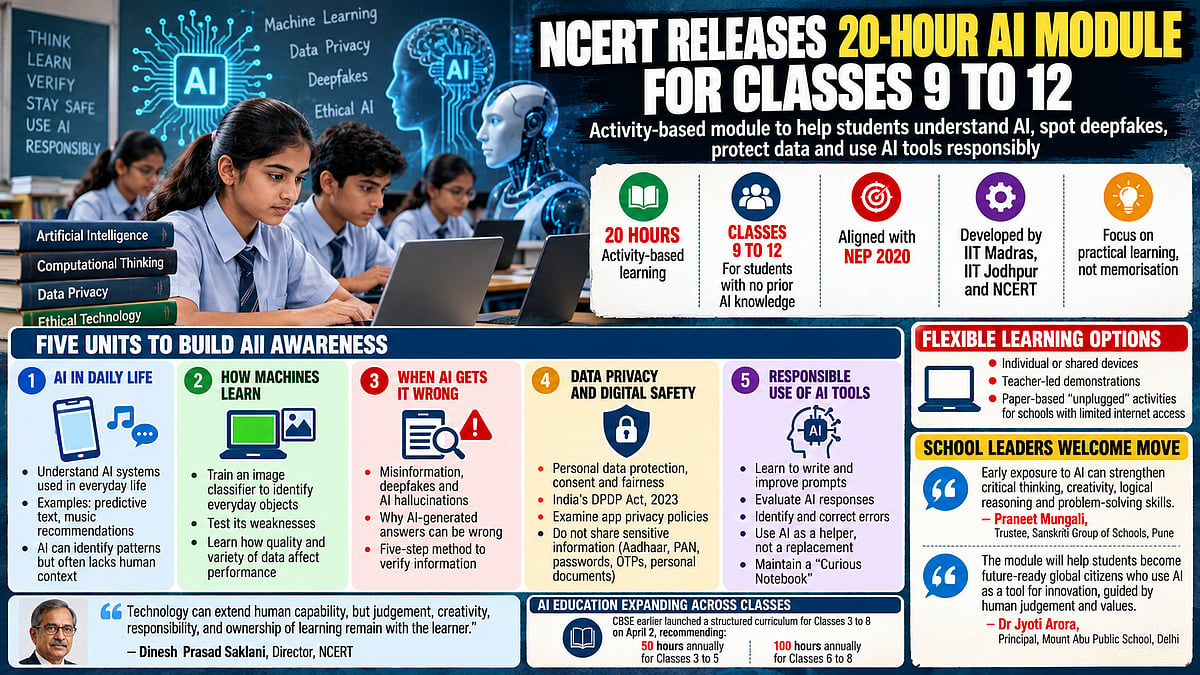
NCERT has introduced a 20-hour artificial intelligence and computational thinking module for Classes 9 to 12. Developed with IIT Madras and IIT Jodhpur, it covers machine learning, deepfake detection, misinformation, data privacy and responsible AI use. The activity-based programme offers flexible learning options, including exercises that can be conducted without computers or internet access.

NCERT Introduces 20-Hour AI Module For Classes 9 To 12; Deepfakes, Data Privacy And Ethical Use In Focus | AI
The National Council of Educational Research and Training (NCERT) has released a 20-hour introductory module on computational thinking (CT) and artificial intelligence (AI) for students of Classes 9 to 12. The activity-based module aims to help students understand how AI works, identify deepfakes, protect personal information and use AI tools responsibly.
Developed by faculty members from the Indian Institute of Technology (IIT) Madras, IIT Jodhpur and NCERT, the module is aligned with the National Education Policy (NEP) 2020. It is designed for students with no prior knowledge of AI and focuses on practical learning rather than memorising technical concepts. The initiative is a welcome step towards preparing students for a world where AI is increasingly becoming part of everyday life.
Five Units To Build AI Awareness
The module is divided into five units covering AI in daily life, machine learning, AI errors, data privacy and the responsible use of modern AI tools. Students will learn how AI-powered applications work, why they sometimes produce incorrect information and how to verify their responses.
The first unit introduces students to AI systems they encounter regularly, including smartphone keyboards that predict words and applications that recommend music. It explains pattern recognition through familiar examples, such as identifying a friend in a crowded school canteen or recognising a song after hearing just three notes. Students are taught that while AI can identify patterns, it often lacks the context that humans naturally understand.
Learning How Machines Think
The second unit explains how machines learn from examples. Students will train an image classifier to identify everyday objects and then deliberately test its weaknesses. The exercise demonstrates how the quality and variety of training data influence an AI system’s performance.
The third unit, titled When AI Gets It Wrong, focuses on misinformation, deepfakes and AI hallucinations. Students will examine why AI-generated answers can sound convincing even when they are incorrect. They will also learn a five-step method to verify information before trusting or sharing it. This is particularly important as students increasingly encounter AI-generated content online.
Data Privacy And Digital Safety In Focus
The fourth unit introduces students to personal data protection, consent, fairness and digital safety. It also familiarises them with India’s Digital Personal Data Protection (DPDP) Act, 2023. Students will examine the privacy policies of applications they use and understand what information is collected, how it may be shared and how long it can be stored, Hindustan Times reports.
The module specifically warns students against sharing sensitive information with AI tools, including Aadhaar and PAN numbers, passwords, one-time passwords and personal documents. Teaching these precautions at the school level could help students develop safer digital habits before they begin using AI tools more extensively.
AI As A Helper, Not A Replacement
The fifth unit focuses on using AI tools effectively without becoming dependent on them. Students will learn to write and improve prompts, evaluate AI-generated responses and identify errors that require correction. The module promotes a “helper-stance”, encouraging students to use AI to improve their work while retaining responsibility for their own thinking.
Students will also maintain a “Curious Notebook”, recording their observations, reasoning and reflections throughout the five units. The module encourages experimentation and learning from mistakes instead of relying only on classroom lectures.
“This is not a module to be memorised. It is a set of habits to be practised,” the module development team states in its Letter to the Students.
Flexible Learning For Schools
The suggested teaching schedule covers 20 classroom hours and offers three ways to conduct activities. Students can use individual or shared devices, participate in teacher-led demonstrations on a common screen or complete exercises using paper and classroom discussions.
The third option, described as “unplugged” learning, allows schools with limited access to computers or internet connectivity to conduct the core activities. This flexibility is an important feature, as it allows students to learn fundamental AI concepts without depending entirely on digital infrastructure.
School Principals Welcome The Move
The introduction of the module has been welcomed by principals and representatives of schools affiliated with the Central Board of Secondary Education (CBSE). They believe that teaching AI concepts from Class 9 will help students develop skills needed in a technology-driven environment.
Praneet Mungali, trustee at the Sanskriti Group of Schools in Pune, described the move as a significant step towards preparing students for the future. He said early exposure to AI could strengthen critical thinking, creativity, logical reasoning and problem-solving skills. He also stressed the importance of helping students understand where AI can be used and what its limitations are.
Human Judgement Remains Essential
Dr Jyoti Arora, principal of Mount Abu Public School in Delhi, said the module would promote responsible technology use while improving students’ critical thinking, creativity and problem-solving abilities.
She said it would help students become “future-ready global citizens who use AI as a tool for innovation, guided by human judgement and values”.
NCERT also emphasised the importance of keeping human judgement at the centre of learning. “The module encourages students to become informed, confident, and responsible users of technology, while reinforcing that human judgement, creativity, and ethical responsibility remain central to learning,” the council said in a press release on Friday.
In the foreword, NCERT Director Dinesh Prasad Saklani underlined the same principle, stating that “technology can extend human capability, but judgement, creativity, responsibility, and ownership of learning remain with the learner”.
ALSO READ
AI Education Expanding Across Classes
The latest module follows an earlier initiative by CBSE to introduce computational thinking and AI education for younger students. On April 2, the board launched a structured curriculum for Classes 3 to 8 to build AI awareness from an early age.
The curriculum recommends 50 hours of learning annually for Classes 3 to 5 and 100 hours for Classes 6 to 8. It aims to introduce computational thinking and AI concepts gradually, according to students’ age and learning abilities.
With AI education now extending across different school levels, the focus is shifting beyond simply teaching students how to use technology. The more meaningful goal is to help them question AI-generated information, recognise its limitations and make informed decisions while using it.
RECENT STORIES
-
-
-
-
-