Jai Hind College Hosts Global Conference On Strategic Autonomy And Indo-Pacific Diplomacy
Jai Hind College inaugurated a three-day international conference on “India in a Multipolar World,” featuring scholars, diplomats and strategic experts discussing India’s global role, strategic autonomy, Indo-Pacific priorities and digital diplomacy.

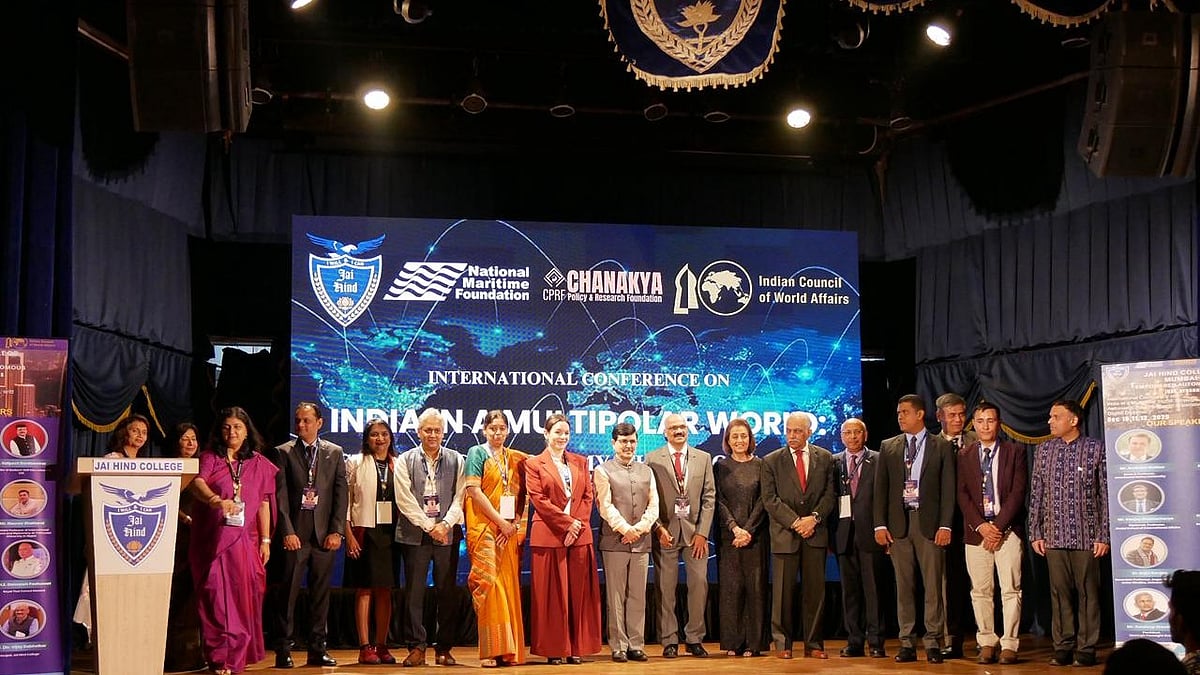
Mumbai: Jai Hind College, Mumbai, inaugurated the first day of its three-day International Conference titled “India in a Multipolar World: Strategic Autonomy, the Indo-Pacific Imperative and Digital Diplomacy,” organised in collaboration with the Indian Council of World Affairs (ICWA), the Chanakya Policy & Research Foundation (CPRF), and the National Maritime Foundation (NMF). Conceived under the vision of Principal Dr. Vijay Dabholkar and convened by Dr. Archana Mishra (Vice Principal, Arts) and Dr. Rajiv Ranjan (Associate Professor, University of Delhi), the conference brought together leading scholars, diplomats, and strategic experts to reflect on India’s expanding global role.
The inaugural ceremony commenced with the traditional lighting of the lamp, followed by acknowledgements to the dedicated organizing team comprising faculty members, Dr. Reema Julka, Dr. Seema Sharma, Ms. N.K. Jyoti, Ms. Safina Rakhangi, Ms. Vaidehi Dhamankar, Dr Deepna Rao, Ms. Khushi Burad, Jatin Sehrawat, Aditya Sawalakhe, Hardika Gupta and an enthusiastic student core team.
The inaugural session was graced by distinguished dignitaries. Prof. Ravindra Kulkarni, Vice Chancellor of Mumbai University, attended as the Special Guest, sharing his insightful reflections on India’s civilisational ethos and the contemporary relevance of Vasudhaiva Kutumbakam. He emphasised how rapid technological advancement and global interconnectedness are shaping a new, dynamic multipolar world.
Honouring the occasion with his presence as the Chief Guest, Mr. Bhushan Gagrani, IAS, Municipal Commissioner of the Brihanmumbai Municipal Corporation (BMC), highlighted the importance of multidisciplinary understanding in today’s unpredictable global environment. He noted that such academic platforms equip young scholars to better comprehend evolving geopolitical and governance transitions, underscoring India’s growing prominence in global affairs.
The conference also hosted eminent Guests of Honour whose perspectives enriched the session. Lt. Gen. Vinod Khandare (Retd.), former Principal Advisor, Ministry of Defence, offered a compelling address on the enduring relevance of Chanakya’s principles of statecraft, strategic thinking, and power management. Ms. Avishag Hefer, Deputy Consul General of Israel in Mumbai, shared her deep and longstanding engagement with India, highlighting India’s rising soft power and the robust Indo-Israeli cooperation in sectors such as agriculture.
Dr. Stuti Banerjee, Senior Fellow at ICWA, presented an insightful analysis of India’s maritime evolution, emphasising the shift in the Global South from traditional security concerns to wider economic and geopolitical priorities and advocating for an Indo-Pacific defined by cooperation and pragmatic partnerships.
Special Session I, chaired by Professor Kishu Daswani, examined India’s strategic autonomy in an era of major power competition. Dr. Sreeram Chaulia (Jindal School of International Affairs) articulated India’s approach as “pragmatic multipolarity,” enabling deep partnerships with diverse global powers while retaining autonomy.
Dr. Asantha Senavirathna (General Sir John Kotelwala Defence University) provided a Sri Lankan perspective on Indo-Pacific dynamics, and Mr. Kashish Parpiani (Reliance Industries Ltd.) highlighted the ongoing shift toward “re-globalisation” shaped by new technological, economic, and political trends.
Special Session II explored India-China relations and regional security through multi-disciplinary lenses. Mr. R.N. Bhaskar traced the origins and strategic logic of the Russia–India–China triangle, highlighting complementarities across markets, capital, and resources. Dr. Rajiv Ranjan applied Qin Yaqing’s Relational Theory to illustrate the continuous, interdependent nature of India-China engagement grounded in civilisational ideas.
Dr. Haans J. Freddy analysed the competitive dimensions of the relationship from territorial disputes to maritime frictions and trade imbalances, stressing the inevitability of calibrated engagement. Dr. Gaurav Bhattarai offered Nepal’s viewpoint, outlining Kathmandu’s measured approach to the Indo-Pacific Strategy while preserving its non-aligned orientation.
Technical Session I focused on India’s strategic resilience and economic sovereignty. Dr. Archana Mishra reflected on India’s civilizational diplomacy and the Global South as core pillars of its multi-aligned foreign policy. Dr. Kalyani Yeola presented India as a “bridged civilization” capable of simultaneously engaging multiple geopolitical blocs.
Ms Priyanka Dhargave discussed the Quad’s long-term strategic relevance despite periodic political uncertainties, while Ms. Forum Shah examined India’s financial strategy centred on rupee internationalisation, gold accumulation, and Digital Public Infrastructure (DPI). The session concluded with thoughtful interventions by Dr. Sreeram Chaulia and Dr. Rahul Mishra, who encouraged deeper structural interpretations of global shifts and reaffirmed India’s centrality in shaping the Indo-Pacific future.
The day culminated in a vibrant cultural evening celebrating India’s unity in diversity through classical music and regional dance performances, including Rajasthani folk, Gujarati Garba, Maharashtrian Lavani, and South Indian traditions, providing a colourful finale to a day marked by rich academic discourse and meaningful exchanges.
RECENT STORIES
-
-
-
-
-