‘Hindi Imposition Narrative Misleading’: Education Minister Dharmendra Pradhan Hits Back At TN CM Stalin
Union Education Minister Dharmendra Pradhan criticised Tamil Nadu CM MK Stalin over ‘Hindi imposition’ claims, calling them misleading and politically motivated while defending NEP 2020.

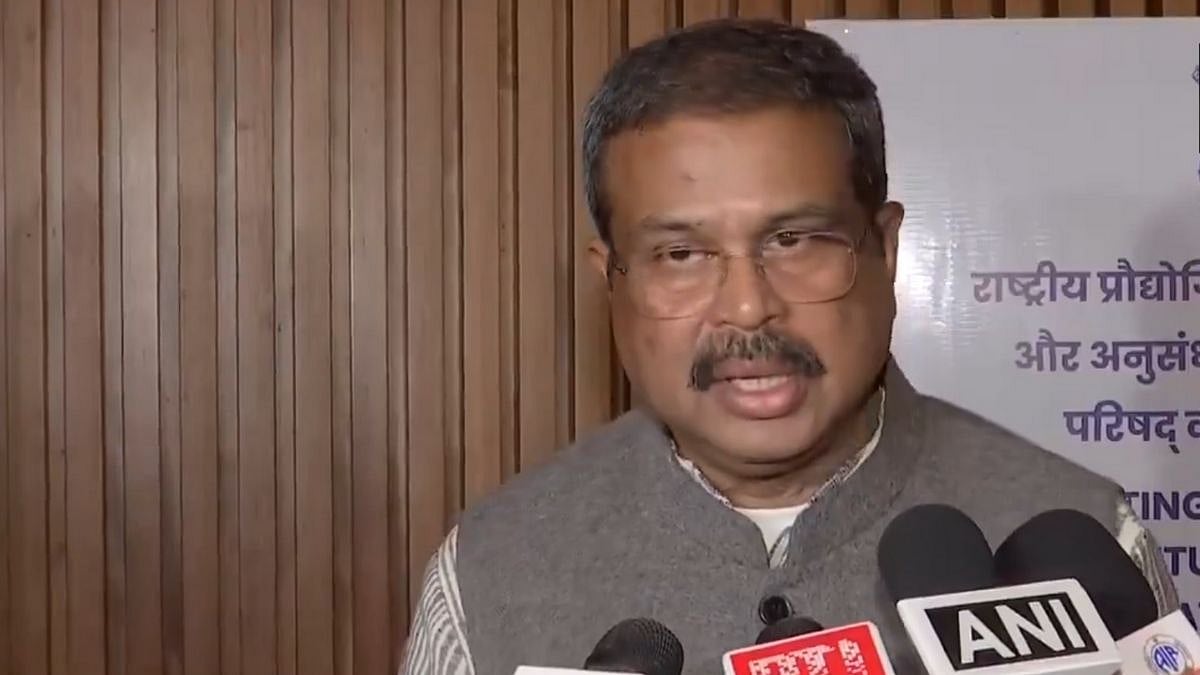
Union Education Minister Dharmendra Pradhan | ANI
Union Education Minister Dharmendra Pradhan on Saturday hit back at Tamil Nadu Chief Minister M.K. Stalin over his recent criticism of the National Education Policy (NEP) 2020, calling the “Hindi imposition” narrative misleading and politically motivated.
In a strongly worded response, Pradhan said such claims were a “tired attempt to mask political failures” and reiterated that the Centre remains committed to promoting all Indian languages, including Tamil.
‘NEP supports multilingualism, not imposition’
Addressing concerns around language, the minister clarified that NEP 2020 does not mandate Hindi but instead promotes learning in the mother tongue. According to him, this was a policy that would help to promote multilingualism while still enabling students to acquire knowledge and develop in their mother tongue.
According to Pradhan, Tamil students could greatly benefit from this because not only could they consolidate their linguistic foundations but also get exposed to other languages as well. He argued that the acquisition of many languages should be considered an asset rather than a liability.
Stalin's criticism and policy rollout
These remarks come after Tamil Nadu Chief Minister Stalin criticised the Central Board of Secondary Education’s (CBSE) new curriculum framework, calling it a “calculated attempt at linguistic imposition” that prioritises Hindi over regional languages. He said the policy undermines federalism, marginalises non-Hindi-speaking states, and places an added burden on students and teachers.
The CBSE is set to roll out a phased three-language policy from the 2026–27 academic session, starting with Class 6. Under this, students will be required to learn three languages, with at least two being Indian languages.
Watch CBSE Curriculum & Scheme of Studies Launch:
The issue has also gained political significance, with Tamil Nadu heading for Assembly elections for its 234-member House on April 23. The counting of votes is scheduled for May 4.
Flags impact of policy stalemate on students
The Union minister also pointed to delays in implementing central education initiatives in Tamil Nadu, alleging that the state government’s stance has affected students’ access to key schemes.
He mentioned that the establishment of PM SHRI schools in the state is delayed because of the lack of an agreement. In the same way, he expressed his worry about the opposition to Navodaya Vidyalayas, which restricts the prospects of the students, especially the underprivileged ones.
Moreover, Pradhan denied any claim regarding scarcity of resources, emphasizing on the fact that the problem was administrative in nature.
Calls for a cooperative approach
By pointing out the endeavours made by the Centre to foster the Tamil language and culture, the minister alluded to programs that strive to recognise India’s linguistic diversity. The minister called upon the Tamil Nadu state government to rise above political considerations and join hands to enhance the performance of education.
Pradhan ended his speech by requesting the state authorities to desist from such divisive rhetoric and instead concentrate on enlarging learning avenues for the students.
RECENT STORIES
-
-
-
-
-