Defining The Meaning Of The Ethical Use Of AI At Educational Institutions Is The Most Important Issue Of Our Time
Dr A K Sen Gupta, Founder of the Higher Education Forum, explains the importance of ethical AI use in education, highlighting academic integrity, data privacy, bias, and AI literacy. He urges students, teachers and institutions to use AI responsibly while preserving human judgment and critical thinking.

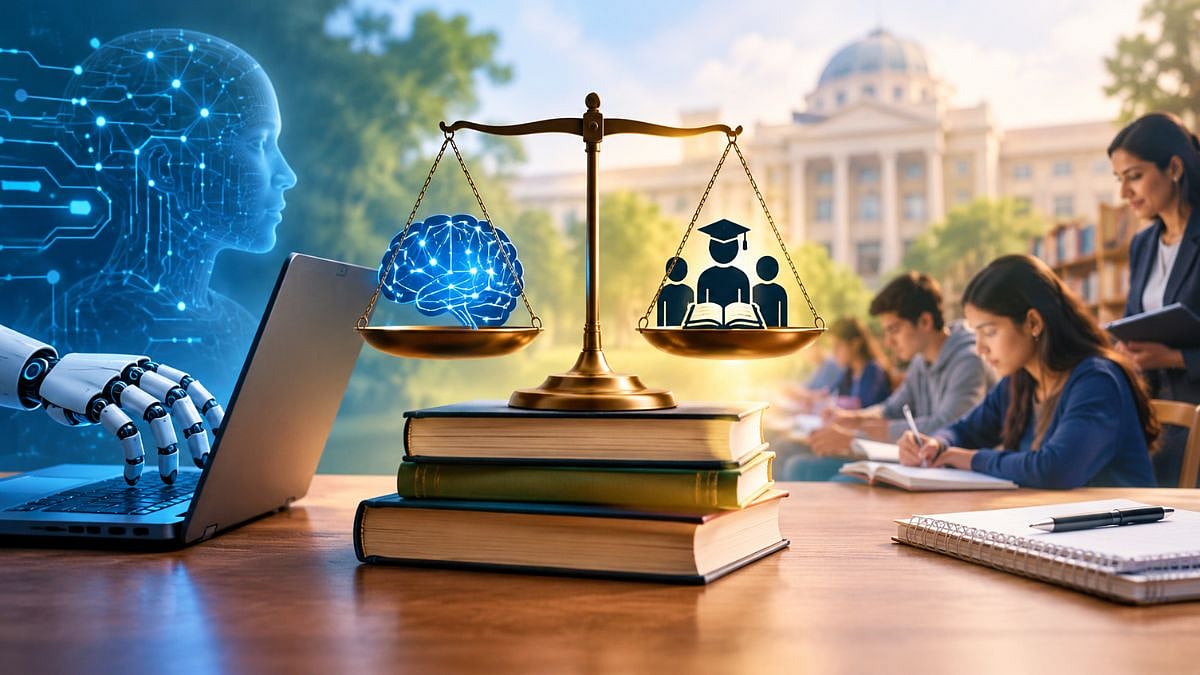
Defining The Meaning Of The Ethical Use Of AI At Educational Institutions Is The Most Important Issue Of Our Time | Chatgpt
Backdrop:
Artificial Intelligence (AI) has moved from being a futuristic concept to becoming an integral part of education. Whether it is generating lesson plans, summarising research papers, solving mathematical problems, or creating presentations, AI has transformed the way teachers teach and students learn. The question today is no longer whether AI should be used in education, but how it should be used responsibly and ethically.
Unfortunately, the term "ethical use of AI" is often used without a clear understanding of what it actually means. Ethical AI is not about rejecting technology, nor is it about blindly embracing it. It is about ensuring that AI enhances human intelligence rather than replacing human judgment, creativity, and integrity.
Also Watch:
What Does Ethical Use of AI Mean?
Ethical use of AI refers to using AI tools in a manner that is honest, transparent, fair, accountable, and beneficial to individuals and society. It involves respecting intellectual property, protecting privacy, avoiding bias, maintaining academic integrity, and ensuring that humans remain responsible for all important decisions.
AI is a powerful assistant, but it should never become a substitute for thinking. Ethical use means treating AI as a support system rather than an authority.
Ethical Responsibilities of Students:
For students, AI opens exciting opportunities for personalized learning. However, it also presents significant ethical challenges.
One common misuse is submitting AI-generated assignments as one's own work. While AI can help generate ideas, improve grammar, or explain difficult concepts, using its output without understanding the content amounts to academic dishonesty. Learning occurs through the process of thinking, questioning, analysing, and reflecting: not by copying polished responses.
Students should therefore:
· Use AI to understand concepts rather than merely obtain answers.
· Verify information generated by AI before accepting it.
· Acknowledge AI assistance wherever institutional policies require.
· Avoid using AI during examinations unless explicitly permitted.
· Develop their own critical thinking instead of becoming dependent on AI.
Perhaps the greatest danger is not plagiarism but the gradual erosion of independent thinking. If every problem is solved by AI, students may lose the ability to analyse, evaluate, and create independently, skills that remain essential in every profession.
ALSO READ
Ethical Responsibilities of Teachers:
Teachers too face ethical dilemmas. AI can prepare lecture notes, generate quizzes, draft assessment rubrics, translate content into multiple languages, and even suggest teaching strategies within seconds. These capabilities can save valuable time.
However, ethical teaching requires much more than efficiency.
Teachers should critically evaluate AI-generated content before using it in classrooms. AI systems occasionally produce inaccurate information, outdated references, or fabricated citations. Blind acceptance of AI output can spread misinformation.
Teachers must also avoid over-reliance on AI while assessing student work. Final academic judgments should remain human decisions. Empathy, contextual understanding, and professional judgment cannot be delegated to algorithms.
Equally important is transparency. When significant teaching material has been generated or substantially modified using AI, teachers should openly acknowledge its use. Such openness builds trust and models responsible behaviour for students.
Major Ethical Concerns:
Academic Integrity: The boundary between assistance and cheating is becoming increasingly blurred. Institutions must clearly define acceptable and unacceptable uses of AI in assignments, examinations, and research.
Bias and Fairness: AI systems learn from existing data, which may contain cultural, social, gender, or linguistic biases. Consequently, AI-generated outputs may unintentionally reinforce stereotypes or discriminate against certain groups. Users must therefore critically evaluate AI responses rather than accepting them as objective truth.
Privacy and Data Protection: Many AI platforms collect user inputs to improve their models. Teachers and students should avoid uploading confidential examination papers, unpublished research, institutional records, or personal information into public AI systems without understanding the associated privacy implications.
Intellectual Property: Who owns AI-generated content? Can AI-created images or text be freely used? Can copyrighted material be uploaded into AI tools? These questions remain legally and ethically complex. Educational institutions must develop clear policies regarding copyright, attribution, and acceptable use.
Research Ethics:
Researchers increasingly use AI for literature reviews, data analysis, language editing, and coding assistance. While these applications improve productivity, AI should never fabricate references, generate fake data, manipulate research findings, or write papers without proper human oversight. Scientific integrity remains non-negotiable.
ALSO READ
Building AI Literacy:
Ethical AI begins with AI literacy.
AI literacy is not merely learning how to use ChatGPT or other AI tools. It includes understanding their capabilities, limitations, biases, risks, and appropriate applications.
Educational institutions should train both teachers and students in:
· Prompt writing and responsible AI usage.
· Verification of AI-generated information.
· Detection of AI hallucinations and misinformation.
· Copyright and citation practices.
· Data privacy and cybersecurity.
· Ethical decision-making while using AI.
AI literacy should become as fundamental as digital literacy.
Institutional Responsibilities:
Educational institutions cannot leave ethical AI use to individual discretion alone. They must establish comprehensive AI policies that address teaching, learning, assessment, research, examinations, data protection, and academic integrity.
Institutions should also encourage dialogue instead of imposing blanket bans. Since AI technology evolves rapidly, policies should be flexible and periodically reviewed.
Faculty development programs should regularly update teachers on emerging AI tools, ethical issues, legal developments, and best practices. Students too require orientation programs to understand responsible AI use from the beginning of their academic journey.
The Way Forward:
The future of education will not be shaped by AI alone but by the partnership between AI and human intelligence.
Routine tasks such as content generation, information retrieval, scheduling, and administrative work may increasingly be automated. However, qualities such as wisdom, empathy, ethical reasoning, creativity, leadership, emotional intelligence, and value-based decision-making will remain uniquely human.
Teachers will become mentors, facilitators, and designers of meaningful learning experiences rather than mere transmitters of information. Students will need to move beyond memorization towards inquiry, innovation, collaboration, and responsible citizenship.
Ultimately, ethical AI is not about controlling technology; it is about strengthening human values while using technology wisely. The guiding principle should be simple: AI should augment human intelligence, not replace human responsibility.
As education enters the AI era, success will depend not on who uses AI the most, but on who uses it with the greatest integrity, responsibility, and wisdom. That is the true meaning of ethical AI, and it is the direction in which education must move.
By Dr A K Sen Gupta, Founder, Higher Education Forum (HEF).
RECENT STORIES
-
-
-
-
-