Alignment Of Education With Employment: The Biggest Challenge Of Today
India’s education system faces a growing employability gap as curricula lag industry needs. The article highlights skill shortages, limited industry exposure and faculty preparedness, and calls for curriculum reform, vocational education and upskilling.

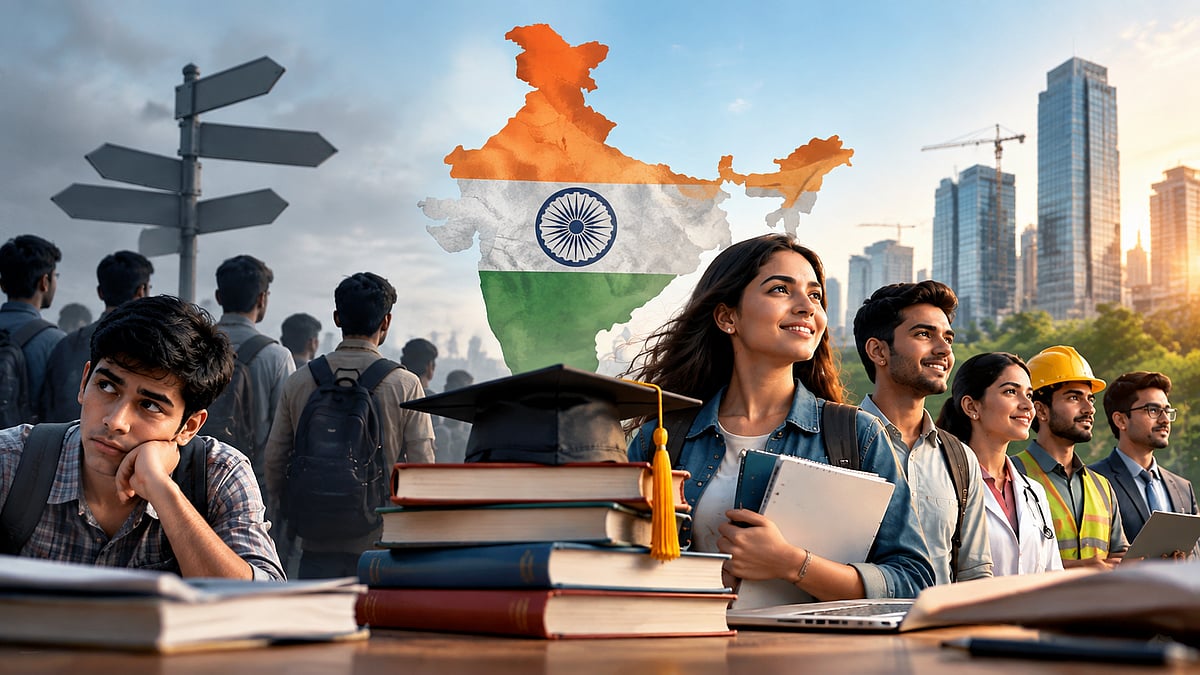
Alignment Of Education With Employment: The Biggest Challenge Of Today | AI
Indian education system is passing through a delicate phase. With structure and processes not keeping pace with the international quality norms and growing divergence emanating from the concepts of access and quality, it is struggling despite the recommendations of NEP 2020. One of the crucial issues in recent times is the emerging debate on education and its impact on employability.
The issue has always been discussed in academic circles. But with around 65 per cent of Indian population (around 95 crores) below the age of 35 and with median age of about 29 years, India today is a land of young people and therefore, there is a growing need of employment alignment.
If one looks at the basic statistics, the situation calls for a quick solution. With more than 1.04 crores students coming out of graduation courses (as per AISHE reports) alone and around 1.5 crore to 2.0 crores of people added to the workforce each year, the question is whether the country can afford to create so many suitable and appropriate jobs in a year. The problem gets more serious with unemployed people from previous years.
With government departments / public sector units jobs getting dried up and AI replacing many traditional jobs, the situation does not seem to be happy. Even the recent report of NITI Aayog report has flagged off an alarming situation with around 8.7 crore young people (15-29 years age) being classified as NEET (neither in education, employment, or training).
What it implies is that we need to speed up the pace of creating suitable job opportunities for the rapidly expanding youth. But the problem has many dimensions:
Mindset Syndrome: In India there is a mindset problem among all sections of people of looking at skills: particularly skills that have got demand but often considered below par by many elitist people. This includes skills like technicians, caregivers, plumbing, mechanics, drivers, medical technologists, among many others. Students and parents think alike that these jobs are not for them, and they deserve to get into so called “higher skill jobs” for which they lack credentials.
Curriculum–Industry Mismatch: Many academic programs continue to emphasize theoretical knowledge while industries increasingly demand practical competencies. Rapid technological advancements, particularly in artificial intelligence, automation, robotics, cybersecurity and data analytics, are changing the nature of work much faster than revision in curricula. As a result, graduates often possess degrees but lack skills required by employers. All studies show that hardly a quarter of graduates are job ready on entering the job market.
Inadequate Focus on Critical Employability Skills: Technical knowledge alone is no longer sufficient. Employers across sectors consistently highlight deficiencies in communication, problem-solving, teamwork, adaptability, critical thinking, digital literacy, and leadership. These competencies, often referred to as employability or future-ready skills, determine how effectively an individual can contribute to a professional environment.
Limited Industry Exposure: A large proportion of graduates complete their education without meaningful exposure to real workplace environments. Structured internships, apprenticeships, industry projects, and mentorship opportunities remain inadequate in many institutions. Such experiences not only improve technical competence but also help students understand workplace culture, expectations, and professional ethics.
Faculty Preparedness: Teachers remain the most critical drivers of educational quality. However, many faculty members themselves have limited exposure to contemporary industrial practices and emerging technologies. Continuous professional development, faculty internships in industry, collaborative research with enterprises and regular upskilling programs are inadequate in the current set up.
Entrepreneurship as an Alternative: For decades, higher education has largely prepared students to seek employment rather than create it. While not every graduate can become an entrepreneur, educational institutions should nurture entrepreneurial thinking, innovation, and problem-solving abilities. Incubation centres, start-up mentoring, innovation laboratories, and access to seed funding can encourage young people to become job creators instead of only job seekers.
Coping Strategies:
The above discussions show that challenges are huge and quick solutions are difficult to find. Addressing the employability challenges requires coordinated efforts from the government, educational institutions, industry, and society.
First, curriculum reforms should become a continuous process rather than a once-in-a-decade exercise. Universities as well as autonomous institutions should actively involve industry experts, professional bodies and alumni while designing programs.
Second, skill development should receive the same importance as academic achievement. Students should graduate with demonstrable competencies supported by practical projects, portfolios, internships, and industry certifications.
Third, “vocational education” deserves equal social respect. Countries such as Germany, Switzerland and Singapore have demonstrated that strong vocational ecosystems significantly contribute to economic growth and employment generation. India too needs to remove the artificial distinction between vocational and academic education. Massive awareness campaign needs to be launched. Government should think in terms of creating “National Vocational Universities” as Institutes of Excellence with requisite Diplomas and Degrees.
Fourth, greater emphasis should be placed on lifelong learning. As technology continues to evolve rapidly, the concept of a “single degree” serving an entire career is becoming obsolete. Professionals will increasingly need to reskill and upskill throughout their working lives.
Finally, career guidance and mentoring should become an integral part of higher education. Students must receive timely information about emerging sectors, future occupations, changing skill requirements and multiple career pathways so that they can make informed decisions.
The Way Forward:
India stands at a historic demographic advantage. With one of the world's youngest populations, the country has the potential to become a global leader in innovation, manufacturing, services, and the knowledge economy. However, this demographic dividend can quickly become a demographic liability if education fails to prepare young people for meaningful employment.
The objective of education should, therefore, extend beyond awarding degrees. It must equip learners with knowledge, skills, values, adaptability, and the confidence to contribute productively to society. Success should not merely be measured by the number of graduates produced each year but by the number of competent, employable, and entrepreneurial citizens the education system creates.
The National Education Policy 2020 has provided an encouraging framework for transforming Indian education. The challenge now lies in translating its vision into sustained action through effective implementation, continuous monitoring, and strong collaboration among all stakeholders.
The alignment of education with employment is not merely an educational reform; it is an economic and national development imperative. The sooner India bridges this gap, the stronger its prospects of becoming a developed nation in the coming decades. To make the dream of Vikasit Bharat by 2027 a reality, this is must.
RECENT STORIES
-
-
-
-
-