AI Safety Kit Urges Mumbai Parents To Teach Children Responsible Technology Use From Age Three
A new AI Safety Awareness Kit in Mumbai has urged parents to teach children responsible technology use from the age of three. Created by Dr Swati Popat Vats of the Early Childhood Association, the kit uses games, stories and activities to promote digital safety, computational thinking and a human-first approach to artificial intelligence among children aged three to eight.

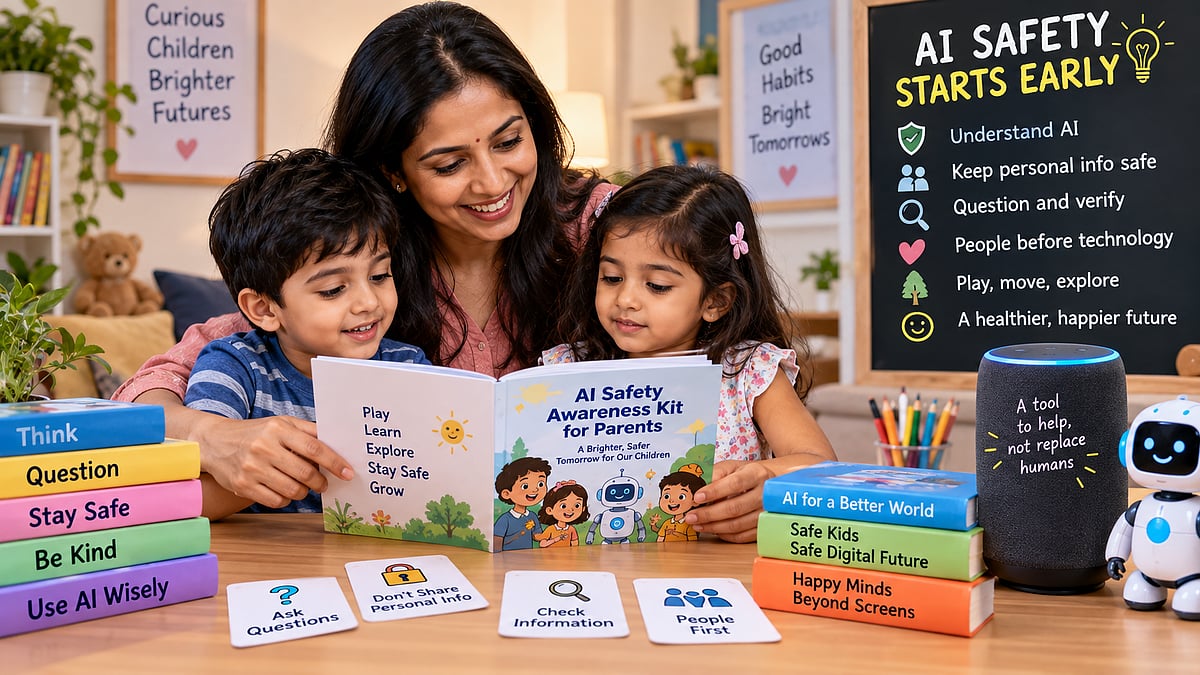
AI Safety Kit Urges Mumbai Parents To Teach Children Responsible Technology Use From Age Three | AI
Mumbai: As artificial intelligence increasingly enters children’s everyday lives through smart speakers, video recommendations, navigation apps and conversational tools, a new AI safety and awareness kit has called on parents to begin teaching children how to interact with the technology from as early as three years of age.
‘AI Safety Awareness Kit For Parents’ Targets Young Learners
The “AI Safety Awareness Kit for Parents”, created by Dr Swati Popat Vats, president of the Early Childhood Association (ECA), is designed for children aged three to eight. Distributed by the Early Childhood Association and Inspirenext Learning Foundation, the kit focuses on computational thinking, digital safety and human-child interaction through play, rhymes, stories and family activities.
At the centre of the programme is a “human first” approach — teaching young children that AI and machines can assist them but should not replace human judgement, relationships or decision-making.
Children Encounter AI Before Understanding The Technology
The kit argues that AI literacy should begin early because children encounter AI-enabled systems even before they understand what artificial intelligence is. Smart speakers, Google Maps, video recommendations and conversational AI are cited as examples of technology that can become part of a child’s daily environment.
It cautions that young children may attribute human-like qualities to AI systems, particularly when devices respond conversationally. The material therefore encourages adults to change the language they use around technology — for instance, describing a smart speaker as something “programmed” to respond rather than saying it “knows” an answer.
AI Awareness Charter Focuses On Safe And Critical Use
A proposed “AI Awareness Charter for Young Children” says children should understand the technologies they encounter, be protected from inappropriate uses of AI, learn to question information and understand that AI is created by people and should remain under human guidance. It also stresses daily exposure to play, imagination, nature, movement and creativity.
Rather than introducing AI safety through conventional classroom lectures, the kit uses games, songs and family activities. One exercise, “AI Detective”, encourages children to question and verify information instead of immediately believing an answer. Another, “Secret Keeper”, teaches children not to disclose personal information to AI or apps and to approach a trusted adult when unsure. Other activities introduce concepts such as algorithms, sequencing, debugging and distinguishing between living things and machines.
Games And Activities Replace Traditional AI Lessons
"Screen habits are another major component. The material encourages children to take breaks from screens and says technology should not replace movement, outdoor play, meals or human relationships," said Swati Popat, President of Early Childhood Association, India.
ALSO READ
"The kit places substantial responsibility on parents, describing them as children’s first AI safety teachers. It encourages families to check information before believing AI-generated answers, protect personal information and ensure that people ultimately make decisions rather than machines," she added.
It also includes a parent observation checklist and a “Family AI Pledge”, under which families commit to putting people before technology, thinking before asking AI, checking information before believing it and not sharing personal information with machines without a trusted adult.
The concluding message stresses that AI education should extend beyond schools and become part of conversations at home, including during meals, travel and bedtime. The objective, according to the kit, is to raise children who can use AI critically and safely without allowing technology to undermine human relationships, imagination and independent thinking.
To get details on exclusive and budget-friendly property deals in Mumbai & surrounding regions, do visit: https://budgetproperties.in/
RECENT STORIES
-
-
-
-
-