Academic Institutions Should Create Entrepreneurs And Role Of Teachers
An entrepreneurial attitude helps students become creative, resilient and self-driven. It builds problem-solving, leadership and risk-taking skills that support academic growth, career readiness and the vision of a developed India.

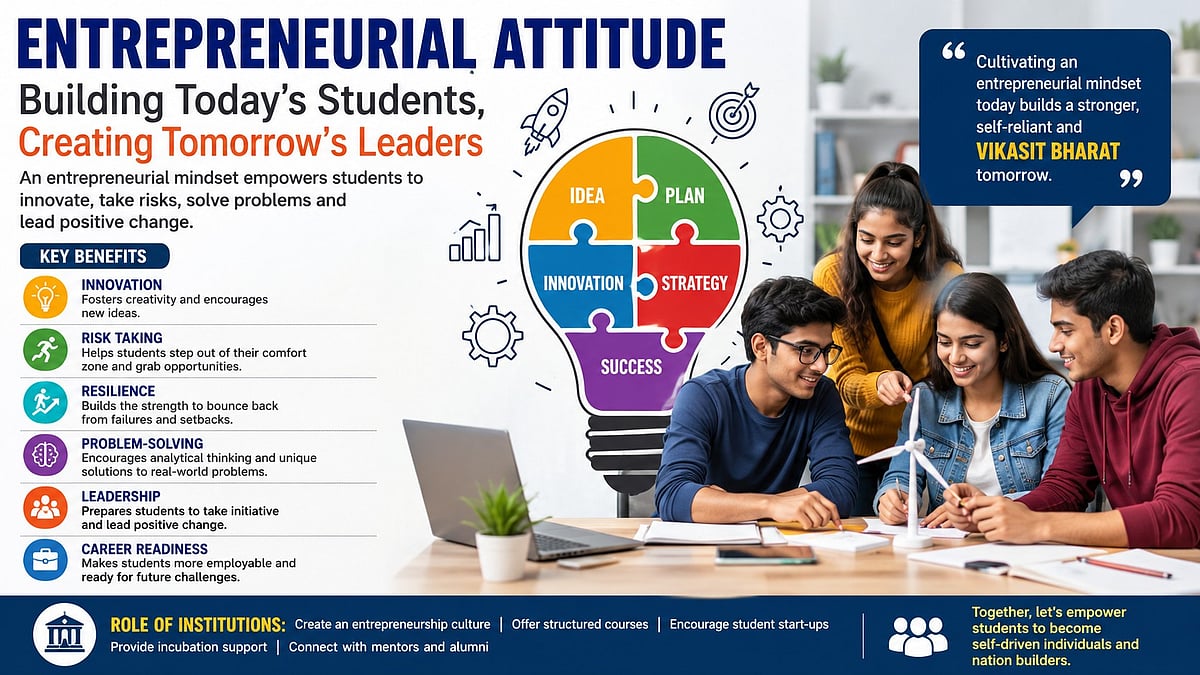
Entrepreneurial attitude is a key trait required of students at any level. It primarily refers to a mindset that enables individuals to identify opportunities, take calculated risks, and innovate to achieve desired goals.
It involves being proactive, adaptable, and resilient in the face of challenges. It helps students immensely in their academic careers and later in their professional and personal lives.
The country needs a large number of entrepreneurs in the coming days to achieve the goal of “Vikasit Bharat.” While not all students may become entrepreneurs, what is needed of the system is that it must develop the attitude and competencies that will help them become “self-driven individuals.”
Key Benefits of Entrepreneurial Attitude
Innovation: Entrepreneurial attitudes foster creativity, leading to innovative solutions. These individuals are often found to have the traits of curiosity and a keen urge to learn new skills.
Risk Taking: Entrepreneurship is always associated with risk taking. This attitude is crucial for success in life, as persons with a “winning attitude” must have adequate risk-taking propensity as well as ability. Risk-taking ability also helps to develop the competency of adaptability, which is very much needed for any situation in today’s context.
Resilience: This is an essential trait that helps individuals bounce back from failures and setbacks. A high “resilience quotient” is essential for successfully facing the ups and downs of life.
Problem-solving: Entrepreneurial thinkers develop unique solutions to any given problem. Students with entrepreneurial attitudes are often known to have “out of the box thinking.”
Leadership: This attitude prepares students to take charge and drive positive changes. This fosters the development of leadership traits. All leaders in any setting have entrepreneurial traits among them without fail.
Career Readiness: Employers often value individuals with entrepreneurial skills. Hence students with such attitudes are the first choice in any selection process. These traits also help students choose “entrepreneurship” as a career option.
Role of Academic Institutions
In many cases, entrepreneurial traits are found to be “genetic” or “born” qualities. Therefore, the debate has always been whether academic institutions can play any role in inculcating entrepreneurial competencies among students; in other words, can they create entrepreneurs? The answer is both “yes” and “no”; while institutional training cannot per se create entrepreneurs, these can help / motivate the students through creating a conducive ambience and learning intervention to try to become “real-life entrepreneurs” besides developing “entrepreneurship qualities” that are essential for success in life. Therefore, it helps students in many ways.
Some of the approaches/strategies that an institution and faculty can adopt are as follows:
Create an entrepreneurship culture: The institute must have an entrepreneurship culture that supports and nurtures “risk taking” and “failure-absorbing capacity” among students. Risk-taking should be encouraged; students ought to be taught how to critically analyse a situation and take strategic risks to achieve the desired goals; some may falter and lose, but that should not demotivate them, and such students must be encouraged to take the next steps forward. This entrepreneurship culture helps students imbibe the essential qualities to be risk-takers. Similarly, the “deferred placement policy” helps students take risks, and if they are not successful, they can come back for college career assistance.
Structured entrepreneurship course: At all levels of study, from school (9th standard onwards) to undergraduate, including professional courses, entrepreneurship should be taught as an integral “core course.” This trend has started as part of the implementation of NEP 2020 recommendations, but it needs to be strengthened in terms of rigor and bringing in cases and real-life heroes (entrepreneurs) to the classroom so that students are motivated to become entrepreneurs. Failures are part of the life journey of entrepreneurship; therefore, a few cases of such “failure stories” should also be shared with students. Teachers need to discuss the concept of “resilience’ at length so that adequate “shock absorption capacity” is developed among students.
Start entrepreneurship while a student: One of the commonly adopted methodologies by many teachers/institutions is that all students or those who are seriously interested in learning and applying entrepreneurship principles to real-life applications are allowed to form their “own company / business entity” and learn all concepts of managing an enterprise through this entity. This is an interesting model that can be tried if students are really interested in becoming entrepreneurs while in school / college. Teachers can also participate in such a “joint venture” so that both can become co-stakeholders in an entrepreneurial entity.
Presence of an incubation center: Such a center will facilitate creating a real-life “entrepreneurship hub” where interested students can seriously think of a place of generating and implement their entrepreneurship ideas both during and after leaving a school/college. Institutions should have adequate number of teachers, alumni, and corporate support networks to work as “Mentors” for this type of initiative so that students are properly guided in their entrepreneurship journey.
Moving Ahead:
Among other qualities, an entrepreneur needs to be perseverant and have a long-term focus; short-term losses sometimes need to be managed with adequate courage, and therefore, it requires a strong “mental attitude.” Therefore, educational institutions and teachers have limited influence on the creation of entrepreneurs.
They can create ambience and environment, but the final call must be taken by the students themselves. However, keeping the current context in mind, teachers should play the additional role of mentors for “enterprise builders” in addition to the other roles. Only then can India see a larger number of self-made people taking the lead to change the future of the nation.
RECENT STORIES
-
-
-
-
-