Why Trump's Ceasefire Extension With Iran Failed to Cool Down Oil Prices?
US President Donald Trump on Wednesday announced an indefinite extension of the ceasefire with Iran. Yet, crude oil, the commodity most impacted by the war, did not show any significant price movement after the announcement

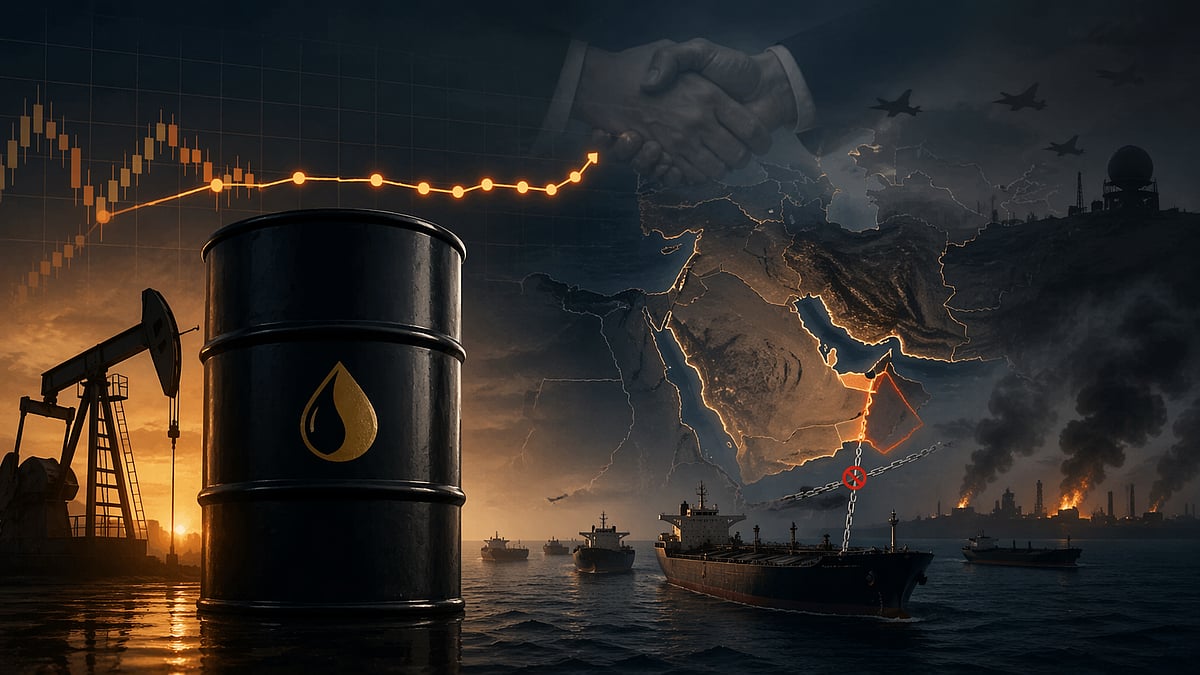
The United States President Donald Trump on Wednesday announced an indefinite extension of the ceasefire with Iran.
The decision has given a further breather to the West Asian region, which reeled under the war for over a month.
Yet, crude oil, the commodity most impacted by the war, did not show any significant price movement after the announcement.
The ceasefire breather was not expected, as Trump had said on Monday that he was very unlikely to extend the ceasefire if a deal with Iran was not reached before the truce ended.
“Upon the request of Field Marshal Asim Munir and Prime Minister Shehbaz Sharif of Pakistan, we have been asked to hold our attack on the country of Iran until such time as their leaders and representatives can come up with a unified proposal,” he said in a post on X (formerly Twitter).
Closure of Strait of Hormuz
The closure of the strait, through which a fifth of the world’s crude supply used to pass before the war, is the biggest roadblock to bringing down oil prices, which are currently hovering at a premium of around 50 percent compared to pre-war levels.
Even after the ceasefire extension, oil prices have remained elevated, with the global benchmark Brent crude nearing the $100 per barrel mark.
Citigroup on Tuesday anticipated that oil prices could rise to $110 per barrel if the Strait remains disrupted for another month.
One of the main reasons behind the muted response of crude to Trump’s ceasefire extension is the continued blockade of the Strait of Hormuz and Iranian ports by the US.
“I have therefore directed our military to continue the blockade and, in all other respects, remain ready and able, and will extend the ceasefire until such time as their proposal is submitted and discussions are concluded, one way or the other,” Trump said in the statement.
The indefinite extension of the ceasefire also implies an indefinite closure of the strait.
Trump’s Shifting Stance
According to market experts, traders were very reactive to Trump’s comments during the initial days of the war. However, his repeated changes in stance on critical matters have now become a cause for caution rather than hope for de-escalation.
Until concrete steps are seen on the ground to restore disrupted supply chains, oil traders are expected to remain apprehensive about developments on the war front.
Even after the ceasefire agreement between the US and Iran on April 6, traffic through the Strait of Hormuz has remained just a fraction of pre-war levels.
According to a report by Reuters, only three ships passed through the strait on Tuesday.
Damaged Energy Infrastructure
Moreover, reopening the strait would bring only limited relief to oil prices, as experts anticipate months, if not years, to restore crude supply to pre-war levels.
The warring sides have damaged each other’s energy infrastructure during the war. Repairing these facilities will be a long process.
While the US has given a waiver on Russian oil to control the steep surge in crude prices, the ground reality has not improved much, as even Russian oil units have been hit by Ukraine in the past few months.
Many experts now warn of structurally high oil prices, as there are virtually no positive signals on the ground.
RECENT STORIES
-
-
-
-
-