Rupee Falls 48 Paise To Close At 96.16 Against US Dollar Amid Rising Crude Prices, Global Tensions
The rupee declined 48 paise to close at 96.16 against the US dollar on Tuesday as rising crude oil prices and geopolitical tensions boosted demand for the safe-haven dollar. Brent crude rose 3.75% amid supply concerns, while weak domestic equities and foreign investor outflows added pressure on the currency.

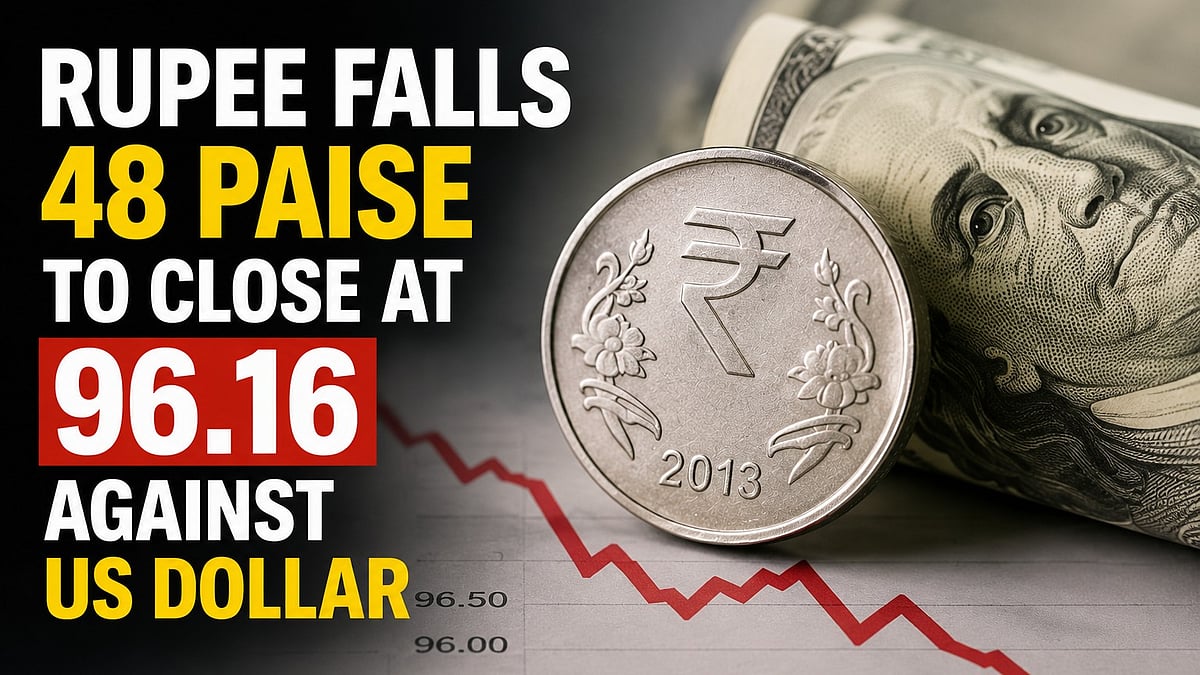
Rupee Falls 48 Paise To Close At 96.16 Against US Dollar Amid Rising Crude Prices, Global Tensions | AI Representational Image
Mumbai, Jul 14: The rupee depreciated 48 paise to close at 96.16 against the US dollar on Tuesday, amid a surge in crude oil prices and renewed geopolitical concerns.
Forex traders said the rupee came under pressure due to a combination of factors -- crude oil prices climbed on renewed geopolitical tensions, while demand for the US dollar increased as investors moved towards safe-haven assets.
At the interbank foreign exchange market, the rupee opened at 95.95 and touched the intraday low of 96.33 before settling at 96.16, down 48 paise from its previous closing level.
On Monday, the rupee depreciated 30 paise to close at 95.68 against the US dollar.
Meanwhile, the dollar index, which gauges the greenback's strength against a basket of six currencies, was trading at 101.07, down 0.16 per cent.
Crude oil prices weigh on rupee
"When uncertainty rises, and interest rates are expected to stay higher for longer, the dollar often becomes the market's preferred shelter, putting pressure on emerging market currencies like the rupee," CR Forex Advisors MD Amit Pabari said.
Brent crude, the global oil benchmark, was trading higher by 3.75 per cent at USD 86.42 per barrel in futures trade amid concerns over disruptions to supplies through the Strait of Hormuz.
An expensive crude oil import bill widens the trade gap because India, which imports over 85 per cent of its crude, must purchase it in US dollars, driving a massive foreign exchange outflow. This surge in dollar demand weakens the domestic currency against the US dollar, traders said.
Analysts flag further pressure
Dilip Parmar, Senior Research Analyst, HDFC Securities, said the rupee underperformed against its Asian peers once again, tumbling to its weakest level in a month.
"Surging crude oil prices - driven by escalating geopolitical tensions - heavily weighed on the local currency. Additionally, rising global bond yields may dampen expected inflows into the FCNR(B) scheme, piling further pressure on the rupee. In the near term, spot USD-INR is likely to head towards 96.50, with support shifting upward to 95.80," Parmar said.
Also Watch:
Markets and economic data
On the domestic equity market front, Sensex tanked 561.46 points to settle at 77,054.94, while the Nifty dropped 158.95 points to 24,052.05.
Foreign Institutional Investors on Tuesday offloaded equities worth Rs 739.69 crore in the domestic equity market, according to exchange data.
Meanwhile, India's exports rose 15.5 per cent year-on-year to USD 40.41 billion in June, while the trade deficit widened to a five-month high of USD 30.43 billion due to a surge in imports, driven mainly by higher crude oil prices.
On the domestic macroeconomic front, wholesale price inflation shot up to 9.87 per cent in June, from 9.68 per cent in May, led by a sharp spike in prices of food and non-food items.
Net direct tax collection grew 16.40 per cent to over Rs 6.51 lakh crore till July 13 this fiscal, driven by higher corporate tax mop-up, government data showed on Tuesday.
(Except for the headline, this article has not been edited by FPJ's editorial team and is auto-generated from an agency feed.)
RECENT STORIES
-
-
-
-
-