Pivotal Visit & Unpredictable Geopolitical Winds: Putin’s India Mission Steals Spotlight From Indo–US Free Trade Deal Delay
As global trade realignments continue, all focus now shifts to Delhi, where the Putin–Modi summit may well reshape the contours of India’s strategic and economic partnerships for the decade ahead.

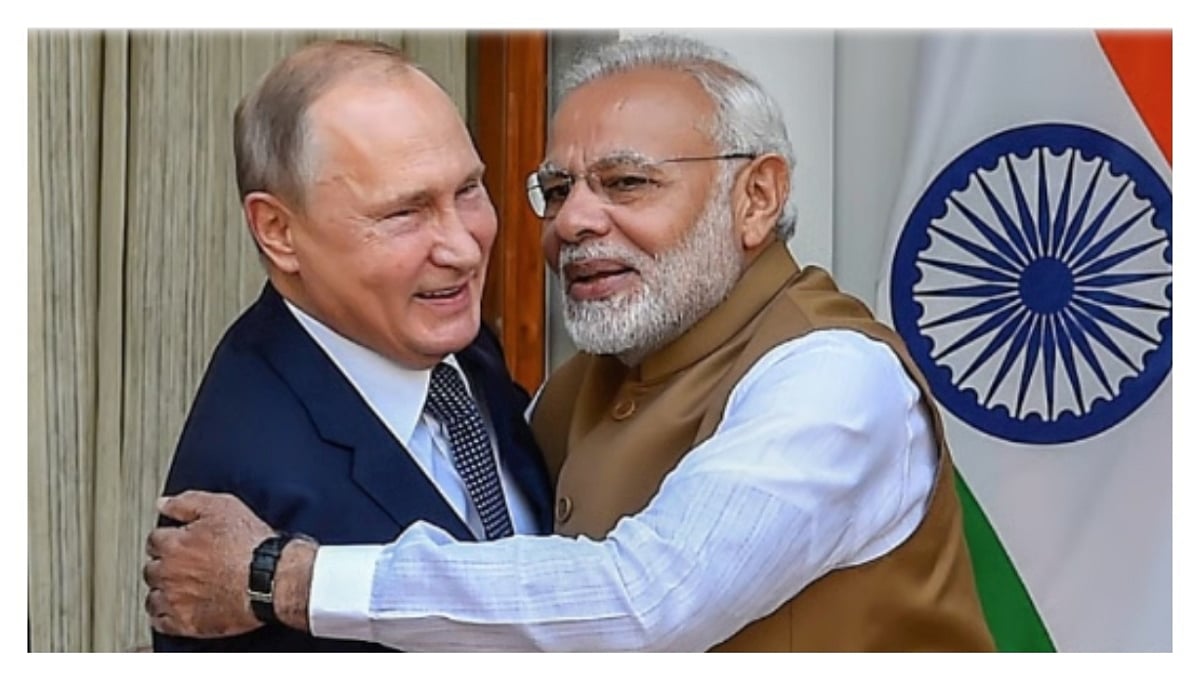
File Image |
Mumbai: All eyes are on Russian President Vladimir Putin’s visit to India this Thursday and Friday (December 4-5), and all ears will be attuned to the tenor and depth of his conversations with Prime Minister Narendra Modi.The Kremlin leader’s arrival—his first since December 2021—comes at a moment when shifting geopolitical winds, revived great-power rivalries, and the resurgence of protectionist sentiment are reshaping global trade diplomacy.
At the same time, lingering Trump-era impulses—marked by a hardening of positions and, as onlookers opine, an erosion of emotional intelligence among several world leaders and lawmakers—continue to impede or defer a series of prospective free trade agreements. This includes the much-discussed Indo–US trade pact, and its delay has now been eclipsed by the strategic weight of Putin’s high-stakes India mission.
ALSO READ
Economists, industrialists and strategic analysts are closely watching for signals of a fresh defence engagement between India and Russia. Speculation is rife over whether the visit may yield a renewed long-term strategic partnership, or even accelerate discussions toward a future FTA with the Eurasian Economic Union, particularly as New Delhi’s large-scale arms procurement cycle with the US nears completion.
India and Russia, whose economic ties have endured through the post-Soviet decades, remain on course to reach their bilateral trade target of $100 billion by 2030.“Modi’s visit to Moscow in July 2024 pushed the economic partnership further. Key outcomes included reaffirming the $100-billion trade target, advancing discussions on long-term energy contracts and promoting joint projects in transport engineering and metallurgy.
ALSO READ
Negotiations on an India–Eurasian Economic Union FTA were described by official sources as “progressing effectively” with a likelihood of “bearing fruit soon”, official Indian sources from Moscow told The Free Press Journal late Sunday.“Putin’s visit coincides with recent US sanctions on two major Russian oil companies, a move that has reportedly reduced (temporarily) India’s intake of discounted Russian crude. Oil pricing, supply predictability and the prospect of long-term procurement contracts are expected to feature centrally in the Modi–Putin dialogue,” a diplomat said.
Defence cooperation will form a major pillar of the talks. High-end systems such as the S-500 air-defence platform are expected to be on the table. Should this materialise, it would reaffirm Russia’s position as India’s most dependable partner in missile-defence architecture. Both sides are also expected to discuss deeper collaboration in missiles, submarines and aviation—a critical push as India advances its ambitions of technological self-reliance in defence manufacturing.
ALSO READ
Putin’s previous visit to India, in December 2021, saw the two nations consolidate their military and technical cooperation through a pact extending to 2031. Twenty-eight investment agreements were concluded then, spanning steel, shipbuilding, coal and energy.Cross-border investments have strengthened considerably. Indian firms have expanded their presence in Russia’s oil and gas, pharmaceuticals and IT sectors, while Russian companies have deepened their stakes in India’s energy, infrastructure and manufacturing domains. Increasing Indian exports to Russia, and boosting joint manufacturing of spare parts for Russian-origin defence equipment in India, remain shared priorities.
"Bilateral trade reached a record $68.7 billion in FY24–25, nearly 5.8 times the pre-pandemic level. India exported $4.88 billion worth of goods—ranging from agricultural produce, chemicals and pharmaceuticals to machinery, textiles, leather goods and surgical tools."Imports from Russia, at $63.84 billion, were dominated by crude oil, petroleum products, fertilisers, metals, machinery, precious stones, timber and pulp. Trade in services has remained stable for five years, with the balance tilted in Russia’s favour," sources said.
Despite global headwinds and heightened uncertainty, India’s economic fundamentals remain resilient. Growth momentum from the June quarter persists, aided in part by recent GST reductions. The IMF has noted that the 50% US tariffs imposed in August will weigh marginally on India’s outlook, though overall exposure remains limited due to India’s modest share of merchandise exports to the US.
Inflation has eased significantly, driven by softer food prices, and is expected to remain subdued in the near term. India’s external position, the IMF added, remains moderately stronger than what medium-term fundamentals alone would suggest.
Disclaimer: This story is from the syndicated feed. Nothing has changed except the headline.
RECENT STORIES
-
-
-
-
-