Maruti Suzuki Launches India's First Flex-Fuel Passenger Car
Maruti Suzuki on Thursday launched India’s first flex-fuel passenger car, positioning the technology as a key part of the country's efforts to reduce crude oil imports, lower carbon emissions and strengthen energy security. The company unveiled the vehicle in the presence of Nitin Gadkari and Hardeep Singh Puri, both of whom have advocated the use of alternative fuels and domestic energy sources

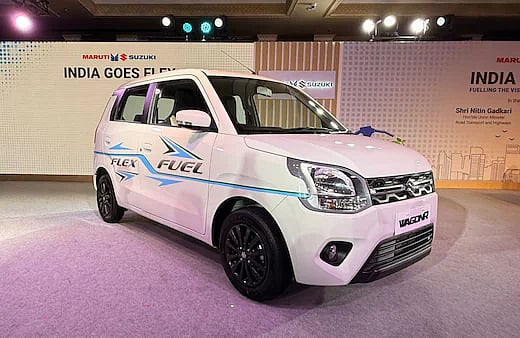
Maruti Suzuki on Thursday launched India’s first flex-fuel passenger car, positioning the technology as a key part of the country's efforts to reduce crude oil imports, lower carbon emissions and strengthen energy security.
The company unveiled the vehicle in the presence of Nitin Gadkari and Hardeep Singh Puri, both of whom have advocated the use of alternative fuels and domestic energy sources.
Hisashi Takeuchi, Managing Director and CEO of Maruti Suzuki, said that the introduction of the flex-fuel Maruti Suzuki Wagon R Flex-Fuel represented "a new chapter in India's energy journey."
Focus on Energy Security and Emission Reduction
Highlighting India's dependence on imported crude oil, Takeuchi said the country needs energy solutions that are cleaner, affordable, scalable and based on domestic strengths.
"India has two national objectives: First, reduce dependence on imported crude oil. Second, reduce carbon emissions. Flex-fuel meets both. It is truly Atmanirbhar and clean," he said.
ALSO READ
Takeuchi credited Gadkari for encouraging the automobile industry to adopt biofuels and alternative energy solutions.
"When nobody believed in biofuels, you guided the industry that the produce of Indian farmers can replace foreign oil," he said.
He added that flex-fuel technology could benefit farmers, ethanol producers and rural communities by linking agriculture with clean mobility.
"It connects mobility with agriculture, technology with farmers, and clean energy with Atmanirbhar Bharat," he said.
Ecosystem Development Key to Adoption
Takeuchi acknowledged that large-scale adoption of flex-fuel vehicles would require coordinated efforts across the ecosystem, including fuel availability, vehicle launches, customer awareness and competitive pricing.
"An entire ecosystem needs to be developed – from fuel availability to more model launches, from customer awareness to fuel and vehicle pricing," he said.
"In the absence of an ecosystem, it is the responsibility of the market leader to take the first step and encourage others."
ALSO READ
The company said the launch is part of its broader multi-pathway strategy to reduce emissions through technologies such as electric vehicles, strong hybrids, compressed natural gas (CNG), compressed biogas (CBG) and hydrogen.
Takeuchi described compressed biogas as a promising route towards achieving net-zero emissions and noted that Maruti Suzuki has announced nine CBG plants, two of which are already operational.
"For Maruti Suzuki, this is a commitment to cleaner mobility, lower oil import dependence, and Atmanirbhar Bharat."
The launch comes as India continues to expand ethanol blending in petrol and promote alternative fuels as part of its strategy to improve energy security and reduce reliance on imported fossil fuels.
RECENT STORIES
-
-
-
-
-