Abundance Amid Ongoing Instability: Harvests Rise, Volatility Persists Across Markets Worldwide
Global agriculture is witnessing rising harvests and improving productivity driven by better farming practices, with the market projected to grow from 6.5 trillion dollars in 2026 to 8.6 trillion dollars by 2030. However, volatility remains high as the FAO Food Price Index rose 2.4 percent in March 2026 due to geopolitical tensions, surging fertiliser costs, and shifting demand patterns.

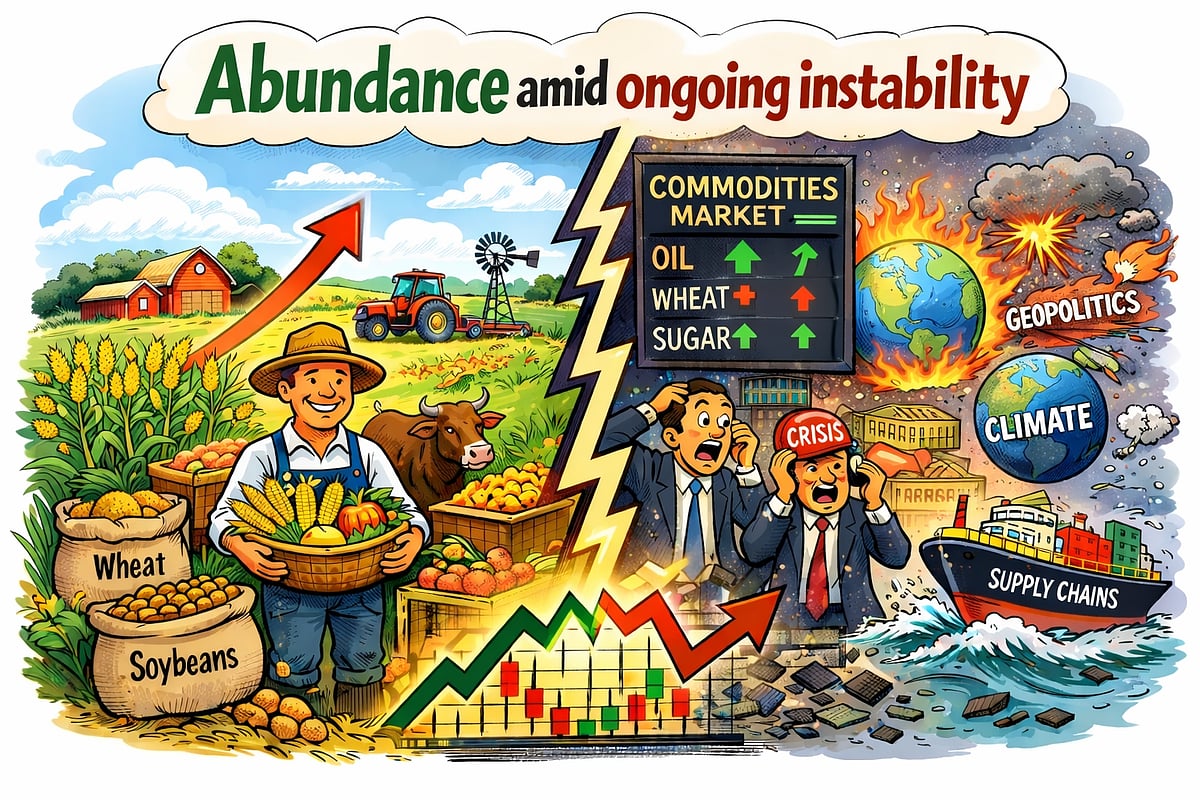
Global agriculture sees rising output and falling prices, but volatility persists amid geopolitical tensions and demand shifts. |
Mumbai: The global agricultural economy is entering a new phase of transformation, where traditional factors such as weather and seasonality are increasingly complemented—and often disrupted—by technology, geopolitics, and shifting consumption patterns. According to Haresh Karamchandani, Managing Director & Group CEO of HyFun Foods, agriculture today operates at a complex intersection where rising output coexists with persistent uncertainty.
On the surface, the outlook appears stable and growth-oriented. The global agricultural commodity market is projected to expand from $6.5 trillion in 2026 to over $8.6 trillion by 2030. This growth is being driven by a combination of population expansion, rising incomes across emerging markets, and evolving dietary preferences that are increasing demand for a wider range of food products. Technological advancements, including precision farming, improved seed varieties, and data-driven cultivation practices, are further boosting productivity and efficiency across regions.
These improvements are expected to exert downward pressure on prices over time. With better yields and optimised farming practices, supply is likely to keep pace with demand, resulting in a gradual softening of commodity prices in the long term. However, this theoretical stability often contrasts sharply with real-world developments.
In the short term, agricultural markets remain highly volatile. The FAO Food Price Index rose by 2.4% in March 2026, driven by price increases in key commodities such as wheat, vegetable oils, and sugar. This highlights the sector’s sensitivity to disruptions, where even minor shocks—such as adverse weather events, supply chain interruptions, or geopolitical tensions—can trigger sharp price movements.
A significant contributor to this volatility is the increasing interdependence between agriculture and energy markets. Fertiliser prices, which are closely linked to energy costs, have surged amid global tensions. This has directly impacted farming decisions, with many farmers opting for less input-intensive crops such as soybeans. While this shift may reduce input costs for farmers, it can also constrain supply in other crops, creating imbalances and cyclical price spikes across commodities.
ALSO READ
At the same time, demand dynamics are evolving rapidly. The Asia-Pacific region has emerged as a dominant consumption hub, accounting for nearly 50% of global demand. Rising urbanisation, changing dietary habits, and increasing protein consumption are reshaping agricultural demand patterns. Additionally, the growing use of agricultural commodities in biofuel production and livestock feed is further linking the sector to energy cycles, amplifying price fluctuations.
This convergence of factors has created a paradoxical scenario. While agricultural output continues to rise and productivity improves, price stability remains elusive. Climate change, trade disruptions, and geopolitical uncertainties ensure that volatility is not a temporary phenomenon but an enduring feature of the global agricultural landscape.
In this environment, the focus for policymakers and businesses must shift towards building resilience. Diversifying supply chains, leveraging data for better decision-making, and proactively managing risks will be critical. As Karamchandani emphasises, the future of agriculture will not be defined by scarcity, but by how effectively the world navigates surplus production alongside recurring shocks and uncertainties.
RECENT STORIES
-
-
-
-
-