Tome And Plume: ‘Jhal Muri’, ‘Bhel Puri’, ‘Parmal-Sev’ Ginger Up Rain-Laced Evening
After eating Dhaka’s ‘jhal muri’, you may pant with watery eyes and a runny nose, but you can only blame yourself for it. ‘Jhal muri’ from Burdwan is considered the best in West Bengal and its adjoining areas. Whenever you are on a long journey and your train stops at Burdwan station, you may find many ‘jhal muri’ sellers, and you can have a taste of this Bengali recipe.

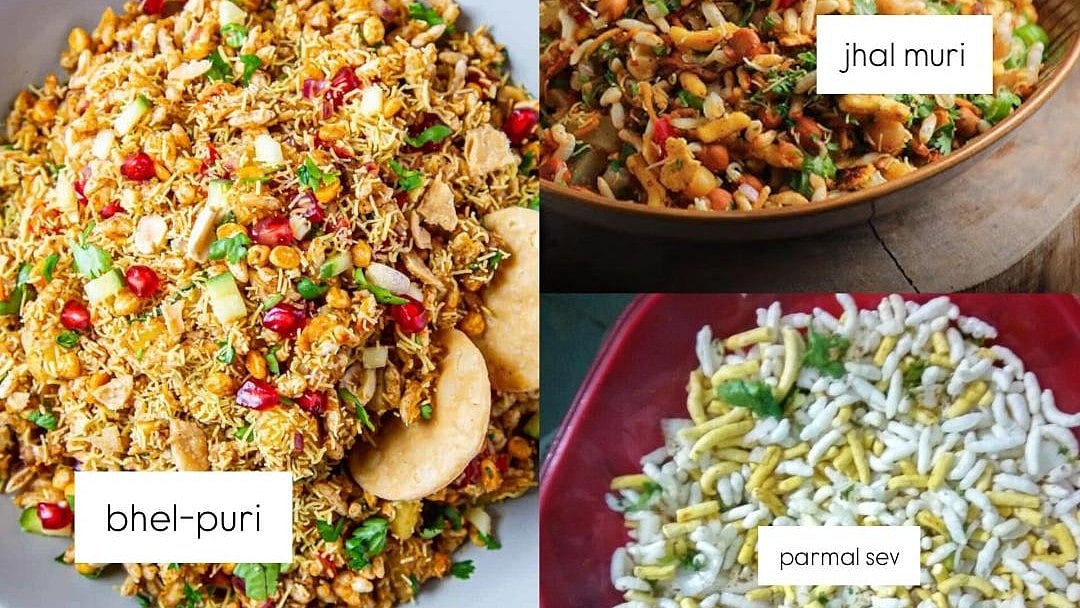
Tome And Plume: ‘Jhal Muri’, ‘Bhel Puri’, ‘Parmal-Sev’ Ginger Up Rain-Laced Evening | FP photo
Bhopal (Madhya Pradesh): The 80th and 81st slokas from Canto seven of Kalidas’s Kumarasambhava refer to the ‘laja homa’ ritual (offering puffed rice to fire) to portray the pure beauty of Parvati because of the sacred smoke emerging from the firepit. ‘Laja homa’ was a wedding ritual in ancient India
Arup Chakraborty
Travellers coming from West Bengal to Madhya Pradesh may be surprised to know the puffed rice Bengalis call ‘muri’ has been available in this part of the country since time immemorial.
Most of the Bengalis have the notion that ‘muri’, ‘murmura’, or puffed rice is available only in the eastern part of the country, and it is a staple food of the people living there.
Such a belief has gained credence after ‘jhal muri’, a Bengali recipe made of puffed rice, has become popular during the assembly election in West Bengal.
Yet, history differs from what many of them may believe. Various recipes of puffed rice have been available in Bhopal and its nearby areas since the days of yore. Pouring puffed rice into the fire was part of a wedding ceremony called ‘laja homa'.
The Rig Veda refers to two rice products, ‘laja’ and ‘prathuka’, which the people of ancient India used.
Beaten rice, or ‘chewda’, was known as 'prathuka'. The Grihayasutra also refers to ‘laja homa’ during the wedding ceremony.
Kalidas, in the seventh canto of the Kumarasambhava, describes ‘laja homa’ when the Lord Shiva walks the isles with his eternal bride, Goddess Parvati. His description consists of emotions and sensual imagery. Kalidas uses ‘laja’ (puffed rice) to limn the purity and transformative penance of Parvati.
Pouring puffed rice into fire in the wedding ceremony also symbolises the household journey of a man and a woman and their eternal reunion.
The over-2,000-year-old Sanskrit text, Charaka Samhita, refers to puffed rice as light and easily digestible food, and Sushruta Samhita speaks highly of its importance in keeping the digestive system normal.
But over time, Sanskrit ‘laja’ has transformed into ‘murmura’ in Hindi, ‘muri’ in Bengali, and ‘mamra’ in Gujarati. Travellers especially carried it for their daily fair in Central India.
Puffed rice has stories scattered everywhere in the country. In Central India, particularly in Bhopal, Bundhelkhand, and Malwa regions, people call it 'parmal'. People of central India also call it 'laiyya' or 'lai'.
In the days of yore, people used the hot-sand and hot-salt technique to prepare puffed rice. Because they prepared in an earthen clay pot, puffed rice contained a different tang and fragrance.
Puffed rice, with Central India’s flavour, became part of Nawab’s cuisine in Bhopal. As puffed rice is made from ‘parmal’, a kind of paddy, people of MP call it by the endearing sobriquet 'parmal'. Ujjain, the city of Kalidas, is a major hub for puffed rice.
Jhal muri, Bhel puri, Parmal-sev
If one segregates ‘jhal’ (long pepper) from ‘muri’, it loses the Bengali flavour. Bengali 'jhal muri' is too pungent.
The rest of the ingredients of ‘jhal muri’, like chopped tomatoes, chopped coriander leaves, black salt, coriander powder, cumin powder, chaat masala, and baked ground nuts, are the same as used in ‘bhel puri’.
There are a few more ingredients, like chopped boiled potatoes, wet grams, raw mustard oil or mango pickle oil, and chopped cucumber, which add Bengali flavour to ‘jhal muri’.
Chopped coconut is often used to make it tastier. A bite of ‘bhel puri’ from Maharashtra is equally delicious, but then one cannot set aside a plateful of well-prepared Bhopali ‘parmal sev’ with a cup of tea to ginger up a rainy evening.
But ‘jhal muri’ from Dhaka, the capital of Bangladesh, is more pungent than its Kolkata counterpart. After eating Dhaka’s ‘jhal muri’, you may pant with watery eyes and a running nose, but you can only blame yourself for it.
‘Jhal muri’ from Burdwan is considered the best in West Bengal and its adjoining areas. Whenever you are on a long journey and your train stops at Burdwan station, you may find many ‘jhal muri’ sellers, and you can have a taste of this Bengali recipe.
Until Kolkata ‘jhal muri’ walks the aisle with its Mumbai counterpart and comes up with its progeny, both remain delicious. Yet, you cannot ignore dry Bhopali ‘parmal-sev’ with a cup of tea to enjoy a rain-laced evening.
ALSO READ
RECENT STORIES
-
-
-
-
-