Tome And Plume: IGRMS Weaves Tales Of India Amidst Syllables Of Upper Lake, Silence Of Shyamla Hills
Nestled between Shyamla Hills and the Upper Lake, Bhopal’s IGRMS presents India’s cultural evolution through tribal dwellings, rock shelters, traditional art and sacred spaces. Its open-air exhibitions, built by native artisans, transform the landscape into a living museum where history, nature and indigenous wisdom exist in harmony.

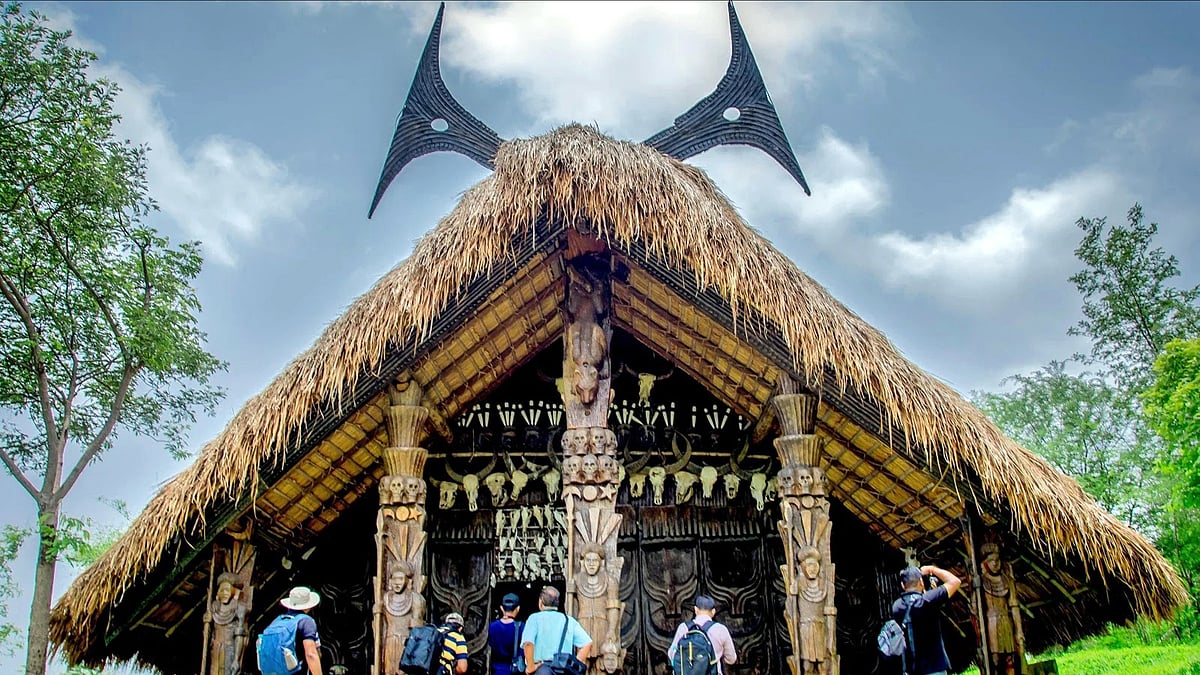
Tome And Plume: IGRMS Weaves Tales Of India Amidst Syllables Of Upper Lake, Silence Of Shyamla Hills | FP photo
Bhopal (Madhya Pradesh): The rhythms of daily life echo through the tranquil arena of the Indira Gandhi Rashtriya Manav Sangrahalaya (IGRMS) in Bhopal. When the morning sun rises over the forest-clad Shymla Hills, it sets the gurgling Upper Lake below the museum aglow. The golden sunlight pierces through the awning of the dense woodland surrounding the museum, waking up the pipers.
Their piping turns the place into a breathing canvas of human history. The museum remains an open-air anthropology park where the earth itself serves as the gallery floor.
The museum breaks free from the concrete wall and glass displays. Whenever a visitor walks through the campus of the museum, he feels like passing through the labyrinth of time. His mind wanders backward and forward through moments.
The cool air fetches the fragrance of moistened soil, withered leaves, and the wild forest. The rainy season enhances its beauty when verdancy appears in various tones under the sunlight. Along the winding pathways, the frantic hum of modern city life fades, replaced by the rhythmic chipping of a sculptor s chisel and the rustle of wind through the grass.
Here, the story of mankind unspools at random through shelters, art, and sacred spaces created by the hands that had perfected their craft since the days of yore. It captures the essence of human evolution and cultural diversity.
Set up in 1977, the IGRMS showcases everything from ethnic dwellings to rituals through displays, consisting of open exhibitions, indoor galleries, Veethi Sankul and Bhopal Gallery, and periodic temporary exhibitions.
Both Veethi-Sankul and Bhopal galleries house an array of artefacts which unfold a story of India s diversity and technological advancements over the centuries.
Yet, the museum s open-air exhibitions consist of tribal habitat, coastal village, desert village, Himalayan village, rock art heritage, mythological trail, and river valley culture. A snake-boat from Kerala, Chundam Vallam, remains the centre of attraction in the museum.
As a visitor moves along the path, a startling architectural marvel looms into view. Prehistoric rock shelters, sleeping in the woodland, emerge with their rough surfaces adorned with deep ancient paintings.
The weather-beaten stones adorned with paintings reverberate the silent past to tell its tales to the noisy present. Our ancestors stood in these places to chronicle their lives.
A visitor can connect himself with the past; he feels as if he had gone into the days of yore, talking to his ancestors through AI mode, but IGRMS is more than that.
A cluster of tribal dwellings rises from the earth to welcome the visitor with their neat verandas, slanted roofs, and open doors and windows. It remains a rare treat for a visitor. Native artisans, who travelled from the far-flung areas of the country, built these houses standing on the premises of the IGRMS with local materials, like bamboo, thatch, timber, and mud.
Intricate geometric patterns, etched into the plaster on one of the houses to drive away evil spirits, remain a puzzle to a visitor.
The warm touches of Gond artists have brought mythical beasts and towering trees to life. When a visitor stands before these works, he can appreciate how our ancestors created a deep harmony between man and nature. They had been in concord with Mother Nature and never fiddled with her. They revered everything they received from Her and wasted nothing.
To appreciate IGRMS, a day s visit remains insufficient because it represents Indian culture and heritage, which is as vast as an ocean.
But just when a visitor wishes to appreciate more to soothe his eyes and mind, the evening approaches and the soft sunlight falters through the canopy of woods. The fifteen-foot brass lamp, Deepa Rani, from Bankura, West Bengal, stands tall against the dusky welkin. Its silhouette commands reverence.
Faint notes from traditional stringed instruments and flutes begin to float through the cool evening air, mingling with the syllables of the Upper Lake. In that tranquillity on the hill, a visitor can understand the true spirit of Bhopal and the museum of man.
RECENT STORIES
-
-
-
-
-