Tome And Plume: Bhojeshwar Temple Weathers Tides Of Time
Located near Bhopal, the 11th-century Bhojeshwar Temple in Bhojpur showcases the architectural brilliance of King Bhoja’s Parmar dynasty. Famous for its enormous Shiva lingam, intricate stone carvings and unfinished structure, the ancient shrine continues to fascinate historians, devotees and tourists. Its mysterious incompleteness adds to its timeless spiritual appeal.

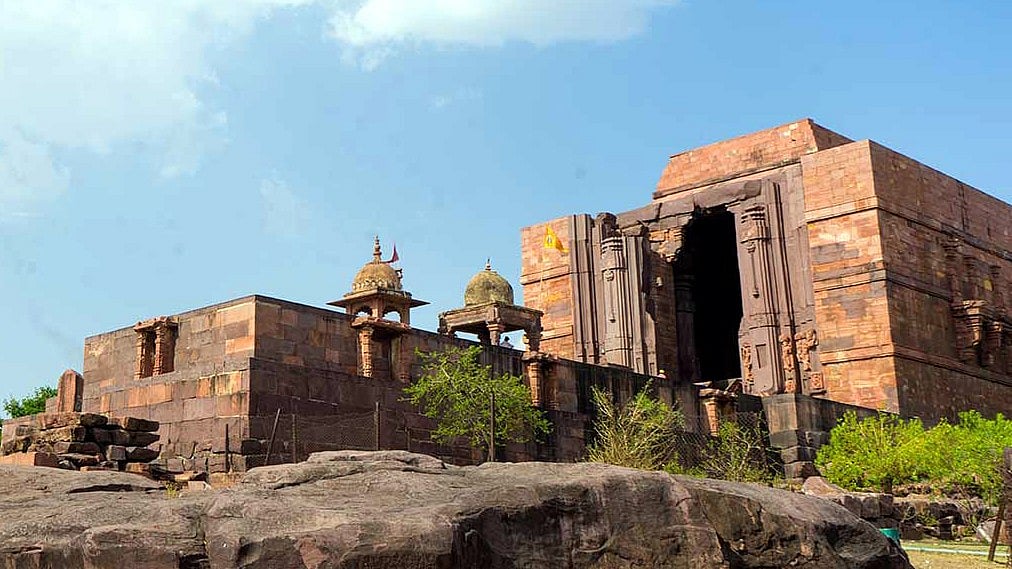
Tome And Plume: Bhojeshwar Temple Weathers Tides Of Time | FP photo
Bhopal (Madhya Pradesh): An autumn morning began to slip into the day. The sun lazily emerged from the misty horizon, bathing the 28-kilometre scrubland between Bhopal and Bhojpur in golden light.
The hilly, rugged terrain embrowned itself moment by moment. A school of whitish clouds floating overhead shut out the horizon.
The four-wheeler headed towards the ancient Bhojeshwar temple, a marvel of stone. As the vehicle moved southeast from Bhopal, the landscape changed from urban edges into the craggy earth lying at the foot of the Vindhya Range. The northern rims of the Ratapani Tiger Reserve lie nearby.
The twilight of the year permeated the weather, but humidity remained. In such contrast, the scrubland wore the appearance of a tattered grey blanket. But the landscape evolved into a thing majestic and impressive.
It is a spot that returns to the canvas of one s memory, which loves it. A lack of rain deprived nearby champs of the verdancy that generally exists in this season. The weathered hillocks lend to this land a sublimity.
As the journey neared its end, the grand Bhojeshwar temple appeared against the white clouds. It looked like a painting made of grey colour on a blue-white canvas.
The temple stands on a sandstone hill, overlooking the Betwa River. A chain of the Vindhya mountain ranges surrounds the 11th-century temple that remains a testament to the aesthetic sense of the King Bhoja of the Parmar dynasty.
The king, however, left the temple incomplete. It houses one of the largest ancient Shiva lingams in the world. Thousands of tourists and historians from different countries across the globe visit the temple every year. Four pillars support the internal dome.
But for the front fa ade, three walls remain plain. The elevated frontage contains the idols of mythical goddesses, who look vivacious even after a millennium. The massive pillars and bracket capitals of the temple feature stone sculptures and figures of Hindu deities.
The upper bracket capitals of four main interior pillars feature the divine couples Uma-Maheshwar, Lakshmi-Narayana, Brahma-Savitri, and Sita-Rama. The ceiling wears the look of an inverted lotus, which historians call the 'lotus ceiling'.
Many years ago, thunder struck the ceiling and destroyed it. The Archaeological Survey of India restored it and gave it the original look. The real wonder lies inside the temple: it is the 22-foot polished Shiva Lingam on a three-level Yoni Patta. However atheist one may be, the elegance of the deity forces one to circumambulate the lingam carved out of a single sandstone block. Together with the platform, the over 40-foot-tall structure stands in the sanctum sanctorum of the temple, commanding respect.
The temple design displays the Bhumija style of architecture, popular during the rule of the Parmar dynasty. A multi-tiered Shikhara (spire) made with rotating square circles remains its salient feature.
The artists of the Parmar era carved out the river goddesses, the Ganga and the Yamuna, Apsaras (divine dancers) and Dwarpalas (sentinels) on the door. The outer walls remain austere, but the massive stone blocks exhibit the engineering skills of the people of that era.
The incompleteness of the temple stands mysterious to historians. King Bhoja visualised a temple complex to rival all structures of ancient India. He, however, halted the construction around 1055 CE. The reason for the king's decision to stop the work stays frozen in the wintry past.
The temple remains a spiritual bridge between the past and the present. So, it stands as more than a place of worship, and its incompleteness adds a tang of mystery to the structure, but the lingam weathers the tides of time. Outside the temple, huge mysterious footprint-like impressions strike a tourist with wonder. As tourists stand in the open air and look at the hillocks, they remain motionless. It occurs to them as if time had stopped. All boundaries of human pride had fallen.
RECENT STORIES
-
-
-
-
-