Their Travail Of ‘Jeevan’ To Collect ‘Jal’’ As ‘Mission’ Goes Phut Across Madhya Pradesh
In Gram Panchayat Barhokhudkpur under Panna district’s Brijpur area, villagers alleged that out of four handpumps installed in the village, two have remained defunct for years, while the remaining pumps barely provide enough water to fill a few containers. Two large water tanks constructed under the JJM have become dry.

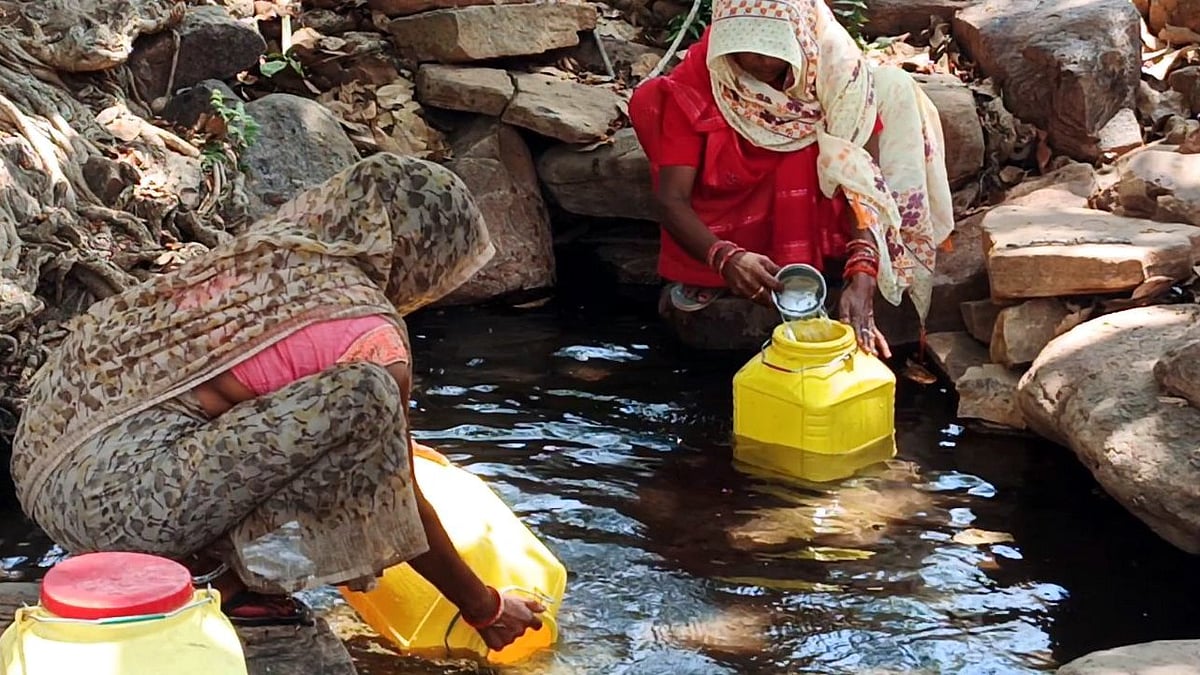
Bhopal (Madhya Pradesh): As temperatures soar and rivers dry up, thousands of rural families across Madhya Pradesh are still fighting a daily battle for something as basic as drinking water.
Women wake up before sunrise to stand in queues at dying handpumps, children carry buckets instead of school bags, and elderly villagers walk kilometres under the blistering sun in search of a single pot of water.
On paper, crores have been spent under the government’s Jal Jeevan Mission (JJM) to ensure “Har Ghar Nal Jal” through tap water connections. The state government has made a provision of Rs 17,136 crore under the JJM. Water tanks have been constructed, pipelines laid and taps installed outside homes. But the ground reality tells a completely different story.
A ground investigation by Free Press across multiple districts of MP exposes how the promise of safe drinking water has crumbled.
Panna: Tribal villages left thirsty
In Gram Panchayat Barhokhudkpur under Panna district’s Brijpur area, villagers alleged that out of four handpumps installed in the village, two have remained defunct for years, while the remaining pumps barely provide enough water to fill a few containers.
Two large water tanks constructed under the JJM have become dry. With no functioning supply system, villagers are forced to walk nearly two kilometres to fetch water from farm wells near the Baghin river or from stepwells.
The situation in Rahuniya village is equally alarming. Residents say handpumps discharge reddish water that turns darker after some time, making it unusable even for washing clothes. The village school too has been affected, with the handpump lying defunct for years and the motor installed under the JJM no longer functioning.
Sehore: Villages survive on others’ borewells
In Sehore district, around 300 villages are facing severe water scarcity. The district has already been declared drought-affected. In villages like Sheikhpura, Dobra, Mungawali and Raipura, Nal Jal schemes have remained shut for long periods despite infrastructure being in place. Surendra Kushwah, a resident of Mungawali village, said villagers are now dependent on a neighbour’s borewell because local handpumps have dried up and the piped water scheme has stopped functioning.
Residents alleged that despite repeated announcements about “Har Ghar Nal”, the reality is that many families are still carrying water in buckets and utensils every single day.
Betul: Tribal families collect donations for borewells
In Betul district’s Bhimpur block Kasya Barri village, women, children and elderly villagers begin queuing near a single handpump as early as 4 AM. Since water flows intermittently, each family gets barely enough to fill one or two utensils. Villagers alleged that despite the Jal Jeevan Mission being implemented, hundreds of villages in the district continue to suffer from acute water shortages. Frustrated tribal labourers reportedly collected money among themselves to dig borewells, but even those efforts failed to provide water. Panchayat representatives alleged that several complaints regarding corruption and poor-quality work were sent from the district level to Bhopal, but no meaningful action followed.
Morena: 705 nal constructed, none fully operational
In Morena, officially, 753 Nal Jal schemes were approved across 478 gram panchayats in the district. Of these, 705 schemes were constructed through the Public Health Engineering (PHE) Department while 48 were approved under the Jal Nigam. However, villagers across several gram panchayats alleged that the schemes are lying non-functional. In Sabalgarh block alone, villagers from Rampahadi, Pacher, Jabrol, Jatoli, Tetra, Khirka, Jawahargarh, Camera Kala and Babdipura alleged that the piped water schemes remain shut or dysfunctional. Ground reports from villages including Bamsoli, Rampur Kalan, Berkheda, Simroda Kirar, Semna, Gobra, Salampur and Dharsola indicate that despite pipelines being laid in many areas, regular water supply has failed to begin.
Satna: Taps installed, water never arrived
In Satna, villagers from Rampurva, Kurwara, Icchawal, Beheta, Parasmaniya and Bharuth say taps have been installed outside homes, but water has never actually reached them. Residents alleged that while government records may show “tap connectivity achieved”, the pipelines remain dry. Many families continue depending on traditional water sources and handpumps despite the completion of infrastructure work.
The MP Human Rights Commission has taken cognisance of the severe drinking water crisis affecting nearly 475 villages under the district panchayat limits in and around Bhopal.
Taking the matter seriously, the commission has sought a detailed action taken report within two weeks from the Chief Engineer of the PHE after conducting an inquiry into the issue. The commission also took cognisance of the worsening drinking water crisis in Rampuriya Kheda village panchayat under the Sarangpur Janpad area of Rajgarh district.
ALSO READ
RECENT STORIES
-
-
-
-
-