Solar Shock In MP: 35% Cost Spike Leaves PM Surya Ghar Projects In Limbo
Projects commissioned before June 1 were exempt from the requirement to use ALMM-listed solar cells. The ministry subsequently issued a circular on May 21 directing discoms and other authorities to ensure timely inspection and commissioning of projects installed before May 31 so that they could avoid falling under the new compliance regime.

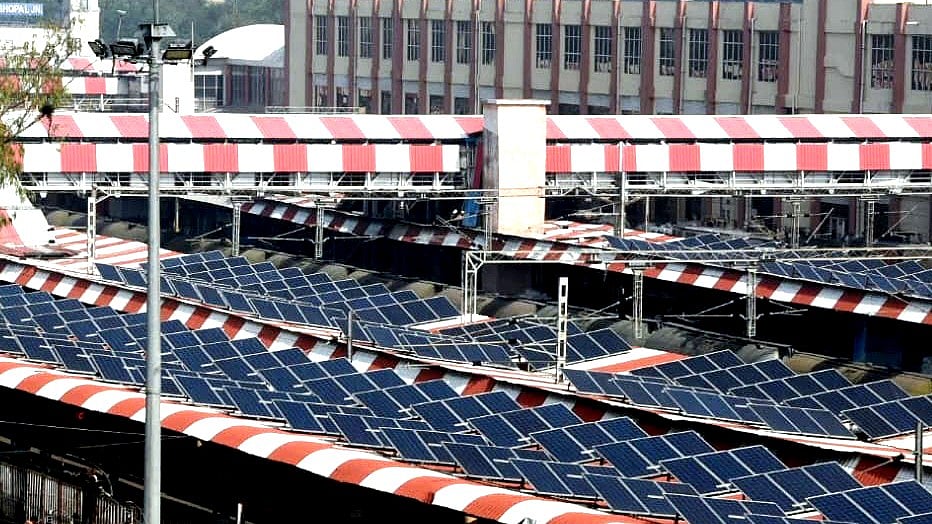
Solar Shock In MP: 35% Cost Spike Leaves PM Surya Ghar Projects In Limbo | FP photo
Bhopal (Madhya Pradesh): Hundreds of ongoing and upcoming rooftop solar projects across Madhya Pradesh, including installations on government buildings and homes approved under the PM Surya Ghar scheme, are set to become costlier.
This is due to the Centre's new Domestic Content Requirement (DCR) norms.
The rule, which mandates the use of Indian-made solar cells from June 1, has increased project costs by 30%-35%, leaving contractors staring at heavy losses as most tenders were awarded at lower rates months ago.
Vendors fear that the sudden cost escalation and shortage of DCR-compliant panels could delay projects, discourage consumers and put the state's rooftop solar expansion plans at risk.
The state has emerged as one of India's major renewable energy hubs. MP has more than 5,500 MW of installed solar capacity and eight sanctioned solar parks with a combined capacity of 4,248 MW.
The impact is likely to be significant in the state, where several large government rooftop solar programmes are already underway.
One ongoing project alone involves the installation of about 14.6 MW of rooftop solar capacity across more than 200 government buildings in Bhopal and Seoni districts.
The policy change has led to an immediate rise in market prices. According to solar vendors, DCR-compliant modules are now costing Rs 8-10 more per watt than non-DCR panels.
Industry estimates suggest that a 5-kW rooftop solar system has become costlier by Rs 40,000-50,000.
Current market estimates show that a 1-kW rooftop solar system costs around Rs 60,000-Rs 80,000 before subsidy, while larger systems have also witnessed a substantial increase due to the DCR requirement.
Biggest impact
Contractors say the biggest impact will be on projects whose tenders were finalised months ago.
Many vendors had quoted prices based on earlier market rates and imported cell-based panels. With material costs suddenly rising, contractors may now be forced to absorb the additional expenditure.
Government buildings across the state are being covered under rooftop solar programmes and contracts have already been awarded.
These projects were bid at old rates. If module prices rise by 20%-35%, contractors will have to bear the loss. Some may even find it difficult to continue execution, said a solar sector representative.
Shantanu Thakur of Solar Surya Energy said that prices started increasing immediately after the new rules came into effect.
According to Thakur, small and medium solar vendors are likely to face the maximum pressure because the supply chain is yet to fully adapt to the new requirements.
Centre's provision
The Ministry of New and Renewable Energy has enforced a provision requiring all rooftop solar projects commissioned on or after June 1, 2026, under net-metering and PM Surya Ghar schemes to use both solar modules and solar cells sourced from approved domestic manufacturers.
Projects commissioned before June 1 were exempt from the requirement of using ALMM-listed solar cells.
The ministry subsequently issued a circular on May 21 directing discoms and other authorities to ensure timely inspection and commissioning of projects installed before May 31 so that they could avoid falling under the new compliance regime.
‘Will explain benefits’
MP Urja Vikas Nigam MD Amanbir Singh said, “Efforts will be made to ensure that consumers have better access to DCR products and understand the long-term advantages of using domestically manufactured solar equipment.
We will create awareness, encourage adoption and strengthen the supply chain to meet the growing demand.”
RECENT STORIES
-
-
-
-
-