Slum Footprint Expands As Clean-Up Plans Falter; Over 6.5 Lakh Residents Live In Over 400 Slums Across Bhopal
Several rehabilitation initiatives, including the Re-densification Scheme launched during the Babulal Gaur government in 2004 and housing projects under Pradhan Mantri Awas Yojana in 2015, failed to achieve the results. Officials attribute the failure to political patronage, administrative lapses and unchecked encroachments.

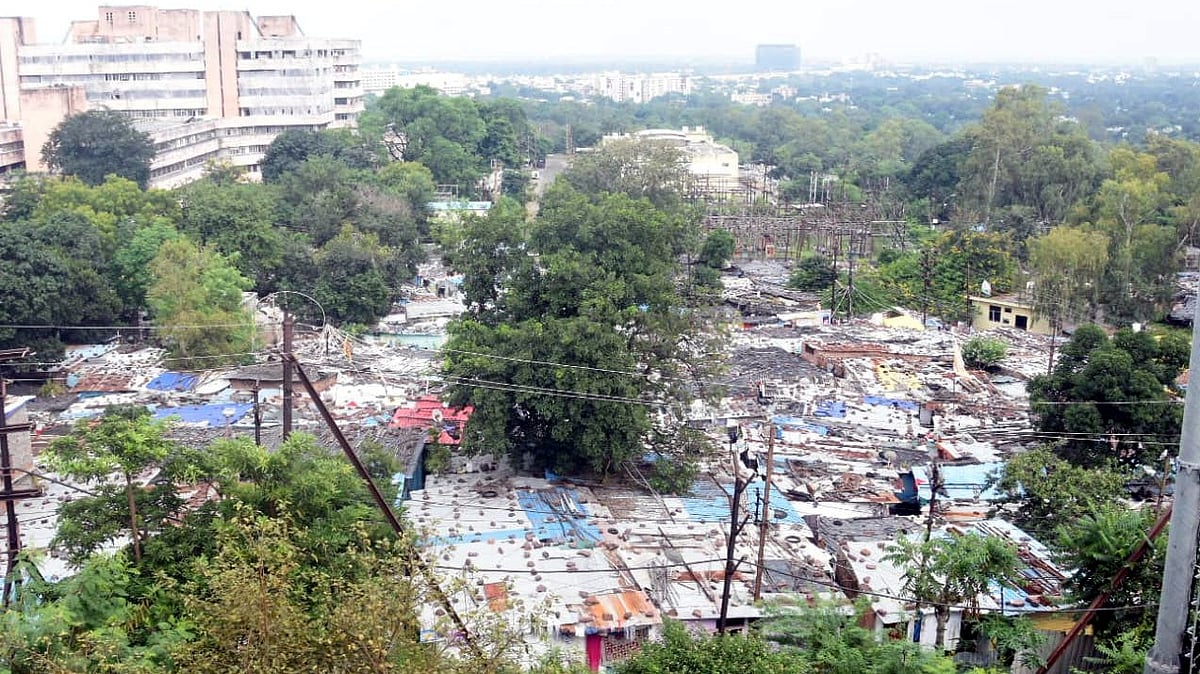
Slum Footprint Expands As Clean-Up Plans Falter; Over 6.5 Lakh Residents Live In Over 400 Slums Across Bhopal | FP Photo
Bhopal (Madhya Pradesh): Bhopal’s long-standing dream of becoming a slum-free city remains far from reality as nearly 20% of its population lives in slums spread across over 400 locations due to lack of a practical plan.
Despite multiple government schemes and crores of rupees spent in last four decades, expansion of informal settlements continue across the state capital.
According to recent urban administration department estimates, 6.5 lakh people out of Bhopal’s total population of nearly 30 lakh reside in over two lakh slum households occupying approximately 2,000 acres of land. A recent survey of the Ministry of Housing and Urban Affairs has also placed Bhopal among the top 25 Indian cities with the highest concentration of slums.
Slums rising
Government records show that in 1984, when the then chief minister Arjun Singh first proposed the vision of a slum-free Bhopal, the city had only 25 slum settlements. Instead of shrinking, the number has multiplied. A 2013 joint survey of Bhopal Municipal Corporation (BMC) and district administration identified 388 slum settlements with nearly 1.5 lakh housing units.
Today, the number of settlements has crossed 400 while the number of slum families has risen beyond two lakh.
Several rehabilitation initiatives including Re-densification Scheme launched during Babulal Gaur government in 2004 and housing projects under Pradhan Mantri Awas Yojana in 2015, failed to achieve the results. Officials attribute the failure to political patronage, administrative lapses and unchecked encroachments.
Prime govt land encroachment
Out of the 2,000 acres occupied by slums, nearly 650 acres consist of government and high-value urban land covered by 72 major slum clusters. Areas like Banganga, Roshanpura, Anna Nagar, Vallabh Nagar, Rahul Nagar, Panchsheel Nagar and Vishwakarma Nagar have expanded into some of the city’s prime localities.
Encroachments have also spread across BHEL land in Piplani, Habibganj and Govindpura and on vacant government plots in Barkheda Pathani, Pipliya Pende Khan, Padmanabh Nagar. Officials estimate that nearly 6,000 shanties have emerged in these areas alone. In VIP and Secretariat zones, the number of shanties has risen from 1,500 in 1990 to nearly 10,000 today.
Plans under review
Additional municipal commissioner Tanmay Vashishtha Sharma said a comprehensive proposal had been prepared to make Bhopal slum-free and had been submitted to the state government for approval.
Largest slum settlements in Bhopal
Banganga: 48 acres, population around 50,000
Roshanpura: 17 acres, population: 45,000
Bag Sewaniya: 16 acres, population: 40,000
Vishwakarma Nagar: 6 acres, population: 37,000
Anna Nagar: 51 acres, population: 32,000
Bhim Nagar: 72 acres, population: 15,000
Official Statement
“Nearly 4,000 acres of land are currently occupied by slums. Redevelopment plans are being reviewed in phases. In-situ slum redevelopment and rehabilitation projects will be the key strategies for resettling residents once new housing flats are developed.”
Priyank Mishra, dist collector
RECENT STORIES
-
-
-
-
-