City’s Blue Map Fades: Urban Rush, Vanishing Lakes: Bhopal’s Water Crisis In Making
The study was conducted by Ishpreet Singh, who is pursuing an MTech in Geoinformatics from IIT Bombay, under the guidance of Prof Jagdish Singh from MANIT, Bhopal. The data was secured from Copernicus Sentinel satellites of the European Space Agency. “It is the responsibility of the government agencies to ensure that urbanisation does not turn the city into a grey concrete jungle,” Singh said.

City’s Blue Map Fades: Urban Rush, Vanishing Lakes: Bhopal’s Water Crisis In Making | File pic
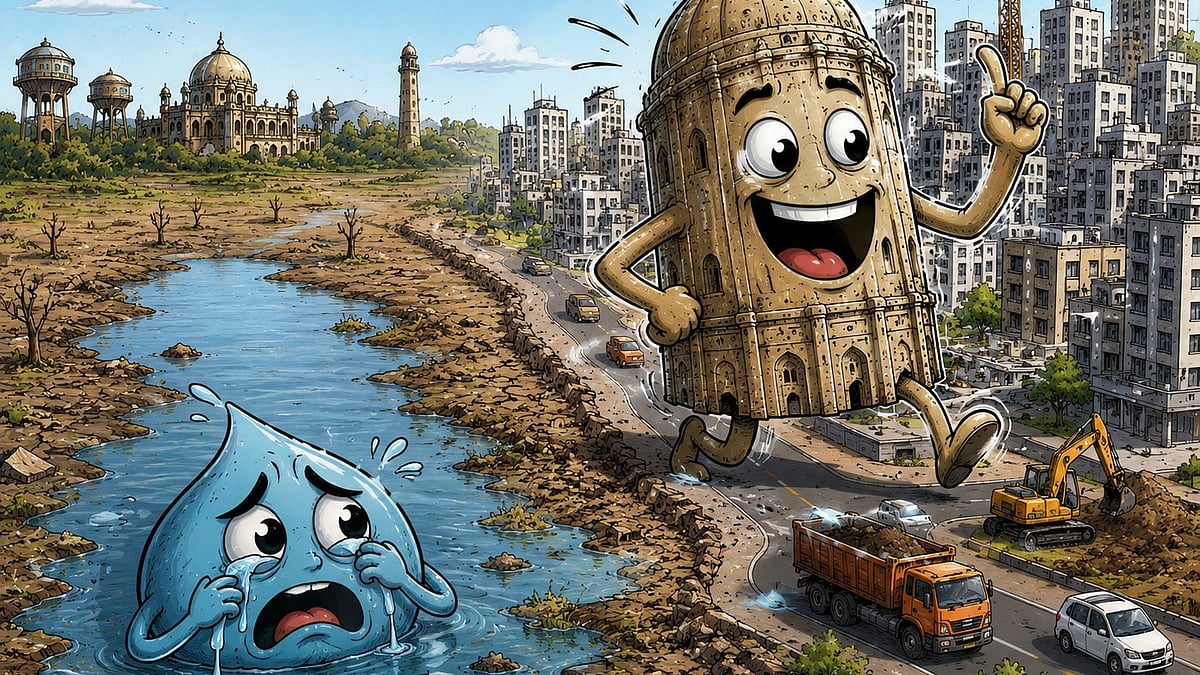
Bhopal (Madhya Pradesh): Over the past 10 years, Bhopal has lost almost 66% of its surface water area. In the same period, the total built-up area in the city has doubled, says a study.
According to a study based on satellite imagery, the city has witnessed massive urbanisation from 2016 to 2026, which has come at the cost of natural water resources. Over the decade, the total surface water area in the city has shrunk from 94.88 sq km in 2016 to 32.18 sq km in 2026.
This represents a loss of nearly two-thirds of the city’s surface water resources. This displacement of water bodies by concrete is behind 62.70 sq km loss in water area over the 10-year study period.
In 2016, the built-up area covered roughly 473.48 sq km in the city. By 2026, it had jumped to 958.18 sq km, effectively doubling the area covered in concrete. As infrastructure and housing projects move outwards, small seasonal ponds, wetlands, and natural drainage channels are filled or paved over.
Without a shift toward more sustainable, integrated urban planning, the vital water resources that once defined Bhopal will continue to diminish, impacting the local climate and long-term water security for its residents, the study says.
The study was conducted by Ishpreet Singh who is pursuing an MTech in Geoinformatics from IIT Bombay, under the guidance of Prof Jagdish Singh from MANIT, Bhopal.
The data was secured from Copernicus Sentinel satellites of the European Space Agency. “It is the responsibility of the government agencies to ensure that urbanisation does not turn the city into a grey concrete jungle,” Singh said.
RECENT STORIES
-
-
-
-
-