Bhopal News: From Villages To Ventures, Women Reshape Agribusiness
During this time, she realized that many small farmers were not getting fair prices for their produce. “Many farmers produce five to 10 quintals of vegetables, but taking them to the market requires hiring a vehicle, which increases the cost. Because of this, they often sell their produce within the village at lower prices,” she said.

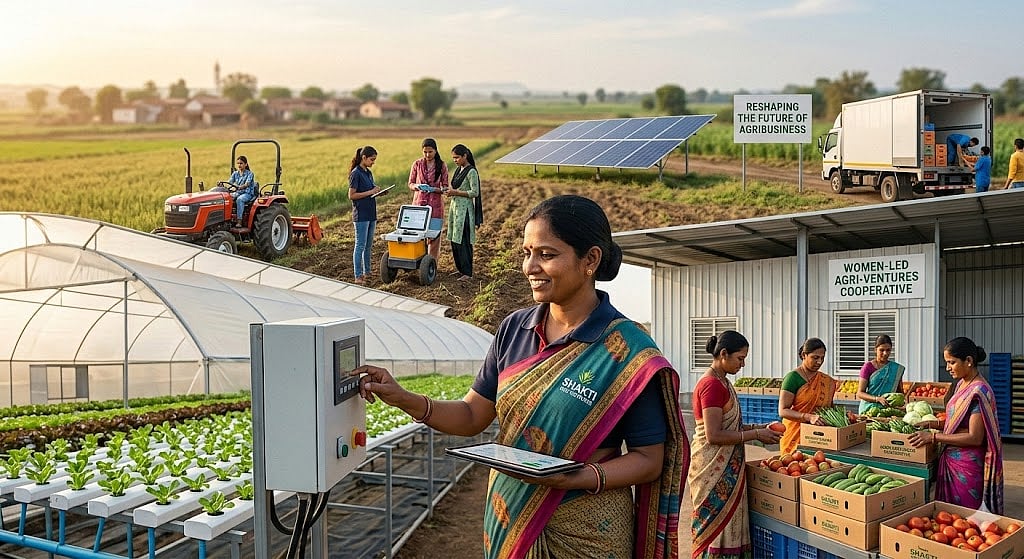
Bhopal News: From Villages To Ventures, Women Reshape Agribusiness | AI
Bhopal (Madhya Pradesh): India is known as a nation of farmers, yet women remain underrepresented in agribusiness and farm-led enterprises. In Madhya Pradesh, however, a few women are quietly changing that reality.
Rising from humble beginnings, they have built successful ventures in the agricultural sector while working closely with farmers. On the occasion of International Women’s Day, Free Press spoke to some of these inspiring women who started from scratch and are now making a meaningful impact in the farming sector.
Started with 10 women, today the group has 925 members
Haseena Bano, 40, who studied up to Class 12, began working with farmers in 2017 in Vidisha district’s Gyaraspur block. She said her interest in agriculture encouraged her to take training programmes related to farming. In the beginning, she earned around Rs4,000 per month while working closely with farmers in nearby villages.
During this time, she realized that many small farmers were not getting fair prices for their produce.“Many farmers produce five to 10 quintals of vegetables, but taking them to the market requires hiring a vehicle, which increases the cost.
Because of this, they often sell their produce within the village at lower prices,” she said. To address this, Haseena and a few women started holding meetings with farmers and discussed forming a company that could purchase crops directly from villages.
Starting with just 10 women two years ago, the group has now expanded to 925 members.
Surabhi’s journey from learning about dal mills to running one
Surabhi, who lives near Phanda toll plaza in Sehore district, started her dal processing unit after learning about the opportunity during training programmes organised for Self Help Group members.
She said she already had a small personal dal mill and during one of the training sessions learned that a mini dal mill could be set up as a small-scale start-up. Surabhi took a loan of Rs3 lakh, deposited Rs20,000 for processing and used the remaining amount to set up the unit and purchase raw materials.
After obtaining the necessary licences, she started producing unpolished desi pulses. Earlier, the family had limited income sources.
Today, Surabhi sources raw pulses from local farmers and also processes pulses for other farmers at a rate of Rs5 per kg. She said the unit has been running for the past four years and the dal processed there is now sold locally and has also reached markets in Maharashtra, Aurangabad and Delhi.
Woman sets up modern farming technique to generate higher returns
Prema Mehra, a resident of Semrikala village in Obedullaganj block of Raisen district, began working in agriculture with the support of her husband. Coming from a modest financial background, she adopted shade net house technology for commercial vegetable cultivation.
Prema said the shade net structure was developed with financial support from a private foundation and technical support from the Livelihood Mission. The structure has been set up on about 2,450 square feet of land at a cost of nearly Rs64,000, including a community contribution of Rs5,000.
The shade net house is equipped with drip irrigation, which helps save nearly 80% of water while improving crop productivity. “Through this technology, farmers can earn an additional Rs50,000 to Rs65,000 annually from just 5.5 dismil (1/100 of an acre) of land,” she said.
According to her, the technology also protects crops from pests and diseases while increasing production two to three times.
ALSO READ
RECENT STORIES
-
-
-
-
-