Bhopal Master Plan 2047 Raises Lake Protection Questions As City Expands
Bhopal Development Plan 2047 significantly expands the capital’s planning footprint, putting lake and catchment protection in focus. Experiences from Hyderabad and Bengaluru highlight the need to safeguard drainage networks and interconnected water bodies, while Delhi and Ahmedabad offer lessons in integrated infrastructure, land management and sustainable urban planning.

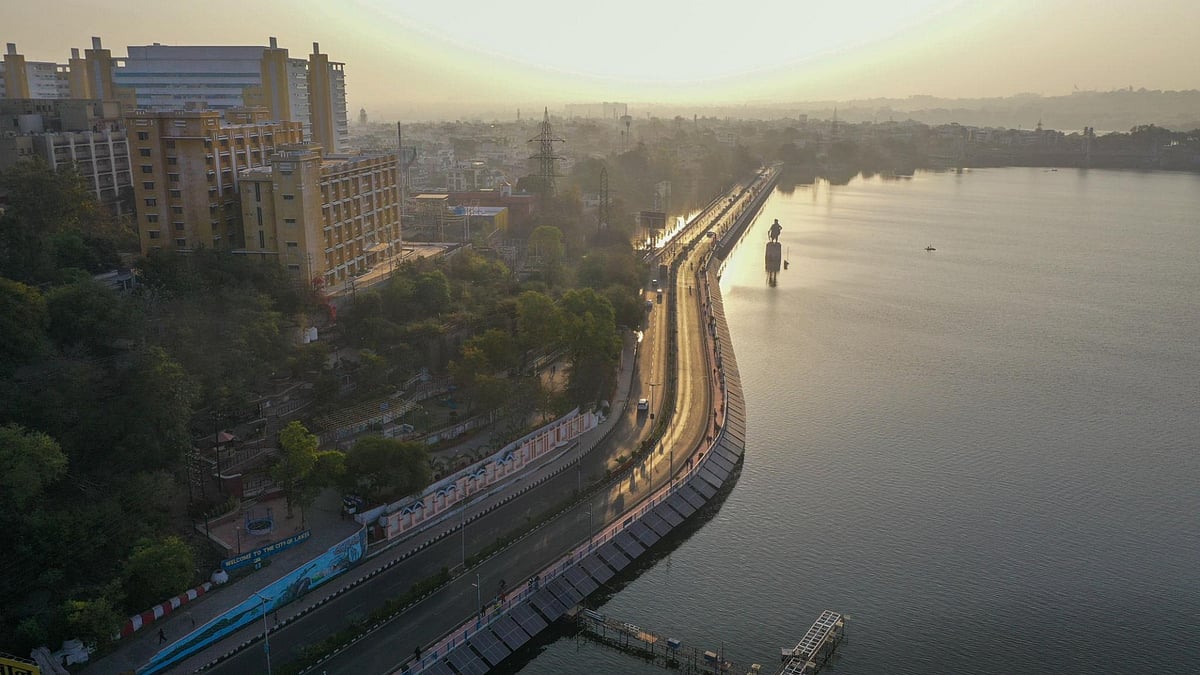
Bhopal Master Plan 2047 Raises Lake Protection Questions As City Expands | FP photo
Bhopal (Madhya Pradesh): The proposed Bhopal Development Plan 2047 aims to transform the capital, but its scale also raises questions over whether infrastructure and ecological protection can keep pace with expansion, particularly when compared with Ahmedabad, Delhi, Hyderabad and Bengaluru.
Bhopal's draft plan covers 1,016.90 sq km and 254 villages, compared with about 601 sq km and 146 villages under the previous planning framework. The proposed land-use distribution includes nearly 50% residential and 27% green areas.
The Ahmedabad Urban Development Authority's (AUDA) 2041 Town Planning Scheme model links land readjustment with roads, open spaces, utilities and social infrastructure. However, researchers have also documented delays, financing constraints and resistance from landowners, raising questions about mixed land-use provisions based on road width.
Similarly, the draft Master Plan for Delhi (MPD) 2047, released in August, separately addresses green-blue infrastructure, water supply, wastewater management, drainage, mobility, parking, transit-oriented development (TOD) and plan monitoring.
Urban experts pointed out that the MPD-2047 framework interconnects these components and assigns responsibilities to individual departments.
Comparison of cities and it’s challenges with lessons
City
Key approach
Lesson for BMP-2047
- Ahmedabad
- Delhi
- Hyderabad
- Bengaluru
Town Planning Schemes pool/readjust land for roads, utilities, open spaces and social infrastructure
MPD 2047 proposed integrated blue-green infrastructure, linking drains, lakes, wetlands and green areas
Dedicated Lake Protection Committee covers lakes and their catchments
Rapid urbanisation, sewage and encroachments have degraded its interconnected lake system
Expansion needs land for infrastructure at the same time as development
Bhopal needs catchment-level lake and drainage planning, not only lake buffers
Water-body protection requires institutional and catchment management
Bhopal's lake network needs protection before surrounding development intensifies
Bhojtal's catchment protection critical to Bhopal's water security
Studies highlight groundwater depletion, pollution and encroachment, drawing comparisons with Hyderabad and Bengaluru.
For a city dependent on Bhojtal, expansion around its wider hydrological system is particularly significant. Research identifies Bhojtal's 305-361 sq km catchment as critical to Bhopal's water security and warns of groundwater depletion, pollution, encroachment and declining ecosystem services.
Hyderabad's Lake Protection Committee provides a useful contrast. The HADA-2031 reference highlights its mandate covering lakes and catchments, including full tank level (FTL) demarcation, encroachment removal and sewage diversion.
Bengaluru's revised development plan experience illustrates the consequences of deteriorating lake interconnectivity, drains and sewage management, with the Comptroller and Auditor General (CAG) reporting encroachment, pollution and loss of connectivity between water bodies.
RECENT STORIES
-
-
-
-
-