Yogi's 2027 Test: Can His Personal Appeal Hold BJP's Social Coalition?
Yogi Adityanath’s personal appeal, the BJP’s social coalition and its governance record will face scrutiny in the 2027 Uttar Pradesh Assembly election. The BJP is focusing on welfare, development, law and order and jobs, while the SP is seeking to expand its PDA coalition. The 2024 Lok Sabha results remain a key reference point.

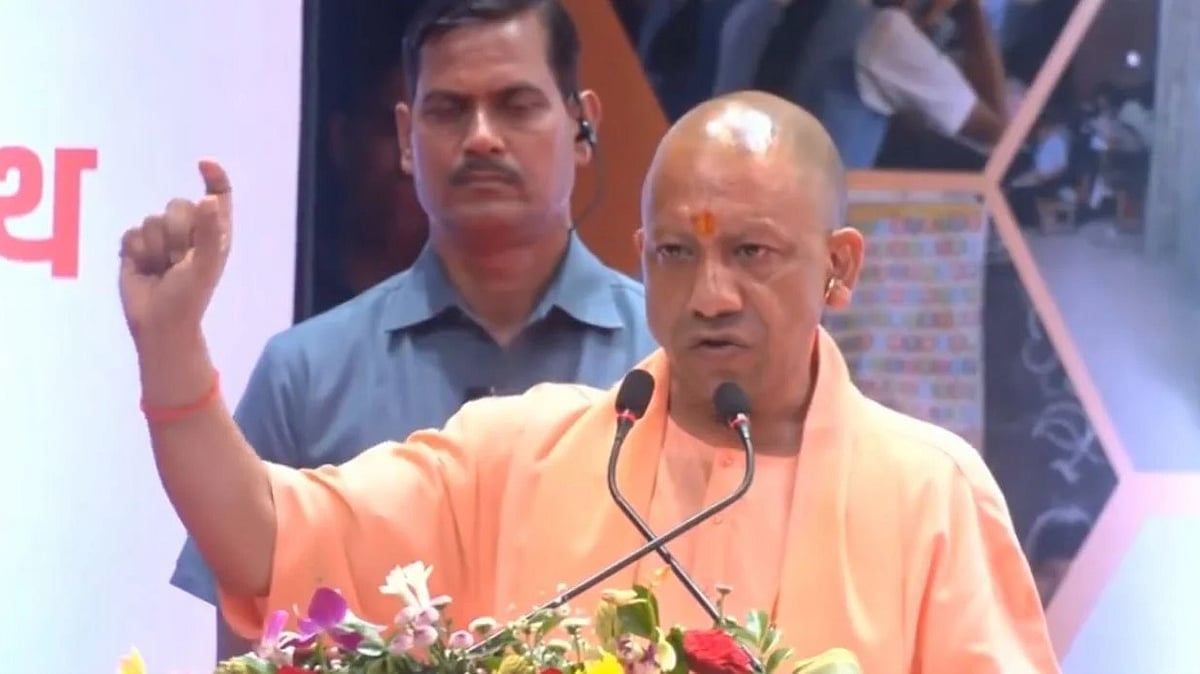
Uttar Pradesh Chief Minister Yogi Adityanath | File Pic
With about five months to go for the Uttar Pradesh Assembly elections, the BJP faces a more complex challenge than a routine contest between the ruling party and the Opposition. Chief Minister Yogi Adityanath remains the party's principal face in the state and has built a political identity that extends beyond its traditional support base. The 2027 election will test whether his personal appeal and the government's record can hold together a social coalition showing signs of strain.
The warning came in the 2024 Lok Sabha election. The BJP's tally in Uttar Pradesh fell to 33 seats, while the Samajwadi Party emerged as the state's largest party with 37 seats. (Election Commission of India) The result did not amount to a complete rejection of the BJP, but it showed that the social arithmetic behind its victories in 2017 and 2022 could be challenged.
Governance And Employment
The BJP's strategy is to keep the election focused on governance, development, law and order, and welfare, rather than allow unemployment, recruitment controversies, and caste representation to dominate the campaign. The government has stepped up its emphasis on appointments and employment schemes, while programmes aimed at women and young people are likely to remain important.
The launch of the Uttar Pradesh Corporation for Outsourcing Services, or UPCOS, is part of this effort. The government says the framework will benefit around 3.5 lakh outsourced employees and their families. (The Indian Express) Yogi has also announced that one lakh young people will receive appointment letters within six months. (Hindustan Times)
But government statistics do not necessarily translate into political satisfaction. For young voters, the problem is not simply the absence of jobs; there is also underemployment, with educated youth often unable to find work matching their qualifications. Recruitment delays, examination irregularities, and allegations of paper leaks have added to the frustration.
For someone waiting for a government job, the number of appointments announced may matter less than whether examinations are held on time, results are declared promptly, and recruitment is seen as fair. Social media has made such grievances politically significant, allowing individual recruitment disputes to become symbols of wider dissatisfaction.
BJP's Social Coalition
This creates a perception challenge for the BJP. Announcing new schemes can demonstrate intent, but it cannot automatically erase accumulated frustration. Yet, youth anger alone is unlikely to decide the election. The bigger challenge remains the BJP's social coalition.
The party's victories in 2017 and 2022 were built around a combination of upper castes, non-Yadav OBCs, and non-Jatav Dalits. The SP is now attempting to disrupt that equation through its PDA strategy, bringing backward classes, Dalits, and minorities into a broader political coalition.
Akhilesh Yadav's challenge is to convert the PDA formula from an electoral slogan into a durable constituency. The 2024 Lok Sabha results suggest that the strategy can weaken the BJP in some areas, but Assembly elections are more localised and caste alliances vary considerably across constituencies.
For the BJP, however, even a modest shift can matter in a close contest. The party must retain its upper-caste support while preventing non-Yadav OBC and non-Jatav Dalit voters from moving towards the opposition.
Representation Debate
There is also unease among sections of the upper-caste electorate, including periodic tensions involving Thakur and Brahmin groups and their political representatives. This makes the BJP's task one of managing competing social expectations rather than simply countering the SP's caste strategy.
The debate over representation adds another dimension. The demand for a caste census and Rahul Gandhi's "jitni abaadi, utna haq" slogan have pushed social representation to the centre of Opposition politics. Questions over reserved vacancies can resonate with the OBC and Dalit voters, while sections of upper-caste youth remain concerned about reservation and merit.
The BJP's response cannot, therefore, be limited to caste arithmetic. Its broader political formula of Hindutva, development, welfare, and law and order will have to accommodate these competing concerns.
Yogi's Personal Appeal
This is where Yogi's personal appeal becomes important.
The Chief Minister has built a distinct image around law and order, action against crime, and a strong administrative style. His appeal is not identical to that of the BJP organisation and is not entirely dependent on Prime Minister Narendra Modi's popularity.
The BJP is likely to make this personal connect central to its campaign. If the election becomes a choice between Yogi's record and the Opposition's criticism, the ruling party believes it has an advantage. If it turns into a referendum on jobs, recruitment, representation, and opportunity, the contest becomes more difficult.
Women voters could provide an important counterweight. Welfare schemes and targeted programmes have helped the BJP build support among women that does not always follow traditional caste lines. BJP leaders believe Modi and Yogi have strong appeal among women, making this constituency crucial to the party's effort to broaden its electoral base.
Opposition Unity And Contest
The Opposition's unity will also shape the contest.
The SP and the Congress benefited from their alliance in the 2024 Lok Sabha election, but an Assembly election across 403 constituencies presents different challenges. Seat-sharing, candidate selection, and competing organisational ambitions can create friction.
If the two parties reach a workable arrangement and ensure transfer of votes, the BJP could face a stronger challenge. If they quarrel over seats or fail to coordinate at the constituency level, Opposition fragmentation could benefit the ruling party.
The BJP still has substantial advantages: an incumbent Chief Minister with a strong political identity, an established organisation, the Modi-Yogi combination, a law-and-order narrative and an extensive welfare network.
But the 2024 Lok Sabha election showed that these advantages do not make the BJP invulnerable in Uttar Pradesh.
For the BJP, therefore, the 2027 battle is not simply about defending the government; it is about preserving the social coalition that brought it to power and ensuring that Yogi's personal appeal remains stronger than the multiple grievances gathering around the election.
The writer is a senior journalist. Views expressed are personal.
RECENT STORIES
-
-
-
-
-