Women’s Reservation Bill Failure Was Political Theatre, Not Real Reform
The opinion piece argues the Women’s Reservation Bill was more political theatre than sincere reform, claiming both government and Opposition used the issue for electoral messaging while key implementation concerns remained unresolved.

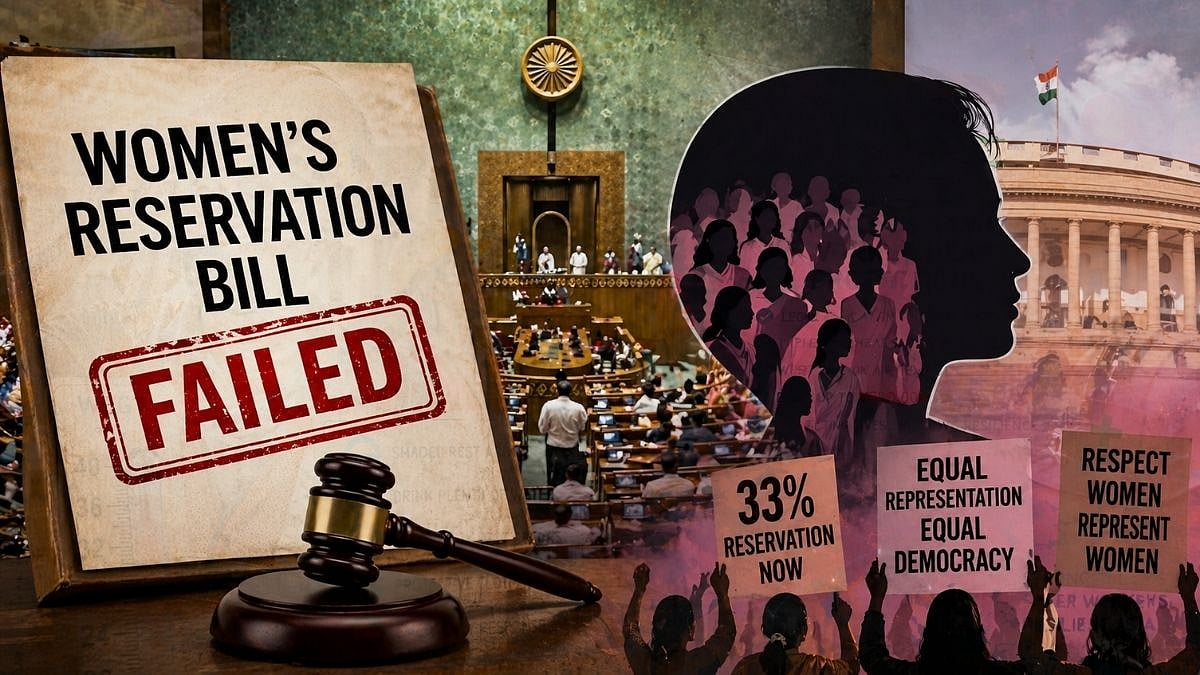
Debate grows over political intent behind the failed Women’s Reservation Bill | AI Generated Representational Image
So the much-touted Women’s Reservation Bill failed to clear the parliamentary hurdle yet again. It truly became the story of Bikram and Betal in contemporary Indian politics. The Bill (Betal) goes back to hang upside down. It will be fetched before it suits the rulers (Bikram) the most. That may happen a year or so before the 2029 general elections.
That the Bill would fail to get the nod of two-thirds of lawmakers was written large even before the special session of Parliament was summoned. At the end of it, both sides were happy. It was a win-win situation for all. The Opposition was pleased that it had managed to defeat the government. The treasury benches were happy since they managed to score some brownie points and got a stick to beat the Opposition in public.
For the Modi government, it was like Heads I Win, Tails You Lose kind of a situation. It was all about getting the bragging rights. The attempt to get it passed lacked the necessary intent required. That the government lacked the required numbers to get it passed was no secret. There was also no unanimity over the nitty-gritty associated with giving women one-third reservation in Parliament and state assemblies. While the Bill was envisaged long, long ago, the roadmap to implement it was never worked out.
The Congress-led opposition, when they were in power before 2014 for a decade, faced stiff opposition from their regional allies to the idea of setting aside one-third of existing seats in the Lok Sabha. That works out to 180 out of 543 seats. The contempt for women by the likes of the late Mulayam Singh Yadav and Lalu Prasad Yadav is well-documented and needs no explanation. The same forces were now talking about implementing the reservation from the existing seats rather than adding 307 seats to the Lok Sabha strength. They knew it would never be tolerated by men who think the world belongs to them. It was hilarious to note that some of these parties talked about giving 33 per cent of their tickets to women. Women candidates are often given tickets from seats where they have little or no chance of winning. It is a common trend that has been in vogue for generations. One has also seen the failure of the experiment of reserving elected village head posts for women in some states. Scenarios like the one shown in OTT serial Panchayat have been played out many times, where women become the titular head. It was best enacted in Bihar, where Rabri Devi was officially the chief minister, but the real power was wielded by Lalu Prasad from behind bars or while out on bail.
All said and done, some of the concerns of the Opposition were genuine. Implementation of the Bill had to go through the delimitation exercise. This is to redraw the boundaries of all the Lok Sabha seats afresh to increase the number of seats from the existing 543 to 850. Delimitation has often been done in the past to benefit the ruling dispensation of the country. It was in full display during a similar exercise carried out in 2023 in Assam, with allegations of gerrymandering tactics adopted to liberate some seats from Muslim control. There is no reason to base the delimitation on the outdated 2011 census when the groundwork for the 2027 enumeration has started. This is where the real intention of the Modi government, trying to rush through the Bill’s passage, made the Opposition see red.
It appears that the plan was to raise this issue just before crucial elections in some of the opposition-ruled states, where the BJP has still been struggling to get a proper foothold. The BJP-ally Nitish Kumar, the former Bihar chief minister, had long ago demonstrated how one could win elections by playing with the sentiments of women. It was just another attempt at the extension of that Bihar experiment. Winning or defeat was made inconsequential. The apparent plan was to do some lip service and show themselves as really concerned about women's empowerment. The fact remains that the BJP has never had a woman president in its 46 years of existence and has just one woman chief minister at present in Delhi, which is not a full-fledged state.
The heavens would not have fallen if the BJP had waited for the 2027 census to get over and do all reservations afresh, based on updated demographic data. The unusual haste in the manner it was brought up, without taking the Opposition into confidence, leaves some serious questions about the Modi government’s real intentions.
The lip service was rendered with all pomp and glory. The moot point remains if this exercise could charm women voters of West Bengal and portray its woman Chief Minister, Mamata Banerjee, as being anti-women. The top BJP leaders harped loudly on Banerjee’s Trinamool Congress’s opposition to the Women’s Reservation Bill in their rallies in West Bengal. One will have to wait till May 4, when the results of all five states where elections were held will be announced, to know if the BJP’s ploy of enacting the Bikram and Betal episode in elections has succeeded.
Ajay Jha is a senior journalist, author and political commentator.
RECENT STORIES
-
-
-
-
-