Why Women Playwrights Remain Underrepresented Despite Progress In Literature And Theatre
Despite progress in literature, women remain underrepresented in theatre writing. Experts cite historical exclusion, male-dominated institutions and limited opportunities as key barriers. Many women face resistance when addressing gender issues, while their work often struggles for mainstream production, keeping the gender gap in playwriting largely intact.

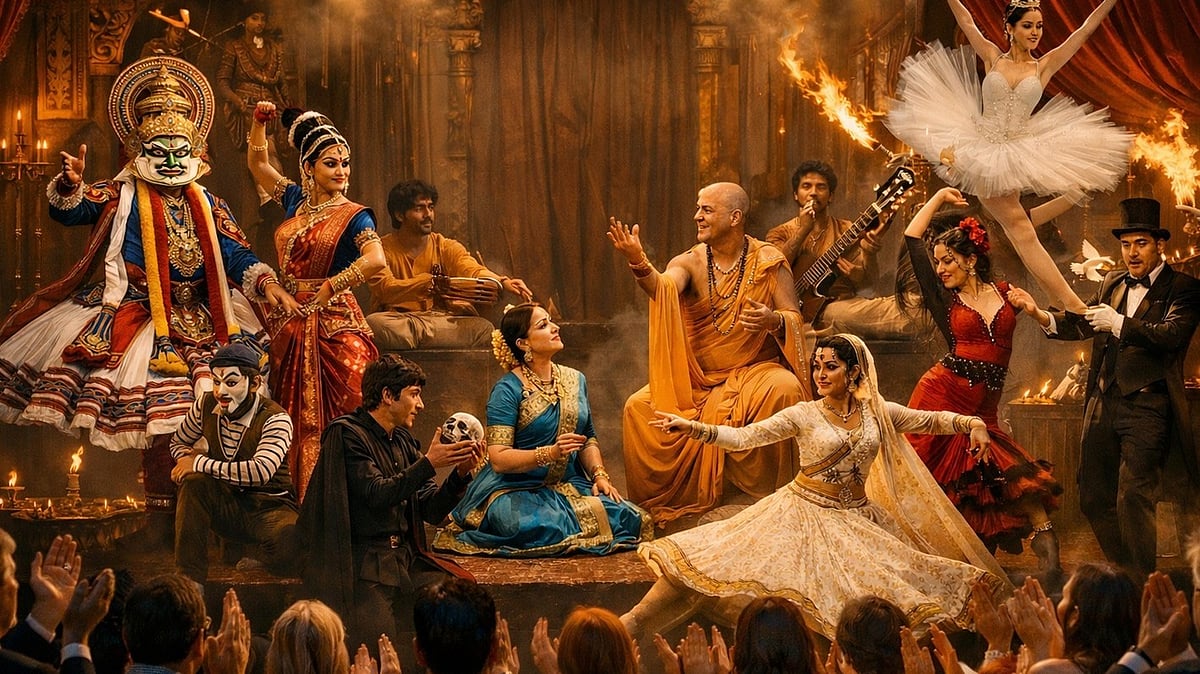
World Theatre Day | AI
It is coming to the end of Women’s Month, and March 27 is celebrated as World Theatre Day. It is perhaps worth pondering why there are still so few female playwrights when, in other forms of creative writing, women are making major inroads.
In India, there have been social and cultural biases against women in show business. Till the mid-20th century, women were not permitted to act on stage; men performed female roles. And until education for women became more widespread, women were kept away from the literary world.
A search for the reasons behind the gender gap in writing even today reveals filtering processes that exclude women. Access to language was a major hurdle, since formal education in classical languages (like Latin or Sanskrit) was historically restricted to men. As high-art drama was written in these languages, women were systemically excluded from the canon.
Women were often relegated to closet dramas—plays written to be read at home rather than performed in public. Writing for a public audience was seen as a breach of modesty, leading many women to write anonymously or not at all.
The plays taught in schools and universities are overwhelmingly by men (Shakespeare, Beckett, Brecht, Ibsen, Miller). This creates the conditioning that only men’s voices have value and indirectly discourages women from attempting to write for the stage.
Because men held positions of power (producers, directors, and critics), the standard for a “good play” was often based on a male perspective. Work that focused on domesticity or female interiority was frequently dismissed as inconsequential.
Work by women is seldom produced on mainstream stages. Smaller, experimental, and fringe groups are where plays written by women are more often found.
In India, the playwright is also often the director of her work and, like Nadira Zaheer Babbar—a prolific playwright and theatre-maker—may also carry the additional responsibility of running a group. She has written 18 plays so far (recently published), spurred by the lack of original scripts.
Purva Naresh—playwright, director, producer (also a musician, dancer, and occasional actor)—has written a slew of successful plays such as Aaj Rang Hai, Ladies Sangeet, and Bandish. She says:
“Women constantly feel oppressed by the system. They are marginalized in a patriarchy, so when they start writing, they take up subjects rooted in that experience. They bring in concepts that are anti-patriarchy and immediately face resistance because the system itself is deeply patriarchal.
Sometimes this pushback energizes them, but for most, it exhausts, intimidates, or silences them. Very few persist. Another issue is that when women begin writing, their craft may still be developing, even though their urge to express marginalization is strong. Their subjects can become overly angst-ridden or agenda-driven, and are often dismissed—what in Hindi is called kanghi-choti writing.”
The financial stakes in theatre are much lower than in cinema, but even here, women playwrights struggle to break through.
“What are your issues, what is your world, what is your lived reality, what are your fantasies—everything originates from your journey,” says Purva.
“The challenge is to not be reduced to a woman who writes only about women’s issues, while still writing about them without being myopic. That is a fine balance and an unwanted responsibility.
We don’t have the male gaze, but we are shaped by it. We must ensure our response is not short-sighted. Experience must be understood, analysed, deconstructed, intellectualised, and then re-presented—not as a verdict, but as a question that opens dialogue.
The woman playwright operates in that space—her work begins as reaction, but must evolve beyond it.”
Despite these difficulties, some women have crafted trailblazing plays—not enough to transform the landscape entirely, but enough to be counted. From Hrotsvitha of Gandersheim (935–1002), Aphra Behn (1640–1689), Lorraine Hansberry (1930–1965), to Caryl Churchill, Lynn Nottage, Yasmina Reza, Paula Vogel, Suzan-Lori Parks, and Yaël Farber in contemporary times.
In India, the list includes Swarnakumari Devi (1855–1932), Cornelia Sorabji (1866–1954), Bharati Sarabhai (1912–1986), Rasheed Jahan (1905–1952), Mahasweta Devi, Dina Mehta, Usha Ganguli, Sai Paranjpye, Nadira Zaheer Babbar, Manjula Padmanabhan, Shanta Gokhale, Poile Sengupta, Anupama Chandrasekhar, Purva Naresh, Divya Jagdale, Faezeh Jalali, Trisha Patel, Manaswini Lata Ravindra, Irawati Karnik, Manjima Chatterjee, Annie Zaidi, and Veena Bakshi.
They have all worked towards representing women’s perspectives on stage, alongside progressive male playwrights.
It is not a race, but women’s stories—told in their own voices—will help level the playing field.
RECENT STORIES
-
-
-
-
-