Why The INDIA Bloc Matters Now More Than Ever Before
The INDIA bloc’s recent meeting reiterated Opposition unity against the BJP, but attendance gaps and internal rifts highlight ongoing instability. The DMK’s exit, state-level rivalries, leadership disputes, and lack of a shared national vision continue to weaken cohesion. Despite BJP’s strong electoral dominance, the bloc remains divided between tactical alliances and long-term political unity.

Why The INDIA Bloc Matters Now More Than Ever Before | X
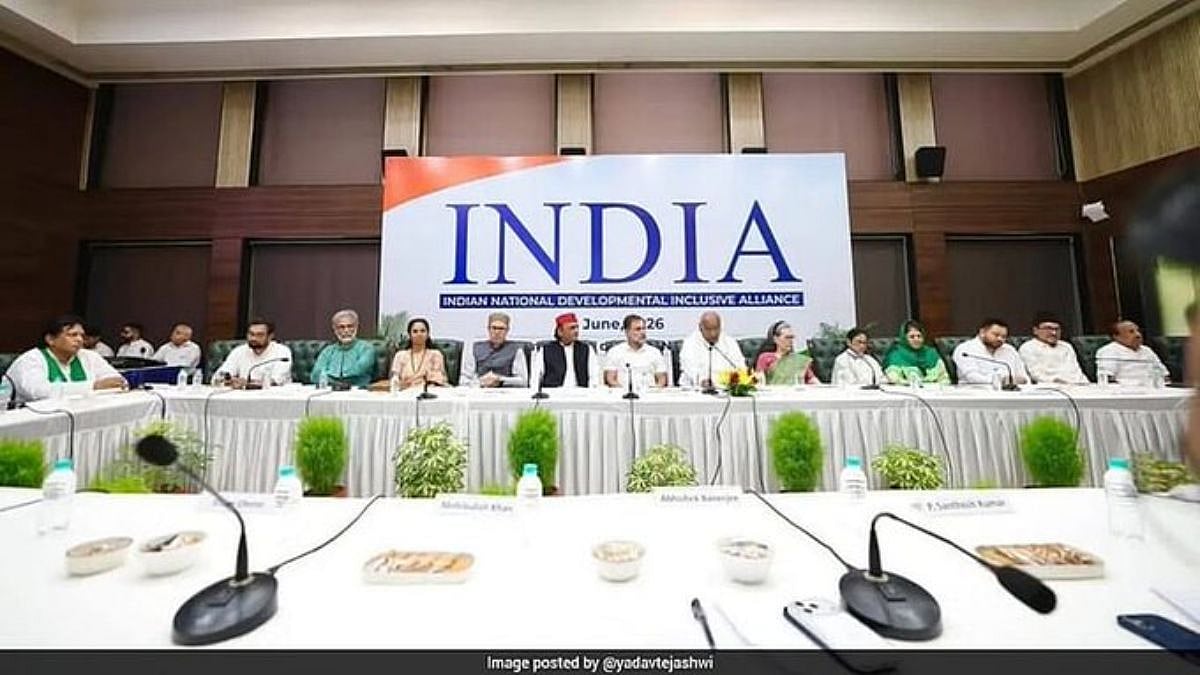
The INDIA bloc’s first meeting on June 8 predictably ended with a familiar message of Opposition unity. Of the 28 parties that had come together to challenge the BJP three years ago, only 23 attended the gathering in Delhi last week. The bloc insisted that some allies which chose to stay away had not formally abandoned the alliance. Projected as a broad national platform, rather than a conventional coalition, it was the first serious attempt to bring together opposition parties that often disagreed with one another but shared one goal: to challenge the BJP in the 2024 Lok Sabha election.
Now, the alliance leaders have once again stressed presenting a united front against the BJP in the 2029 general election. Claiming that India’s political diversity is their strength, the question arises whether the INDIA bloc is really united, considering the biggest rupture to its unity has come from the DMK, considered the bloc’s strongest southern pillar. It is early days to assess the impact of the DMK’s decision to leave the alliance—triggered by the Congress party’s decision to end its alliance with the Dravidian party last month—on Opposition unity.
There are rumours that the BJP is trying to woo the Dravidian party into the NDA camp to shore up the alliance’s numbers in both houses of parliament, as the saffron party’s eyes are set on passing the Delimitation Bill, which it has linked to women’s reservation. There is also speculation whether the DMK will float the idea of a third front. It is certainly going to be a difficult call for the DMK, despite being miffed with the Congress, to join the NDA. But it raises questions on how the DMK will act in parliament. The third front idea will also impact Opposition unity.
Since its inception, the INDIA bloc has been a divided house, struggling to maintain Opposition unity because of deep-rooted structural contradictions impacting long-term cohesion. Still, despite palpable strains, the idea of Opposition unity has held because practically every constituent of the bloc needs it for its own survival. The obvious reason being the BJP’s increasing political dominance, despite a major setback in the 2024 general election in which the ruling party had failed to get an outright majority in parliament. The INDIA bloc’s troubles are rarely ideological: most of the strains stem from state-level turf wars, contested leadership, and national-level ambitions.
Opposition parties may agree to fight the BJP nationally, but they often compete fiercely against one another in states. This makes unity difficult to sustain and differences and stresses difficult to mask. Also, most of the regional parties are often hostile towards the Congress because they are the grand old party’s rivals on their respective home turfs. A simple increase in vote share of the Congress makes them feel insecure. The fault lines and built-in contradiction within the bloc and the absence of a broader political partnership are the reasons why the Opposition struggles to mount a challenge to the BJP. Perpetual uncertainty over the alliance’s long-term cohesion is a result of the grouping’s failure to clearly define its role—whether it is only an arrangement to fight the BJP in general elections or a broader political partnership to ideologically oppose the BJP with a shared programme.
This uncertainty—united against the BJP in Delhi, but rivals in states—has often fuelled disputes over strategy and seat-sharing. Another uncertainty is the absence of a leader and a welldefined leadership structure, unlike the NDA, which revolves around a powerful leader and proper consultative coalition structure to manage grievances, differences, and disputes besides reducing friction within the alliance. Political coalitions need a dominant party to act as a force to drive the engine. Lack of consensus in the INDIA grouping over who should play that role has been a major difficulty in leading a united fight against the dominant adversary, which is breaking new political ground. The NDA’s stunning Bihar victory last year and the BJP’s sweep in Bengal last month, according to political observers, indicate the Opposition’s limitations in fighting the BJP as an “integrated coalition” instead of only as an “integrated aggregation”.
In their view, beyond opposing the BJP, the Opposition parties have failed to explain what unites them, which reflects the absence of a common national vision. Like it or not, the INDIA bloc was born out of a common fear that the already weak Opposition would deplete further unless it united to fight against the BJP for its very survival. Surprisingly, two years after the united Opposition succeeded in depriving the BJP of a full majority in Lok Sabha, the INDIA bloc has woken up to the same reality of an existential crisis that they stared at in 2023 when the BJP was on a winning spree in state after state.
The irony is that the BJP/NDA’s stunning show in assembly elections in Haryana, Maharashtra, and Bihar did not ring the alarm bells in the Opposition camp. It took the fall of Mamata Banerjee’s seemingly impenetrable Bengal bastion and the subsequent implosion of her party for the Opposition to realise the extent of the BJP’s resurgence since the 2024 general election. Not only is the BJP on top of the electoral game once again, but the scale of its victory in Bengal and the collapse of the TMC have finally changed the political mood in the Opposition camp. They are now speaking of the criticality of remaining united to face the BJP.
Also, the saffron party’s resurgence has forced the bloc to confront its fragility, talk unity, and accept the Congress party’s leadership to lead the fight against the Opposition’s common adversary. It is easy to call the INDIA bloc a failed project, though its survival is profoundly critical now more than ever before. The central question before the Opposition bloc is whether its constituents can manage their differences in pursuit of a common political goal. The socioeconomic and geopolitical environment buffeting the government and the cracks in its narrative about development, growth, fiscal management, job creation, and economic policies present an opportunity for the Opposition to change the narrative in its favour. Whether they come to grips of issues and chart a roadmap for the future remains to be seen.
RECENT STORIES
-
-
-
-
-