Why Hearing ‘Waterman’ Rajendra Singh Matters As India Faces Growing Ecological Crisis And Urban Environmental Challenges
Rajendra Singh’s message underscores the urgency of ecological literacy and collective action as India faces rising environmental challenges. His work in river revival and community mobilisation highlights the need to reconnect people with nature beyond economic priorities.

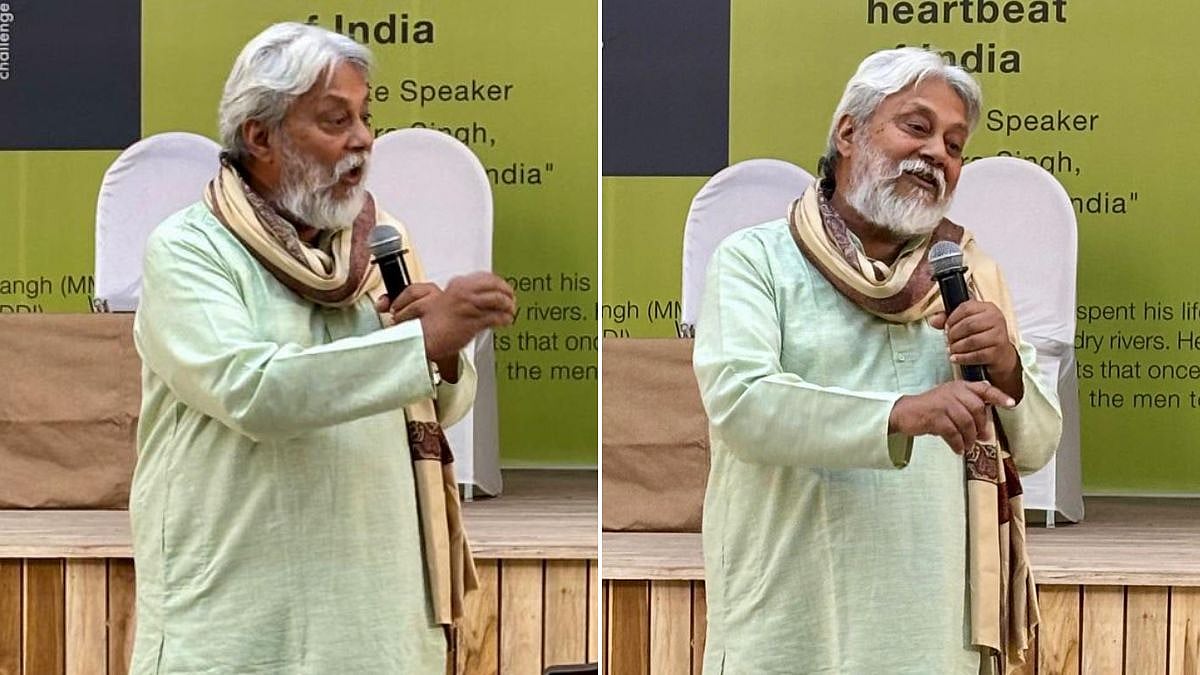
Rajendra Singh highlights urgent need for ecological awareness and people-led action amid rising environmental threats | File Photo
“There are challenges, and the resolutions to these challenges can now come neither from the courts of India nor from the government of India. They don’t have solutions to these challenges because their priority is economic infrastructure.
And when this happens, ecology doesn’t remain a part of it. There’s a disconnect of ecology with life. The disconnection that exists between this government and ecology has resulted in we, the people, becoming helpless, worthless, and ill. If we want to set this right, then once again, the Constitution of India is the seed of hope, a ray of hope.
With that, we will have to tell officers to fulfil their commitment to the Constitution, but they will not do it because we tell them to. So, what’s the way out? We will have to raise a movement, undertake ecological-environmental-climate literacy. People will have to come out.”
These words from Dr Rajendra Singh, delivered in chaste Hindi with an earthy cadence, reverberated around the hall last Saturday evening. Singh, often called the ‘Waterman of India’, could just as well be the Mountainman of India or even a reformer of dacoit lands.
He was being his usual self, drawing from his 50-plus years of experience working in the arid regions of Rajasthan, Madhya Pradesh, and elsewhere to revive rivers, protect the Aravallis, and more. He is compelling and gentle at once—both in argument and delivery.
His passion to act and to share remains unalloyed by age, and his willingness to travel and take on new challenges remains undimmed despite ecologically insensitive governments and courts.
From doctor to river revivalist
Singh’s life story is riveting. Trained as an Ayurvedic doctor, he worked in a government job for the first four years of his remarkable career until an old man, Mangu kaka, told him that his dawai and padhai (medicine and education) were of no use to the earth in the villages of Alwar when the Arvari river had been dry for years. That moment set Singh on a journey to understand and revive rivers in Rajasthan.
Reviving rivers through community action
The Arvari, originating in the Aravalli hills and meandering for less than 100 kilometres, was brought back to life with community participation after remaining dry for over five decades. Singh has not stopped since. His work has led to the revival of about 23 rivers—small and large—including in the Chambal badlands once known for dacoits.
This community-led effort has had a cascading positive impact on at least 17,000–18,000 villages across central India. His petition to the Supreme Court against mining in the Sariska Tiger Reserve resulted in a landmark May 1992 judgment that shut down mining there.
Building a people’s movement
This network of communities, rooted in a symbiotic relationship with land and water, has laid the framework for a people’s movement. The reconnection of people with nature enabled and strengthened this movement as they fought local battles across the Aravallis.
This was visible when hundreds mobilised following the Supreme Court’s November 2025 judgment redefining “hills” in a way that opened vast areas to mining, a ruling later held in abeyance. Singh’s work through Tarun Bharat Sangh has consistently relied on the power and wisdom of women to energise communities and sustain rivers.
Mumbai’s fragmented ecological struggles
The importance of this reconnection was evident in Mumbai, where multiple groups continue to fight for ecological causes—from protecting Sanjay Gandhi National Park and Aarey to opposing mangrove destruction, safeguarding trees, preserving the Mahalaxmi Racecourse, and resisting construction over wetlands and salt pans.
Yet these battles remain scattered, isolated in silos, even as the state government and the Brihanmumbai Municipal Corporation simultaneously push projects impacting natural areas. Activists often ask why a stronger, unified people’s movement has not emerged.
The need for ecological literacy
The answers lie in Singh’s words: governments and courts cannot be solely relied upon. People must come together, but that requires a deeper connection with nature—knowing their environment, recognising biodiversity, and understanding that life depends not only on economic growth but also on natural wealth.
An emphasis on economic infrastructure often sidelines ecology. Ecological literacy, as Singh stresses, is the need of the hour. His message offered hope and strength to activists who often find themselves walking lonely paths.
Smruti Koppikar, senior journalist and urban chronicler, writes extensively on cities, development, gender, and the media. She is the Founder Editor of the award-winning online journal ‘Question of Cities’ and won the Laadli Media Award 2024 for her writing in this column.
RECENT STORIES
-
-
-
-
-