What Makes Or Breaks A Space Mission? The $23 Million Artemis II Toilet That Malfunctioned And Became A Plumbing Nightmare
From makeshift Apollo-era waste bags to advanced ISS recycling systems, managing human waste in space remains a challenge. The Artemis II mission saw its $23 million toilet malfunction early, forcing astronauts to improvise. The episode highlights how even modern space missions struggle with basic sanitation in zero gravity.

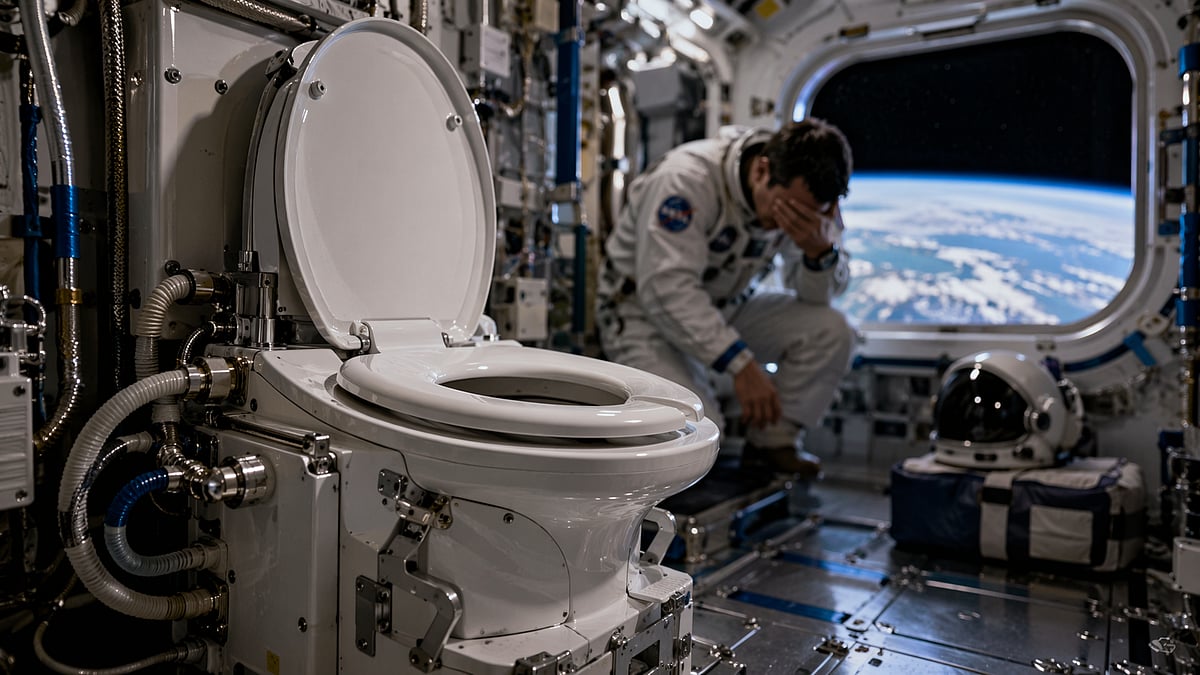
What makes or breaks a trip is not the memories but the toilet. A good toilet is a necessity, not a luxury. I’m no Dave Barry, but as an astrophysicist, it’s my duty to educate the general public on the questions they’re too afraid to ask but are dying to know—space toilets. | AI
What makes or breaks a trip is not the memories but the toilet. A good toilet is a necessity, not a luxury. I’m no Dave Barry, but as an astrophysicist, it’s my duty to educate the general public on the questions they’re too afraid to ask but are dying to know—space toilets.
The one onboard Artemis II cost $23 million to make, and it didn’t work. It may be hard to believe this malfunctioning water closet still holds the title of being the most luxurious in the brief history of mankind’s venture into the final frontier.
It began with the Mercury-Redstone 3 mission on May 5, 1961, part of Project Mercury (1958–1963), the United States’ first foray into orbit. It was a 15-minute suborbital flight, eliminating the need for onboard toilets. However, as the launch was delayed, astronaut Alan Shepard was confined to the Freedom 7 shuttle for three hours. When his request to use the facilities was denied, he was given the go-ahead to do his business in the suit and hopefully not get electrocuted. Thankfully he survived, but this incident was a precursor to figuring out how astronauts could be made more comfortable in space.
If you’re already experiencing space sickness, please desist from reading further.
The primitive solution to this was the Apollo Fecal Containment Device—a plastic bag attached to the spacesuit’s rear end, with a finger tube halfway down for astronauts to mix the contents with a germicidal liquid. It wasn’t as watertight as hoped, considering the history of these substances breaching containment. It is, however, still the unfortunate last resort. According to late astronaut Walt Cunningham of the Apollo 7 mission, the entire process took 45 minutes. His colleague Wally Schirra was the first to name the ‘Urion’ constellation, a shimmering shower of yellow crystals observed during a routine urine dump in space. It was later described as “the most beautiful sight in orbit ... is a urine dump at sunset” by Apollo 9 astronaut Rusty Schweickart.
In a spaceship, where it’s a zero-gravity zone, everything is weightless. You can’t flush anything down; instead, ‘solid’ waste has to be redirected via airflow to vacuum-sealed bags, which in turn are stored in canisters that are released upon re-entry, burning up all evidence. In the ISS, thanks to the fancy Universal Waste Management System (UWMS), ‘liquid’ waste is recycled for use as drinking water via an advanced filtration system.
The Artemis II (a camper compared to the mansion that is the ISS) is only on a 10-day sojourn, making the filtration system a moot point. A smaller version of the ISS’s UWMS, this tiny commode is built onto the floor of the Orion cabin, equipped with handrails and foot guards to ensure that even if you don’t quite know which way is up, your business stays down. It’s lined with chrome-yellow foam taped over insulation to ensure whatever happens in the bathroom stays in the bathroom. It’s also very loud, so astronauts need hearing protection. Solid waste would be collected, while liquid waste would be dumped out into the far reaches of space. It’s a state-of-the-art space-tech toilet.
Which proved to be problematic, signalled by a blinking fault light just hours after launching on April 1st, 2026—a sort of cruel April Fool’s joke gone wrong. The toilet fan was jammed, and there wasn’t enough water to get the pump working. Astronaut and Mission Specialist Christina Koch added space plumber to her designation when she fixed it, putting an end to a tense Day 1 and 2 of their 10-day journey.
It didn’t end there.
The next issue that popped up was on Day 3, when their waste management system was unable to dump liquid waste overboard, likely due to frozen urine in the vent line. The astronauts once again had to resort to alternative backup collection devices while they lined up the vent to the Sun in hopes of thawing out the clogged pipe. Between the full, concentrated power of the Sun and on-ground engineers heating the vent pipes, the system was back up and running.
And then came the smell. As Mission Specialist Jeremy Hansen informed Mission Control: “For me, it was some sort of burning odour, and then it was definitely in the hygiene bay. And when I opened up the hygiene bay, the rest of the crew could smell it pretty much immediately.”
Mission Control speculated that the source could be the brightly coloured insulation around the door, but the Artemis II crew was given the green signal to continue using the facilities despite the odour.
Back in the day, during Apollo 8, the crew had to share cabin space with globules of vomit and faeces when Commander Borman vomited twice while suffering from diarrhoea. Unfortunately for his co-passengers, catching or dodging liquid waste matter is a challenging endeavour in zero gravity.
One of space’s biggest mysteries continues to remain unsolved: Apollo 10’s UFT (Unidentified Floating Turd) incident. The responsible party is still at large. Each astronaut was passing the buck, according to available audio recordings, where they can be heard arguing that the consistency of the UFT didn’t match theirs. Lunar Module Pilot Gene Cernan ominously admitted: “I don’t know whose that is. I can neither claim it nor disclaim it.”
Meanwhile, on the lunar surface, Apollo 11’s Buzz Aldrin might not have been the first man to walk on the moon, but he’s certainly the only man to pee on the moon. The lunar module landed too softly, so the legs did not compress. The resultant jolt broke Aldrin’s urine collection device and redirected the flow, forcing him to slosh around in his boots during his moonwalk.
As of now, there are 96 bags of human faecal waste dumped on the moon’s surface from past Apollo missions. We might have been making small steps for mankind, but there’s still a huge leap to go for lunar plumbing services.
Rudraa Abirami Sudarshan is an astrophysicist, science communicator, and journalist.
RECENT STORIES
-
-
-
-
-