What Explains The Wave Of Defections, Mergers And Political Realignments?
Political defections and party realignments in India are increasingly driven by electoral pragmatism, leadership dynamics and proximity to power rather than ideology. It analyses developments involving the TMC, Shiv Sena, NCP, AAP and Congress to explain the changing nature of India's political landscape.

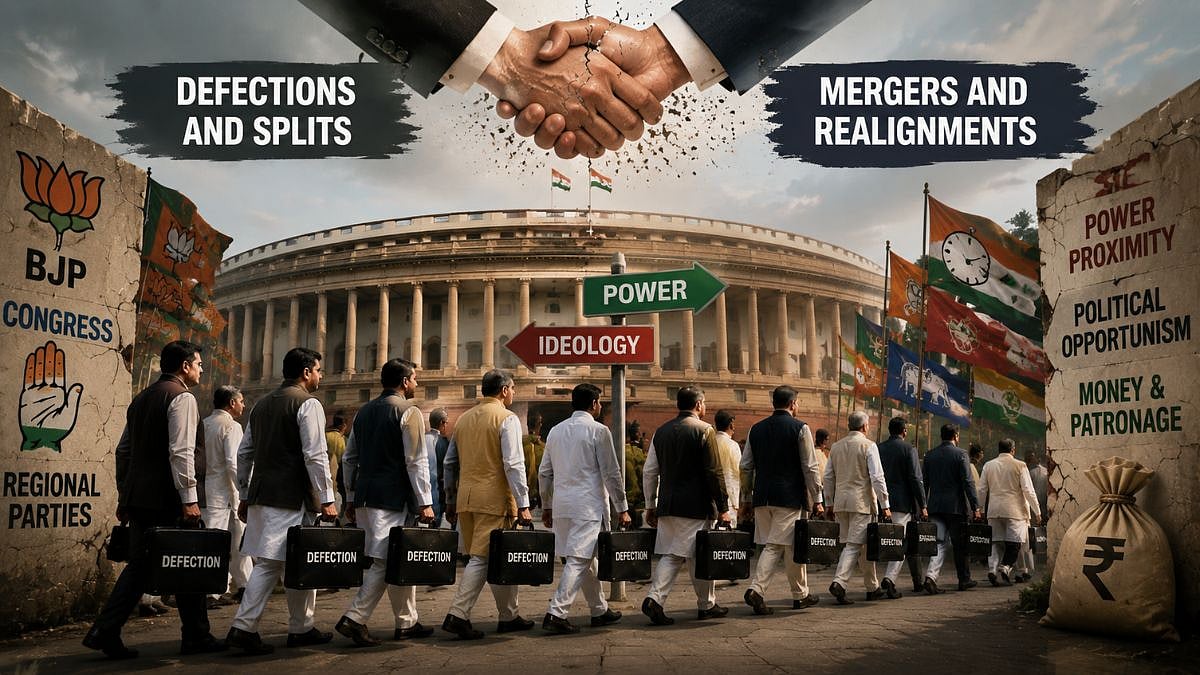
The commentary examines how ideology, leadership and electoral pragmatism are driving political realignments in India | AI Generated Representational Image
In Western democracies, political parties are primarily bound together by shared ideologies, mutual pursuit of political power, and institutional rules. Ideology, values, and cohesive sets of principles, like liberalism, conservatism, and social democracy, provide a moral and intellectual foundation for like-minded politicians and voters, while the pursuit of power incentivises disparate factions within a party to unify behind a single platform.
In India, on the other hand, the core forces unifying political parties include the constitutional framework, ideology and policy platforms, leadership and personality cults, caste, religion and community ties, pragmatic alliances, and financial and patronage networks. Together, these elements glue the otherwise diverse political landscape into recognised political parties.
Ideology And Political Practice
The differentiating factors between Western and Indian political parties are primarily their philosophical foundations and organisational dynamics. While parties in Western countries typically align along rigid socio-economic axes, such as Left versus Right, with a focus on individual rights, Indian political parties rely heavily on community-based identities, popular/populist leadership, and welfarism.
As ideologies are intertwined with social identity in India, political parties often blend cultural, community-based agendas with economic policies, making the Left versus Right classification less applicable. This makes ideology both a foundation for governance and a flexible tool for electoral mobilisation and alliances.
Political ideologies in India are complex, often blending universal concepts like socialism and secularism with localised concerns like caste identity, linguistic pride, and religious nationalism. Traditional doctrines exist, but the role of ideology has shifted significantly in recent years, as the gap between theory and practice has widened for reasons like pragmatism over purity and coalition compulsions. As a result, ideology has often taken a back seat to political opportunism.
Frequent defections, crossovers, splits, and mergers demonstrate that winning elections and accessing power often dictate alliances more than deep-seated ideological loyalties. While ideology has not lost its importance in contemporary Indian politics, it has rather fundamentally transformed and repackaged into new forms centred around cultural nationalism, pragmatic welfarism, and personality-driven governance.
Although traditional Left-wing economic and political ideologies have seen a major electoral decline in India, their core social justice platforms remain a reactive baseline for many political parties.
There are two reasons why politics feels non-ideological now: one, the rise of a strong, overarching leadership, often overshadowing institutional party manifestos; and, two, the frequent crossing of the floor by politicians and the formation of highly pragmatic coalitions.
Both have obscured clear ideological lines, leading many observers to cite power as the ultimate governing credo. In other words, ideology remains a vital mechanism for voter differentiation and party identity, but political opportunism and the pressures of electoral maths reshape how these beliefs are put into practice.
Rise Of Political Opportunism
So, what happens when the glue holding political parties together is not ideological commitment but the promise of proximity to power? Parties tend to splinter through a combination of electoral failure, ideological drift, internal fractures, and external pressure.
This is precisely what we are witnessing in the ongoing season of mass defections and splits. Some political analysts see it as a gradual and deeper structural shift from a multiparty to a two-party system, while others feel it is a result of a generational shift in regional parties—from regional satraps, who commanded respect, trust, and popularity through decades of grassroots work, to their successors, who are disconnected from the grassroots.
The sheer collapse of Mamata Banerjee's Trinamool Congress (TMC), as a result of the revolt by its legislative and parliamentary wings after a surprising defeat to the BJP in the recent West Bengal Assembly election, has been so stunningly swift that it's being seen as an unravelling of an organisation of patronage, personalised welfare, and muscle power rather than a party of ideology, principles, and integrity.
Legislators and MPs who had sworn loyalty to Mamata before the Assembly election went their separate ways within days of the TMC losing power in Bengal.
Carved out of the Congress in 1998 on the politics of anti-Left populism and Bengali cultural assertion, the TMC functioned more as a leader-centric party or an extension of Mamata's will for two decades.
Therefore, the TMC's defeat is being seen not as a defeat of an idea or an ideology but as the fading aura of a leader who failed to deliver victory for her party, despite a 40 per cent vote share.
It is too early to write off the firebrand leader and her party, but the revolt of her legislators and parliamentarians is a huge setback for Mamata, currently firefighting the accelerated desertions by her cadres and leaders.
Regional Parties Under Strain
In Maharashtra, the cause of the split in the Shiv Sena has been attributed to the generational shift in leadership: from the late Bal Thackeray, who founded the party on the back of a movement of Marathi pride and, later, Hindutva assertion, to his son Uddhav Thackeray, who was unable to match his father's commanding style of functioning and domineering control over the party.
Eknath Shinde, who led the rebellion, succeeded because he and others who followed him calculated that their alignment with the NDA dispensation offered better political prospects than just remaining loyal to a party that was diminishing politically, weakened largely by the BJP's expanding electoral footprint in Maharashtra.
Similarly, the split in the Nationalist Congress Party, caused by a revolt against Sharad Pawar's leadership by his nephew Ajit Pawar, played out in the same manner and political calculation. The rebellion in the Aam Aadmi Party, which was born out of the anti-corruption movement and was based on a governance-first model, has lost seven Rajya Sabha members to the BJP.
The reason: Arvind Kejriwal's fading personal brand built around welfare delivery and confrontationist politics. The list is quite long, starting with the Congress a decade ago, with many of its leaders walking across to the BJP for a better political future.
While the Congress, after a difficult phase of high attrition, has shown signs of stabilisation, regional parties, family enterprises, and personality-driven parties are breaking down because of their declining political influence and inability to deliver votes.
Changing Political Landscape
What's helping the ongoing defections and desertions is the BJP's emergence as a reliable platform for future electoral success and political security in the current political ecosystem.
In this phase of fear of investigative agencies, alleged financial inducements, and offers of political positions, the larger concern for democracy is declining ideological commitment, erosion of political morality, and misuse of the electoral mandate.
The writer is a senior independent Mumbai-based journalist. He tweets at @ali_chougule.
RECENT STORIES
-
-
-
-
-