Unfortunately, Manual Scavenging Ban Is In Name Only
Despite a legal ban, manual scavenging continues to claim lives across India due to poor enforcement and inadequate mechanisation. The Supreme Court has sought accountability from states, while activists are demanding stricter implementation of the law, timely compensation and modern sanitation systems.

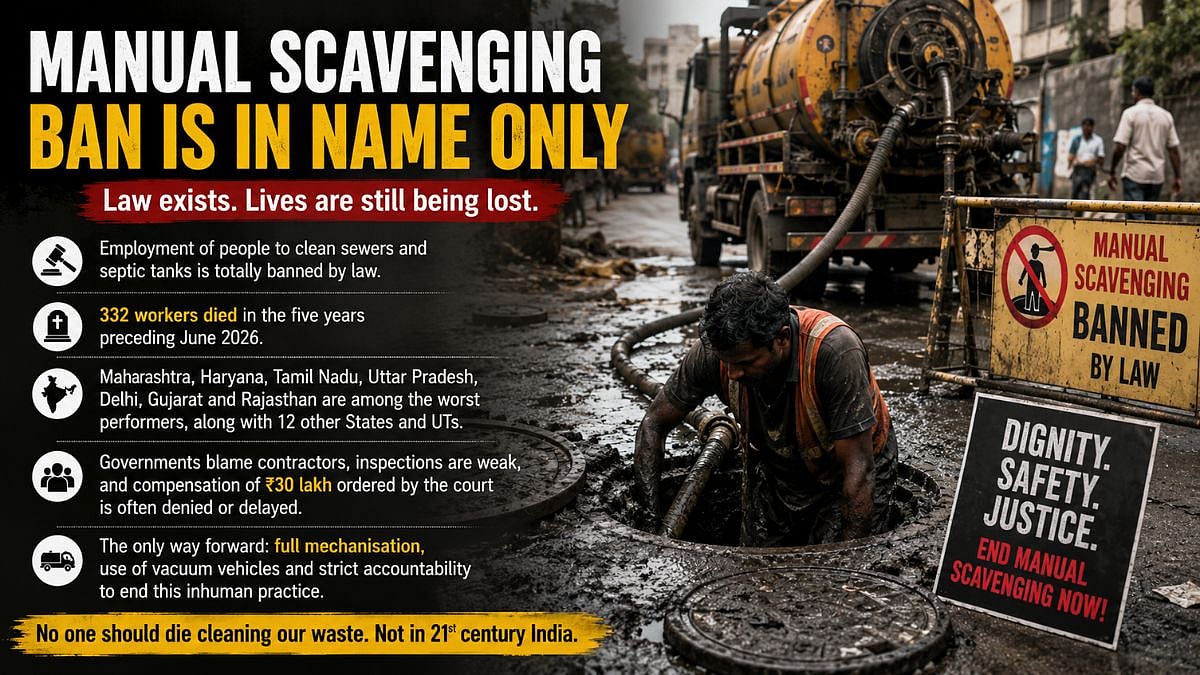
The continued deaths of sanitation workers have reignited calls for strict enforcement of the manual scavenging ban and full mechanisation | AI Generated Representational Image
Banned by law but still inflicting a significant toll of lives lost, manual scavenging in sewers and septic tanks remains a blot on governance, and the Supreme Court is making a renewed push to ensure accountability of state governments under the Prohibition of Employment as Manual Scavengers and their Rehabilitation Act, 2013.
The court’s move comes in the wake of 332 worker deaths in the five years preceding June 2026. Although the employment of people to remove human excrement from sewers and septic tanks is totally banned, many states have an abysmal record of implementation—Maharashtra, Haryana, Tamil Nadu, Uttar Pradesh, Delhi, Gujarat and Rajasthan are the most prominent in the hall of shame, joined by 12 other states and Union Territories where sanitation workers lost their lives.
The Supreme Court has ordered show-cause notices to be issued to the Chief Secretaries of the five worst-performing states for contempt, but if past experience is any guide, the issue risks getting lost in the thicket of other immediate headline-grabbing matters. Governments blame contractors for the continuation of the practice but do not see the need for aggressive inspections.
They are also shockingly indifferent to the court-ordered mandate to pay enhanced compensation of Rs 30 lakh to the families of each deceased worker. In fact, the Aurangabad Bench of the Bombay High Court recently ordered the payment of compensation by the state for two sanitation workers who died in a septic tank after it dragged its feet for five years on the ground that they were engaged by a private party.
The court, correctly, fixed responsibility for compensation on the state even when workers were engaged by a private party, but allowed for recovery of the funds from the violator.
Need For Political Commitment
Without sufficient political commitment, the Swachh Bharat Abhiyan has not moved to end the dark saga of workers dying in sewers and septic tanks, which contain poisonous gases and no oxygen. The abhiyan was started to overcome the national shame of open defecation and inadequate sanitation in a country that constantly showcases its galloping economic growth.
What prevents the formation of a fully equipped mechanised sanitation agency, on the lines of the State Disaster Management Authorities, that can offer cleaning services even in small towns and cities? The government owes an explanation to activist groups, such as the Safai Karmachari Andolan, which have disputed the official figure of worker deaths and called for a strict audit of the National Action for Mechanised Sanitation Ecosystem scheme and other sanitation issues through a parliamentary standing committee.
Sewer and septic tank deaths often claim Dalit lives, and the answer to the shameful national record is full mechanisation and the use of vacuum vehicles for cleaning. A continuing mandamus of the court could end manual cleaning, ensure compensation, and upgrade the operation using technological solutions.
RECENT STORIES
-
-
-
-
-