Two Cheers To The Economy, However Nothing For People
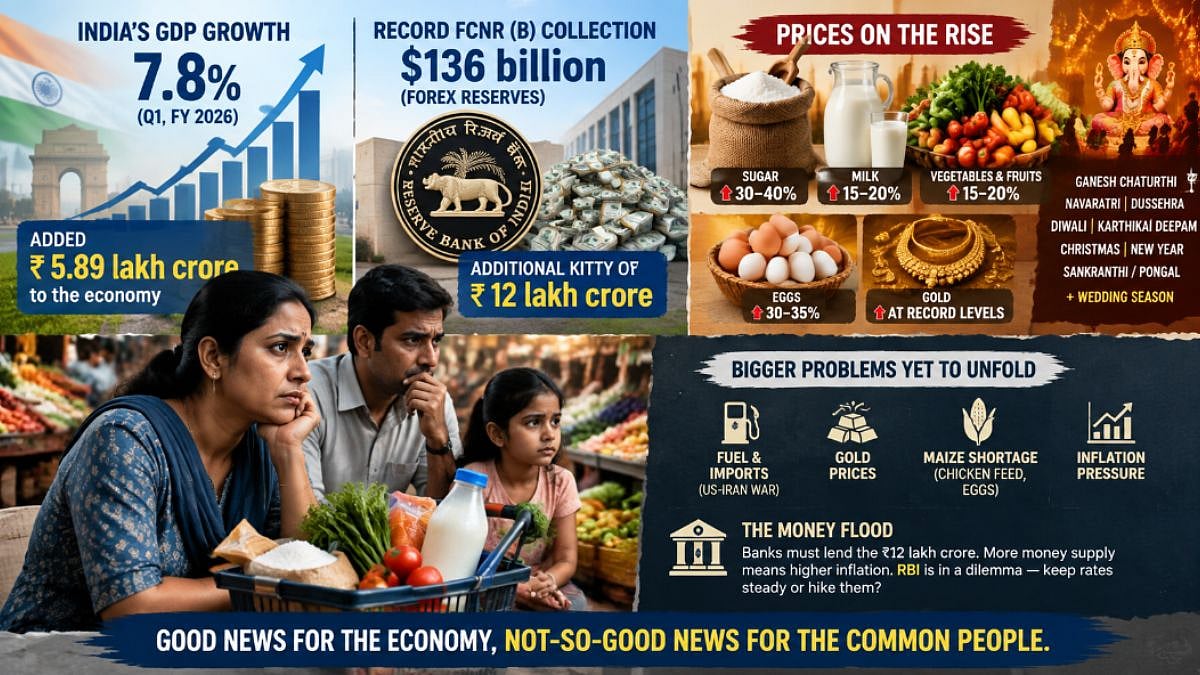
An opinion article argued that India’s 7.8% GDP growth and $136 billion FCNR(B) inflows may not immediately benefit households. It highlighted rising prices of sugar, milk, vegetables and other essentials ahead of the festive season. The article said increased money supply could add inflationary pressure, while consumers may have to wait for broader economic gains.

Two Cheers To The Economy, However Nothing For People | AI
Two pieces of macroeconomic news have brought cheer to the economy and financial markets. India clocked a surprisingly strong GDP growth of 7.8 per cent for the first quarter of the current fiscal year. The other good news for the economy is the record collection of 136 billion dollars through the RBI’s FCNR (B) scheme. The 7.8 per cent GDP growth means we added Rs 5.89 lakh crore to our economy during April-June, 2026. And the $137 billion collection means we have an additional kitty of Rs 12 lakh crore.
Time to celebrate. Yes, ruling party circles, analysts, policymakers, and financial experts have been celebrating these two achievements on social media. There’s also a slugfest going on the sidelines, which is largely political. This article is not about claims and counterclaims; it’s all about what these two macro developments mean for the common citizens of our country.
Nothing! Yes, nothing for now, and not for another 6 months to a year. We have to wait for the trickle down, and God knows when and how much. Financial markets may cheer, but the bitter truth is to be seen in the real markets of vegetables, fruits, groceries, milk, and items of daily consumption besides fuel, transport cost, etc.
Here’s why: First, let’s take a look at the day-to-day rise in the cost of living. Sugar stands out. Why is sugar important? It’s the most important ingredient in the kitchens of millions of families and sweet shops during festive seasons.
The festive season is about to kick off with Mumbai preparing to welcome Lord Ganesha on the 14th of this month. This is followed by Navaratri and Dussehra, Deepavali, and Karthikai Deepam, stretching till the end of November. After a couple of weeks’ break come Christmas, New Year, and Sankranthi/Pongal. This 4-month window is also the wedding season, which lasts till the end of March. During this period, consumption will be at its peak across all income classes.
Ethanol’s fuelling sugar price surge:
You may say this is a common seasonal factor. True, but there is a serious structural change in the farm-fuel-sugar economy. Sugar prices have already shot up by 30 to 40 per cent and are still at elevated levels. Retail sugar prices per kg: Rs 62 in Delhi, Rs 66 in Mumbai, Rs 63 in Chennai, Rs 61 in Bangalore, and Rs 68 in Ranchi. Ranchi has been the worst hit, according to reports.
India has imported sugar for the first time in at least over a decade. The 1 million metric tonne import was intended to augment supplies and bring down the price. But it hardly had any impact. Mills released old stock at higher prices and held back the new. Overall, the impact has helped prevent a further rise in prices. But that’s the story as of today. The festival season is yet to begin. We have to see how the government helps the consumers in the coming season.
Many analysts and anti-ethanol policy lobbyists have blamed the diversion to ethanol for the surge in sugar prices. This is partly true. The ethanol policy is not new. It has been around for many years. But it’s only this year that we are witnessing such a sharp surge in sugar prices. According to data provided by the government of India, the share of sugar diverted for ethanol production has declined from around 12% in 2022-23 to around 9% in 2025-26. Nearly three-fourths of the ethanol produced in the country now comes from grains, particularly maize, says the government. The current shortage, according to the government, is due to:
• Lower-than-expected domestic production
• Increased demand ahead of the festive season
• Weather-related damage to the sugarcane crop
• Tightening global sugar supplies and rising prices, and
• Speculation and hoarding by some sections of the industry
• Maize, chicken feed, and egg prices
As claimed by the government, maize is a big contributor to ethanol production, leading to a shortage of chicken feed and the surge in its prices. Egg prices, in turn, have gone up by 30-35 per cent, as they depend on imported corn. During festivities, it’s not about eggs but about sugar.
Bigger problems yet to unfold
The issue at hand for common citizens goes beyond sugar. Prices of milk, vegetables, and fruits have all gone up anywhere between 15 and 20 per cent, depending upon which market you look at. This is only the beginning. The festive season sees a big surge in demand across goods and services. This year, particularly, we are going to face the bigger challenge of imported inflation through fuel, fuel-based chemicals, and industrial inputs arising from the US-Iran war, which shows no signs of cooling. The other bigger issue would be gold prices, which are already at record levels. Gold is as precious as food for every family in our country.
The problem of plenty
So, why am I relating the two pieces of good news—record GDP growth of 7.8 per cent and the 136 billion dollar surge in forex reserves coming from the FCNR (B) scheme? Both have the potential to fuel inflation further. There is plenty of money in India, but the poor cannot use it to buy goods and services at affordable prices.
How will this work
The rupee equivalent of 136 billion dollars is roughly Rs 12 lakh crores. Banks who have collected these deposits have to lend; they can’t keep it in the locker. An increase in money supply and increase in lending will lead to higher inflation. The RBI has kept its repo rate (basic interest rate) unchanged after the last rate cut in December 2025, essentially to ensure inflation does not go out of control. Now the sudden dollar deluge will only add to the RBI’s pressure. It’s a dilemma—if it keeps the tap open, it will fuel inflation, and if it hikes rates, it will add to existing cost pressure and, therefore, inflation. How the RBI manages in the coming months needs to be seen.
But for now one thing is very clear—good news for the economy is not-so-good news for the common people.
Muralidhar Swaminathan is former Managing Editor of NDTV Profit and a veteran financial journalist.
RECENT STORIES
-
-
-
-
-