The War In West Asia In The Aftermath Of The New Delhi Summit
The West Asia war continues despite diplomatic contacts on the sidelines of the New Delhi BRICS Summit. The article examines how India, China, Russia and Gulf states could use their relationships with Iran and other regional powers to support crisis management, protect shipping and energy infrastructure, and prevent the conflict from triggering a wider global economic shock.

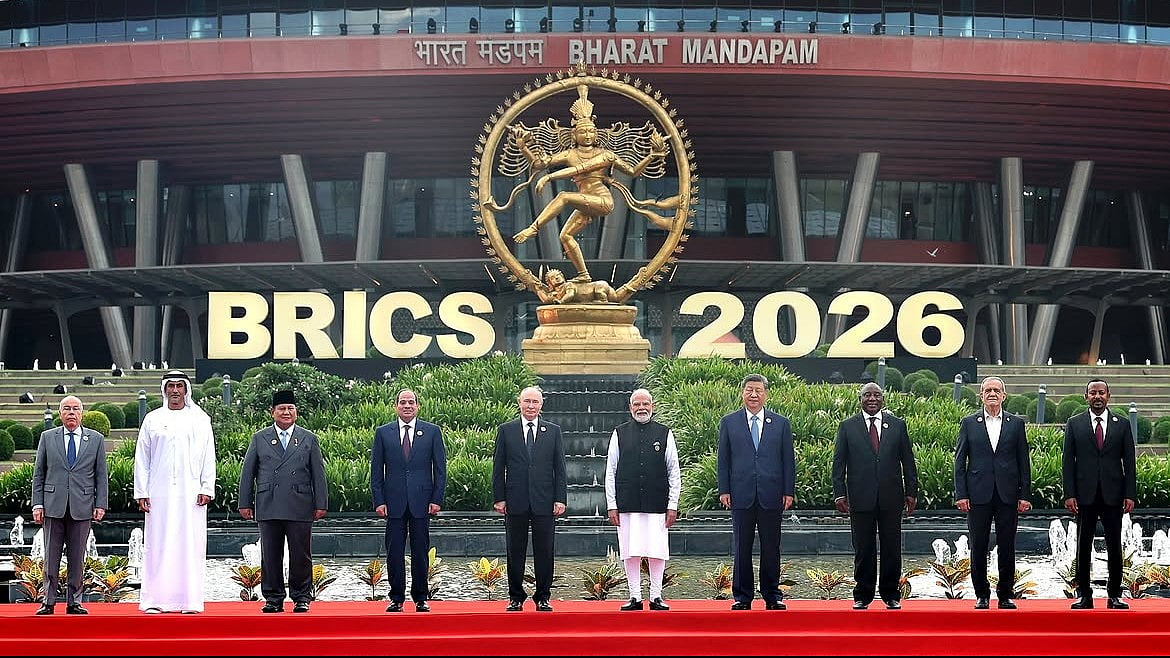
Diplomatic contacts at the New Delhi BRICS Summit have opened fresh discussion on de-escalation and protecting vital regional trade routes | File Photo
The war in West Asia rages on as Saudi fighter jets pound Houthi positions. This despite a meeting on the sidelines of the New Delhi BRICS Summit, the first of its kind since the war started in February this year between the Iranian President and the Abu Dhabi Crown Prince in what was seen as an attempt to bring about a breakthrough.
However, the follow-up meeting on Monday, where the Iranians were supposed to unveil their plan for a safe transit corridor through the Strait of Hormuz, seems to have been overtaken by the war in Yemen, where the success of the Iran-backed Houthi rebels has worried Saudi Arabia to no end. The Houthis have taken charge of the mouth of the Red Sea even as missiles fired from Iraq have damaged the Saudi East-West pipeline, crippling evacuation of the oil-rich kingdom’s natural resources.
Be that as may be, the tentative steps taken by the ‘dove of peace’ set loose at Delhi may still be able to fly if cooler heads were to sit down and work towards that goal.
The most revealing moment of the BRICS Summit in New Delhi may have come after the leaders had finished talking. Let’s look at what exactly happened last week, which gives some hope for the grim situation in West Asia, which has seen stock markets and currencies collapsing, energy crises erupting, and factories shutting down across the globe.
BRICS And Diplomatic Reach
BRICS by itself cannot stop the war. It has no ceasefire mechanism, peacekeeping force or authority to compel Iran, the US or their partners to halt hostilities. Nor can it guarantee the security of shipping through Hormuz or the Red Sea.
However, the expanded 11-member grouping has something more useful at this stage—diplomatic reach. The grouping brings together major energy producers and consumers, including countries with close relationships with Iran, the Gulf states, Russia, China, and India. Its members have little agreement on the wider geopolitical order, but they share an immediate interest in preventing a regional war from becoming a global economic shock.
Which is why the members unanimously expressed deep concern over the conflict, called for maximum restraint, and condemned attacks on civilian infrastructure and peaceful nuclear facilities under IAEA safeguards, while stressing nuclear safety and security.
India, Russia, and China also perhaps helped steer the interesting bit of diplomacy which saw Iranian President Masoud Pezeshkian meeting Sheikh Khaled bin Mohamed Al Nahyan, Crown Prince of Abu Dhabi, on the sidelines of the gathering.
Tehran And Gulf Capitals Talk
Saudi Arabia was represented by its foreign minister at the BRICS Summit, and notes must have made their way on what was transpiring even as the two sat down. There was no public announcement of breakthroughs, but the encounters demonstrated something important: Tehran and the Gulf capitals can still talk directly even as the wider confrontation continues.
BRICS did, as it should, resist the temptation to present itself as a mediator. Its comparative advantage lies elsewhere—as an umbrella under which several channels of diplomacy can operate simultaneously.
The ‘Big Three’ in the BRICS grouping—India, Russia, and China—have one immediate objective, which is to protect commercial shipping, energy infrastructure, and civilian and nuclear facilities. That is where the reported discussions over a temporary shipping arrangement through the Strait of Hormuz become significant.
Hormuz Corridor Under Discussion
A limited corridor would not amount to a reopening of Hormuz in the normal sense. Iranian foreign minister Abbas Araghchi has indicated that any temporary arrangement should not be confused with full reopening, with Tehran linking normal transit to wider political understandings with Washington.
The question is no longer simply whether Hormuz is open or closed, but whether it can be placed under some form of managed access while the political confrontation continues. That would be crisis management, not peace-making, but crisis management is precisely what markets need.
The economic stakes are enormous. Hormuz is one of the world's most important energy arteries, while the Red Sea and Suez Canal form a parallel route for global trade. Disruption raises oil, freight, insurance, and import costs, feeding directly into inflation. A prolonged or simultaneous disruption of both routes could produce a global shock far beyond West Asia.
India And China’s Role
India and China need dependable energy supplies and trade routes. Gulf producers need their export infrastructure protected. The unavailability of either is feeding a global crisis. As it is, the benchmark Brent crude price has risen from $73 in February, just before the war broke out, to $107 on Monday morning, while the Sensex has fallen by 1,473 points in the last five days, while the Shanghai Composite Index has fallen by over 2 per cent.
China possibly has the greatest potential leverage because of its close military and economic ties with Tehran while also enjoying deep relationships with the Gulf monarchies, and it played a central role in restoring diplomatic relations between Saudi Arabia and Iran. That gives Beijing a possible channel into conversations that other powers may find difficult to open.
While India has less leverage in Tehran than China, its relationships are unusually broad. New Delhi also has strategic partnerships with the UAE and Saudi Arabia, retains important ties with Iran, and is deepening its relationship with Washington. And it can play a potential bridge role.
Informal Division Of Labour
This suggests an informal division of diplomatic labour rather than a single BRICS peace process: China can help connect Tehran and Washington; India can work across its Gulf and Iranian relationships, while the UAE and other regional actors can handle the technical details of any shipping or de-escalation arrangements.
New Delhi has shown that BRICS can get regional actors to agree, at least for now, on the need for restraint. The harder task will be converting that consensus into practice and, thereby, keeping the ships moving, the oil flowing, and, eventually, creating the conditions in which the guns can fall silent.
The writer is Editor, United News of India.
RECENT STORIES
-
-
-
-
-