The Quiet Realism Of India’s Advertising Boardrooms
Brands are increasingly opting for safer advertising strategies as social media outrage, reputational risks and stakeholder pressures make bold campaigns harder to justify. The article argues that CMOs are acting pragmatically, weighing immediate risks against uncertain rewards in an environment where backlash spreads faster than support.

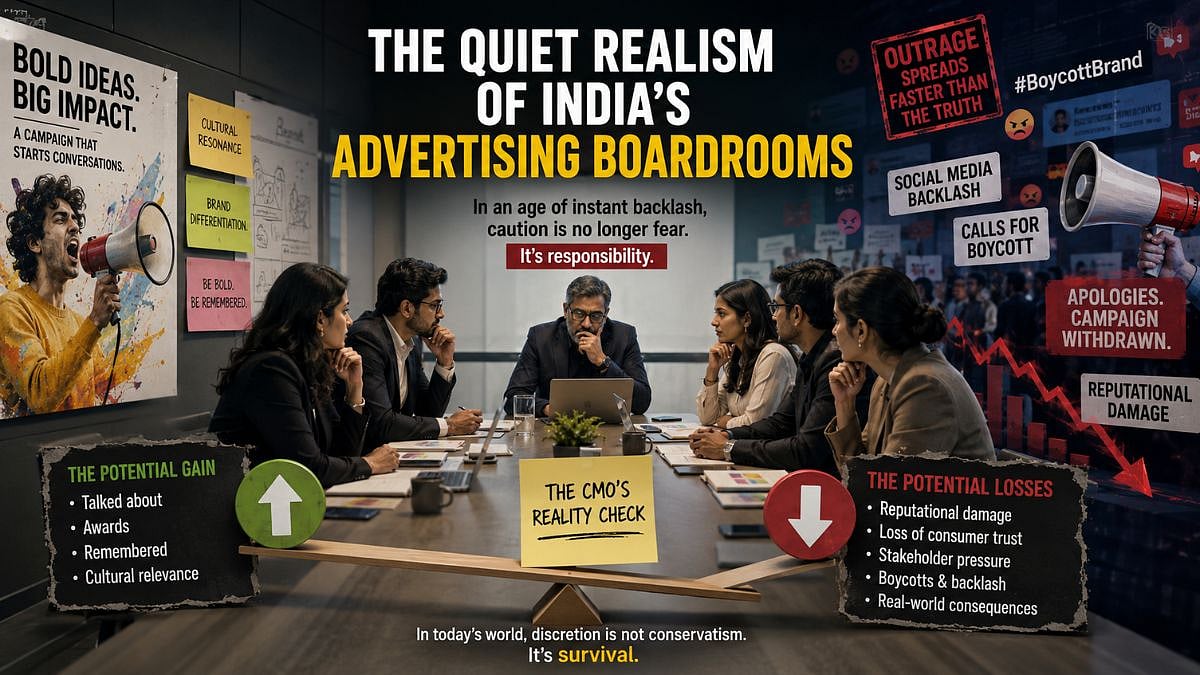
Brand leaders are increasingly prioritising risk management and reputation protection as social media scrutiny reshapes advertising decisions | AI Generated Representational Image
A quiet realism is settling into boardrooms, and it deserves more empathy than critique. The modern CMO is not timid. The CMO is responding rationally to an equation where the risks and returns are fundamentally, and increasingly, uneven.
Once upon a time, advertising bravery was celebrated as a necessary gamble. A bold campaign could provoke, polarise, and still ultimately elevate a brand into cultural memory. Today, the same boldness carries a very different weight. The upside remains largely symbolic: a “remembered” and even an awarded campaign, a fleeting moment of relevance. The downside, however, is sharper, faster, and far more personal.
It is, quite simply, no longer a fair trade.
In recent years, we have seen multiple instances of brands, sometimes with intent, sometimes inadvertently, venturing into sharp, culturally loaded storytelling. The goal is often noble: to stand out, to take a stance, to resonate deeply with a specific community. And indeed, resonance does happen. But it is quiet. It does not trend.
Offence, on the other hand, does.
What follows is almost procedural. A section of the audience feels misrepresented or slighted. Social media amplifies the grievance. Hashtags emerge, outrage compounds, and the narrative quickly escapes the brand’s control. Calls for boycotts surface. The brand responds, retracts, and apologises. The campaign is withdrawn. The conversation lingers, but rarely in the brand’s favour.
What is telling is the asymmetry. The community that resonates rarely rallies in equal measure. There is no counterweight of support that matches the velocity of outrage. Appreciation remains passive; offence mobilises. In a system governed by algorithms that privilege engagement over nuance, the loudest sentiment wins, and it is seldom the positive one.
From the CMO’s vantage point, this is not a creative dilemma; it is a risk assessment. And the maths is unforgiving.
The potential gain: a campaign that is talked about, perhaps awarded, possibly remembered.
The potential losses: reputational damage, sustained backlash, loss of consumer trust, pressure from stakeholders, and, increasingly, spillover into real-world consequences. It is no longer just about brand boycotts. Employees, partners, and extended ecosystems have been targeted, harassed, and, in some cases, threatened. The cost is not just strategic; it is human.
In this context, caution is not conservatism; it is a responsibility.
There was a belief that digital precision would mitigate this and that targeted media would allow brands to speak only to those predisposed to agree. But the illusion of containment has long been shattered.
Content travels. Context collapses. A message crafted for one audience is inevitably consumed by many others, each interpreting it through their own lens. There is no such thing as a closed conversation anymore.
Philosophically, one could lament this as a loss of creative courage. But that critique often comes from a place of distance—from those who no longer carry the consequences of the decision. The lamenting, chest-thumping nostalgia of advertising veterans, mourning the loss of edge, overlooks a crucial truth: they no longer have skin in the game.
The CMO does.
It is the CMO who answers to the board when sales dip. The CMO who navigates stakeholder pressure when controversy erupts. The CMO whose teams and partners may bear the brunt of backlash that spills beyond the screen. To expect reckless bravery in such a context is not idealism but abdication.
Advertising does not operate in isolation, nor can it afford to. It is shaped by the environment it inhabits and the sentiments of its audience. And that audience itself is no longer stable or singular. Brand loyalties are fluid, affinities are flimsy, and communities are fragmented. The idea of a clearly defined “core audience” is, at best, aspirational.
In such a landscape, adaptation is not a compromise; it is a necessity.
And so, the CMO adapts.
Playing it safe is often dismissed as a lack of imagination. But perhaps it is better understood as a recalibration of priorities. If non-edgy, non-defining communication can still deliver business outcomes such as awareness, engagement, and sales, it weakens the argument for unnecessary provocation. Particularly where short-term performance is scrutinised and long-term brand building feels increasingly abstract.
In many ways, advertising itself has come full circle. It is morphing back into the street caller: the loud, immediate, and attention-seeking voice. A flash of interest. A momentary hook. High-decibel, provocatively safe, but careful never to step over the invisible, ever-shifting line. It is less about deep persuasion and more about fleeting intent. Less about standing apart and more about staying acceptable.
And perhaps the industry cannot be faulted for this regression. Agencies, brands, and their extended ecosystems are not operating in a vacuum; they respond to the incentives and penalties of the environments they inhabit. When survival depends on avoiding backlash, discretion becomes a shared discipline.
Brands have not stopped speaking. They have learnt to speak in a language that minimises risk. The tone is more inclusive but less specific. The messaging is more agreeable but less distinctive. It may not inspire, but it rarely offends.
And that, today, is often enough.
It is easy to romanticise the era of bold advertising, to wish for brands that take unapologetic stands. But from the CMO’s perspective, the equation is clear: when the downside is immediate, amplified, and potentially harmful, and the upside is uncertain and unevenly defended, restraint is expected.
In a world where the rules are rewritten daily, playing along is not surrender; it is survival. And for an industry that must live to fight another season, survival is reason enough.
Sanjeev Kotnala is a brand and marketing consultant, writer, coach and mentor.
RECENT STORIES
-
-
-
-
-