The More Things Change, The More They Remain The Same
Despite advances in education, careers and legal protections for women, deep-rooted misogyny continues to shape Indian society. Citing recent dowry death cases, workplace harassment allegations and portrayals of women in films and web series, the piece questions whether attitudes towards gender equality have evolved as much as public discourse suggests.

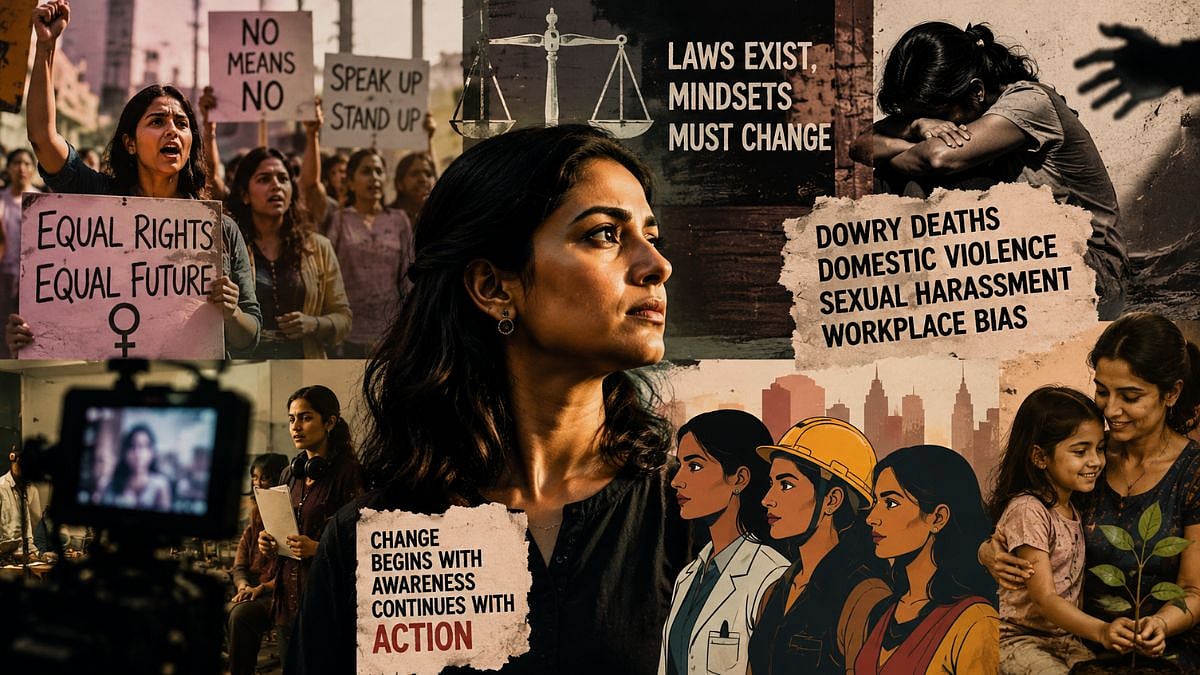
Recent controversies and popular screen narratives reignite debate over women's rights, workplace safety and entrenched gender biases in India | AI Generated Representational Image
In urban India, a certain smugness has set in as far as women’s rights go—girls are getting an education, some of them are following careers, choosing their own partners, and deciding if and when they want to have kids. Laws have changed over time to protect women, or at least give them a semblance of justice. But in spite of that, there is little decline in rapes, domestic violence, dowry deaths, and sexual harassment in the workplace.
Persistent societal challenges
Does that mean that under the surface wokeness, mindsets have not changed all that much? The Twisha Sharma dowry death case has shocked those who believe they are not like that. The husband and mother-in-law of the unfortunate woman are not just educated but in the legal profession.
In film circles, there are furious debates about a cameraman in a Yash Raj Films project, Akka, accused of sexual misconduct, called to complete patchwork on the film. YRF did, however, take action and drop the DOP’s credit. A similar thing happened to a production designer, whose name was dropped from Dhurandhar and Akka. Major film companies have adopted a zero-tolerance policy to sexual harassment; many hold gender sensitisation workshops before a project. It is also true that many women choose not to file complaints either with the production houses, industry organisations, or the police, because they might find themselves out of work for being troublemakers. There is also the fear that film companies may just reduce the number of women working on their crews to avoid such 'hassles'.
Which is not to say that harassment has stopped or the perpetrators have been punished—so many of them, accused of improper behaviour during the wave of #MeToo revelations by women, are continuing to work in the industry and have suffered no Harvey Weinstein-like trial and conviction.
Portrayal of women in films and series
There remains the problem of how women are portrayed in films. The offensive portrayal may not be overt, but it is no less toxic for being insidious. Without the context of rampant sexual harassment of women in the industry (and elsewhere too), Anurag Kashyap’s film Bandar seems to be a backlash against the #MeToo movement. The film is about a fading singer-actor, Samar (played by Bobby Deol), who is falsely accused of rape by a jilted dating-app match, Gayatri (Sapna Pabbi). She had become so possessive and stalker-ish that the immature and entitled Samar took the easy way out by ghosting her. In a rage she files a complaint against him; he is arrested and thrown into a hellish prison, where every bit of dignity is stripped from a human—guilty or innocent hardly matters.
Women are not always blameless, and laws have been misused as vengeance against men. It is also a fact that more women suffer the misogyny inherent in our society and rarely get timely justice. One man trapped in an unjust legal system is undoubtedly a tragedy, but it hardly wipes out the hundreds of rape, dowry, violence, and harassment cases that drag on for years, offering no relief to the survivors.
The crime show Brown has a female protagonist (played by Karisma Kapoor) investigating the gruesome murders of two women by beheading. As in most plots about serial killers, the man is unhinged, usually by a childhood trauma. He takes it upon himself to judge and punish women, who, to his mind, have strayed from the path of virtue. The wish to push women back into traditional roles as wives and mothers has raised the level of misogyny in men, already corrupted by the twisted values of patriarchy. Giving men the power of judge, jury, and executioner, even in a fictional setting, is disturbing. More so because the helplessness and struggle of the victim can be titillating for some men.
In the otherwise harmless Gullak 5, the homemaker Shanti Mishra (Geetanjali Kulkarni) is held up as a model of ideal womanhood, who slogs all day for the comfort of her husband and two sons, who, as a line reveals, don’t even wash their own underwear. The comic, busybody neighbour Shalini, better known as Bittu Ki Mummy (Sunita Rajwar), gets it into her head to be a social media crusader who mocks Shanti’s domesticity and extols her newfound feminism until she falls flat on her face. From the short-lived revolt of insisting that women be addressed by their given names, her failure means the two women revert to being Bittu Ki Mummy and Annu Ki Mummy, as if they have no identity of their own. Women in most series set in small towns still do not utter the names of their husbands, resorting to the commonly used “woh”.
Women in David Dhawan’s films have always been ditzy, so why should Hai Jawani To Ishq Hona Hai be any different? The career woman who does not want kids is felled by an unplanned pregnancy while her husband cavorts with another woman, resulting in a pregnancy. Audiences might not take such films seriously, but the disrespect toward women remains after the last image has faded from the screen.
A whiff of progressive storytelling
In the depressing toxic mist, Suresh Triveni’s Maa Behen is like a whiff of oxygen. Rekha (Madhuri Dixit), wearer of sleeveless blouses and mother of two daughters (one of them born out of wedlock), faces the full force of society’s disapproval of independent women. Nobody in the colony talks to Rekha, though the men all lust after her. They scribble nasty graffiti on the walls of her house and call her names like dayan (witch). Eventually, the three use their brains and their ‘tarnished’ reputations to defeat the haters of their housing complex—mainly the one who wants to evict them. May the coven of women in sleeveless blouses thrive!
Deepa Gahlot is a Mumbai-based columnist, critic, and author.
RECENT STORIES
-
-
-
-
-