The Devil Wears Prada 2: Miranda Priestly, The Boss Lady, Marches On In Stilettos
Miranda Priestly’s character in The Devil Wears Prada 2 reflects how attitudes towards ambitious women have evolved over two decades. Once viewed as cold and ruthless, the iconic fashion editor is now seen as a symbol of female authority, resilience, and leadership amid ongoing debates around gender double standards in workplaces.

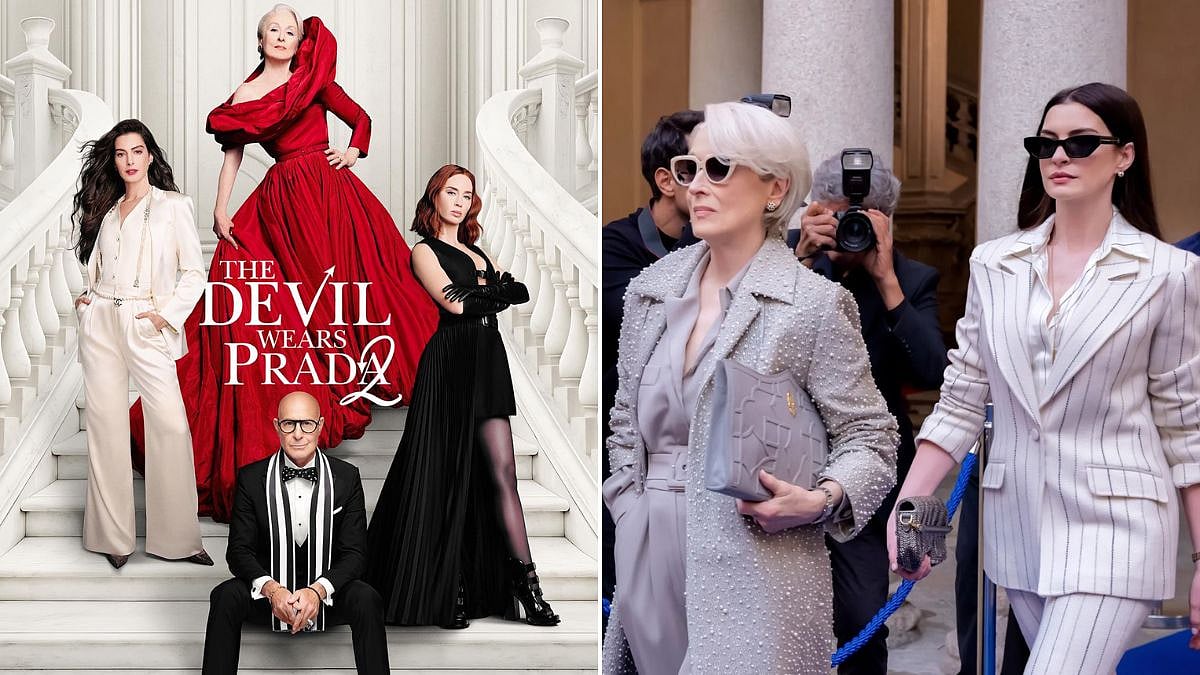
Miranda Priestly’s return in The Devil Wears Prada 2 reflects changing attitudes towards ambitious women in power | X
Twenty years ago, when The Devil Wears Prada was released, women in top positions of power were relatively rare. The number has inched up, but not by much.
From bestselling novel to iconic film
Based on Lauren Weisberger's bestselling novel, inspired by her own experiences of working with Vogue's formidable editor Anna Wintour (though the producers of the film denied it), the book and film are about an aspiring journalist, Andy Sachs, who takes up an entry-level job as the second assistant to Miranda Priestly, the editor of the fictional fashion magazine Runway.
Difficult, demanding and imperious, in her own words, Miranda has the kind of clout that makes or breaks designers. In the office, she treats everybody like her slaves. She strides in, dressed in designer outfits, and flings her coat and bag on the assistant's table, expecting the already quivering woman (Emily Blunt in the first film) to hang them up.
The assistants have to fetch her coffee and lunch, deliver her dry cleaning and cater to her every whim.
Miranda Priestly’s intimidating workplace presence
At edit meetings, she shoots down ideas with withering comments. Either by temperament or design, because bad-tempered women are dismissed as hysterical, her put-downs are little more than a whisper.
As Andy observes, "She is not happy unless everyone around her is panicked, nauseous or suicidal."
Two decades later, the sequel has come out, capturing the times when the power and reach of print media are eroding under the onslaught of digital alternatives. Miranda Priestly, who is just slightly less nasty — she has to hang up her own coat — is still leading Runway with the loyal Nigel (Stanley Tucci) by her side, perhaps the only colleague she treats like a human being.
Changing perceptions of ambitious women
However, 20 years later, Miranda doesn't seem like such a monster. Because ambition and power are no longer considered negative traits for women, and like Miranda, they are willing to pay the price of making sacrifices in their personal lives. Men never have to choose between career and home, but women are still guilt-tripped if they put their work above their families.
Back then, women had to claw their way to the top and work doubly hard to stay there. Most of them did not have female role models in top executive positions, so they behaved as obnoxiously as the powerful men they may have encountered on their career paths.
The films don't go into Miranda's background, but the book does — she rose from humble origins and reached the top of her profession by the sheer dint of ambition and talent. That may just have made her more conceited and perhaps more insecure too, which leads to her toxic behaviour towards her subordinates.
Miranda Priestly as a modern female archetype
But that is just speculation. In any case, the woman who was perceived as the classic movie villain in 2016 is, in 2026, a woman to be admired. Not only has she retained her position and power in the notoriously ageist fashion industry, she still has the shrewdness to wheel and deal in boardrooms. She doesn't even hesitate to throw Nigel under the bus when it comes to her own career.
There was, and still is, a double standard applied to ambitious women. When a man is ruthless, he is praised for his leadership qualities; a woman is labelled cold or bitchy. Women are also judged harshly, from their appearance to their working style. Consequently, they are constantly teetering between strength and caution, lest their authority be taken for tyranny or their civility for weakness. It is not surprising that Miranda loses her empathy in the process of getting ahead, playing by the tough hierarchical rules made by men.
Debate over double standards in leadership
Kelly Wendorf, writing in kindredmedia.org, observed, "To me, in spite of her foibles and her less than conscious complexity, she represented that exquisite paradox that is the strong female archetype. Miranda Priestly is not the villain. She is a complex creature, a highly intelligent servant leader, ensuring the livelihoods of countless millions of employees. Her loyalty is to her industry, not to making friends. And though not perfect, her strength, mental prowess, and steely directness absent pleasing is an important model for women and girls.
"Yes, we could argue that Priestly is cruel, manipulative, two-faced and backstabbing… um, like the celebrated Steve Jobs perhaps. We could argue that makes her evil and brush her off as a mere caricature. We might enforce a double standard, that women only make great leaders if they are perfect… Obliquely double-standardised, The Devil Wears Prada parades about as a fun stab at badly behaved power moguls — a kind of feminine David and Goliath — but, in fact, it is a dangerous contributor to the sexist status quo.
"Do we forget that some of our great male leaders were equally complicated? John F Kennedy, Gandhi and Martin Luther King, for example, were all highly complex individuals. Just lightly scratch under the surface of their biographies and you discover a sketchy moral fibre, impenetrable hubris, and a great capacity for intimidation. The likes of Elon Musk and Jeff Bezos are described as ‘intimidating’ and ‘calculated’ — all of those adjectives said with such reverence and awe. Steve Jobs was also complicated, but no one wants to watch The Devil Wears Black T-Shirts and Sneakers.
"Can a woman be intelligent, powerful and imperfect? Can she go down in the halls of history revered for her leadership in spite of her sketchy moral fibre and impenetrable hubris?"
Streep drew inspiration from Clint Eastwood
Streep often said her performance was inspired by men but didn't reveal their identities until the movie's tenth anniversary in 2016.
"The voice I got from Clint Eastwood," she said in an interview. "He never, ever, ever raises his voice and everyone has to lean in to listen, and he is automatically the most powerful person in the room."
By 2016 standards, Miranda was a devilish go-getter; by the time she reaches 2026, without age daring to touch her, she is Boss Lady, and she can wear whatever she wants. Designer, of course!
Deepa Gahlot is a Mumbai-based columnist, critic and author.
RECENT STORIES
-
-
-
-
-