Student Protests Should Not Be Seen As Ranchi VS Jantar Mantar
Sayantan Ghosh writes that protests by aspirants in Ranchi and Delhi highlight a deeper frustration with recruitment systems. The author says young people are demanding answers over alleged irregularities, delayed results and paper leaks rather than political ownership of their movements. He argues that governments must respond with lasting reforms instead of temporary assurances.

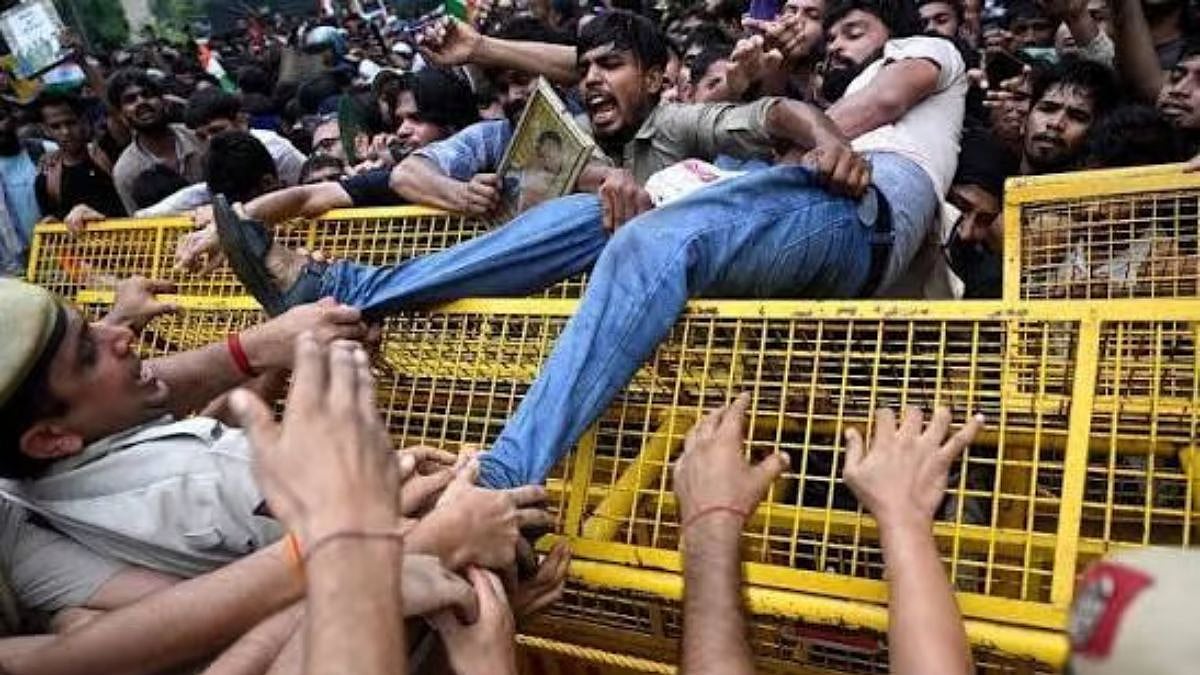
Student Protests Should Not Be Seen As Ranchi VS Jantar Mantar | Representational Image
In Ranchi, a young man who has cleared prelims multiple times but never seen a final appointment list lies on a stretcher, his body weakened by nine days without food. Around him, women wipe tear-gas from their eyes while still clutching faded admit cards that represent years of unpaid labour, postponed marriages, and family land sold for coaching fees. In Delhi, only weeks earlier, teenagers in cockroach masks danced, cried, and refused to leave Jantar Mantar until a union minister stepped down. Two cities, two governments, one unbroken human demand: stop treating our futures as disposable.
The temptation to turn this into Ranchi versus Jantar Mantar is almost irresistible for those who traffic in binaries. Because Hemant Soren’s JMM-Congress government rules Jharkhand, while the BJP holds the centre, some would like us to believe one protest was pure and the other contaminated. That framing is not analysis; it is an insult to the young people who have spent the best years of their lives preparing for examinations that keep springing leaks, selling seats, and vanishing results. Accountability is not a one-time password that works only against the party you dislike; it is the daily, unglamorous insistence that power must answer for broken promises—every time, everywhere, without exception.
Look closely at the faces in Ranchi. Many are not Gen Z. They are men and women in their late twenties and thirties who have watched younger siblings enter coaching centres while they themselves reappear for the same JPSC and JSSC papers year after year. Some sold ancestral land. Others delayed starting families. When the 14th JPSC preliminary results appeared and anomalies surfaced—alleged seat sales running into lakhs of rupees, manipulated answer sheets, and private agencies under a cloud—the anger was not abstract. It was personal and intimate and accumulated over a decade of quiet humiliation. The same personal fury had filled Jantar Mantar after the NEET paper leak. Different exams, different ages, same wound: the growing certainty that the system treats sincerity as foolishness and patience as weakness.
Every serious protest is political because it confronts power. The Jantar Mantar agitation was political; it forced Dharmendra Pradhan’s resignation. That did not make every student who stood there an opposition agent. The Ranchi agitation is political; it has already produced CID arrests, the detention of former JPSC chairperson L Khiangte, an ED money-laundering probe, and government offers to cancel certain examinations. That does not make every protester a BJP tool simply because Babulal Marandi and the state unit have offered solidarity and called a bandh. Congress workers have sent food packets and submitted memoranda. The Cockroach Janta Party has extended public support. These facts prove only that parties still recognise the electoral value of youth anger. They do not define or own the anger itself.
The more troubling narrative is the one that claims limited physical presence of one group in Ranchi somehow exposes the earlier movement as manufactured. That argument confuses organisational choice with popular legitimacy. The students who first occupied Jaipal Singh Munda Stadium did so when cameras were few and political attention thinner. Their hunger strikes and assembly marches grew from lived betrayal, not from any party’s strategy document. If some organisations that thrived in Delhi have been slower to fully embed themselves in Jharkhand, that is a failure of consistency on their part, not evidence that the Ranchi demand is less authentic. The opposite is true: the protest’s organic character makes it harder to dismiss and more dangerous to ignore.
What the two protests together reveal is more profound than any partisan scoreboard. Successive cohorts of the same generation have discovered that the street remains one of the few places where the powerful still have to listen. They have watched paper leaks become routine, recruitment calendars turn elastic, and enquiries end in quiet compromises that protect institutions more than candidates. They have also watched one minister fall and one state government scramble to offer reforms, arrests, and dialogue. The lesson they are internalising is simple and dangerous for every establishment: selective accountability is no longer enough. Youth now understand that the right to demand answers does not expire when the government changes colour.
Hemant Soren is right when he says dialogue, not batons, must resolve the crisis. The BJP is right when it demands transparent investigation. Both are wrong if they believe the demand ends when their rival is embarrassed. The young people in Ranchi are not fighting the JMM-Congress. The young people at Jantar Mantar were not fighting the BJP alone. They are fighting a deeper culture in which examinations—the only ladder many still trust—keep being sawn halfway up. That culture will not change if we keep converting every genuine grievance into a proxy war between Ranchi and Jantar Mantar. The streets have already moved beyond that map. The only question left is whether those who govern, in every capital, are prepared to meet them there with something more durable than temporary probes and carefully worded assurances. Until then, the hunger for dignity will keep finding new pavements.
Sayantan Ghosh is the author of two books, Battleground Bengal and The Aam Aadmi Party, and teaches at St. Xavier’s College (Autonomous), Kolkata.
RECENT STORIES
-
-
-
-
-