SEBI And India’s IPO Boom: What Happens After The Sale?
India’s record IPO boom is raising questions over whether headline fundraising reflects genuine capital formation and lasting investor conviction. With OFS accounting for a major share of proceeds, the article argues that SEBI should track one-year IPO performance, capital utilisation, investor retention and promoter exits rather than focus mainly on subscriptions and listing gains.

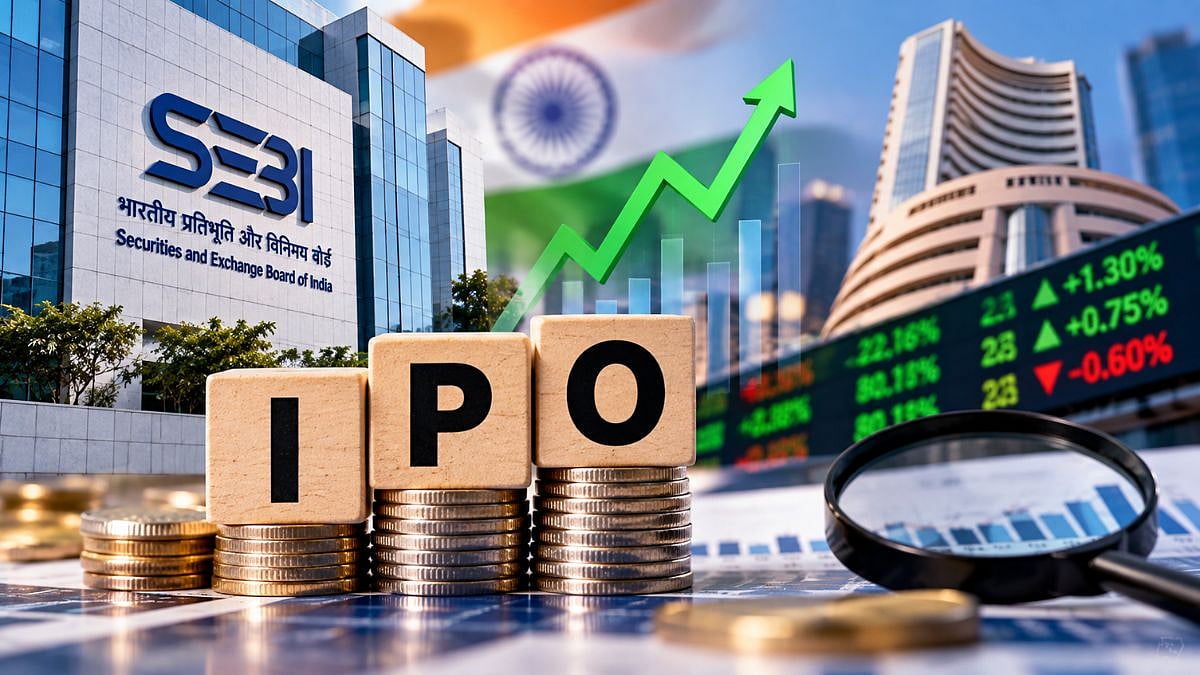
India’s record IPO fundraising is prompting renewed scrutiny of capital utilisation, investor behaviour and long-term corporate performance | AI Generated Representational Image
In the first half of FY27, companies raised a record Rs 2.4 lakh crore through public equity markets, 75 per cent higher than the corresponding period last year. Mainboard IPOs alone accounted for Rs 94,200 crore across 78 issues, the highest first-half total on record. The pipeline remains substantial, with hundreds of companies seeking approval and planning to raise several lakh crores more. Yet, over the same six months, the Nifty 50 gained just 1.3 per cent, capped by a sharp 6 per cent decline in September.
SEBI chairman has described India’s IPO market as “particularly vibrant”. But a booming IPO market is not necessarily evidence of an equally strong investor conviction in equities. This divergence deserves scrutiny. The size of the IPO market is also not, by itself, a measure of capital formation. What matters is where the money goes and what happens after listing.
Capital Formation Or Private Equity Monetisation?
There is a fundamental distinction between a fresh issue and an Offer for Sale (OFS). In a fresh issue, capital flows directly to the company for factories, technology, expansion or debt reduction. In an OFS, existing shareholders sell their holdings and receive the proceeds.
The Rs 22,563 crore NSE IPO, for instance, was entirely an OFS. Proceeds accrued to selling shareholders rather than to NSE. While an OFS provides liquidity to early backers and recycles venture capital into the startup ecosystem, it is economically distinct from funding corporate growth. A recent analysis found that over 60 per cent of mainboard IPO funds raised over the preceding 18 months came through OFS. A record in primary fundraising, therefore, cannot automatically be equated with a record in corporate capital formation.
A rising IPO tally can coexist with modest incremental investment by listed companies. If much of the money represents ownership changing hands rather than new capital entering businesses, the headline figure may exaggerate productive capital formation.
The Illusion Of Conviction
The secondary market eventually provides the reality check. Average listing day gains rose to 19 per cent in H1 FY27 from 7 per cent a year earlier. Subscription numbers were staggering: 42 of 64 IPOs were oversubscribed more than 10 times.
Yet, subscription multiples can reflect listing arbitrage rather than long-term conviction. SEBI’s 2024 study revealed that 54 per cent of IPO shares allotted to non-anchor investors were sold within one week of listing. The market focuses on issue size and listing pops but pays less attention to post-listing churn. How many applicants remain invested after six months or a year? Are shares moving to genuine long-term holders or merely between short-term traders seeking quick profits?
IPO frauds and irregularities are not merely theoretical risks. SEBI’s enforcement record during the IPO boom around 2011 shows why intense primary market activity requires heightened vigilance. The lesson is not that today’s IPO boom is fraudulent, but that extraordinary primary market enthusiasm can create opportunities for misconduct that regulators need to actively test for.
The Anchor Investor Myth
Anchor participation is frequently presented as institutional validation, but holding duration matters more than initial subscription. SEBI’s 2026 study found anchor investors sold approximately 3.2 per cent of their allocation after the initial lock-in, 8 per cent within 60 days and 17.3 per cent within 90 days. Within a year, about half of aggregate anchor holdings were sold, exceeding 70 per cent in smaller IPOs. While exits after lock-in expiry are legitimate, presenting initial anchor participation as durable conviction can mislead retail investors.
Listing Day Versus Accounting Day
Listing day is a market event; one year post listing is an accounting event. By then, the initial hype fades, quarterly results accumulate, cash flows can be assessed, and capital deployment can be evaluated against pre-IPO promises.
SEBI and the exchanges should publish a standardised One-Year IPO Scorecard tracking five metrics:
Price Performance: Issue price versus 6-month and 1-year market-adjusted returns against relevant benchmarks.
Proceeds Utilisation: Fresh issue versus OFS proceeds and actual deployment against stated objectives.
Financial Delivery: Post-listing revenue growth, cash flow generation, debt and working capital performance.
Investor Holding Behaviour: Retention of allotted shares across retail, HNI and institutional buckets over one year.
Promoter and Anchor Behaviour: Holdings sold by pre-IPO investors and promoters during the first year.
Such a scorecard would improve the IPO debate. Instead of treating subscription multiples and listing gains as principal indicators of success, investors would have a framework for assessing whether the company delivered on the economic proposition presented before the listing. It would shift attention from issuance excitement to post-issue performance.
Compliance Is Not Transparency
Disclosures must move beyond checklist compliance. An offer document can satisfy regulatory requirements while obscuring core business economics. Disclosures should make it seamless to evaluate customer concentration, related party transactions, contingent liabilities, working capital intensity, and adjusted non-GAAP earnings that may inflate pre-IPO profitability.
Measure What Happens After The Sale
India needs vast amounts of patient capital for infrastructure, manufacturing, technology, and energy transition. As domestic household savings become a critical source of equity capital and a buffer against global volatility, primary market quality is paramount for safeguarding retail investor trust, protecting household wealth, and maintaining long-term market stability.
A regulator should celebrate the depth of India’s primary market without getting carried away by headline numbers. An IPO’s success should not be judged by whether it is subscribed 50 times or pops 30 per cent on day one. India has proven it can generate extraordinary demand for the primary market. The next step is measuring what happens after the sale, because true corporate value is defined not on the listing day, but one to three years later.
The writer is a retired IRS officer and Ex-Chief of Surveillance at SEBI. Advisor to corporates, market participants and tech entrepreneurs.
RECENT STORIES
-
-
-
-
-