Sanātana Dharma’s Unity In Diversity: One Festival, Many Traditions Across India
Festivals like Vaisakhi, Vishu, Bihu, and regional New Years celebrated across India highlight the unity of Sanatana Dharma. Despite cultural variations, they reflect a shared belief in one divine force, showcasing how diversity and spiritual oneness coexist within Indian traditions.

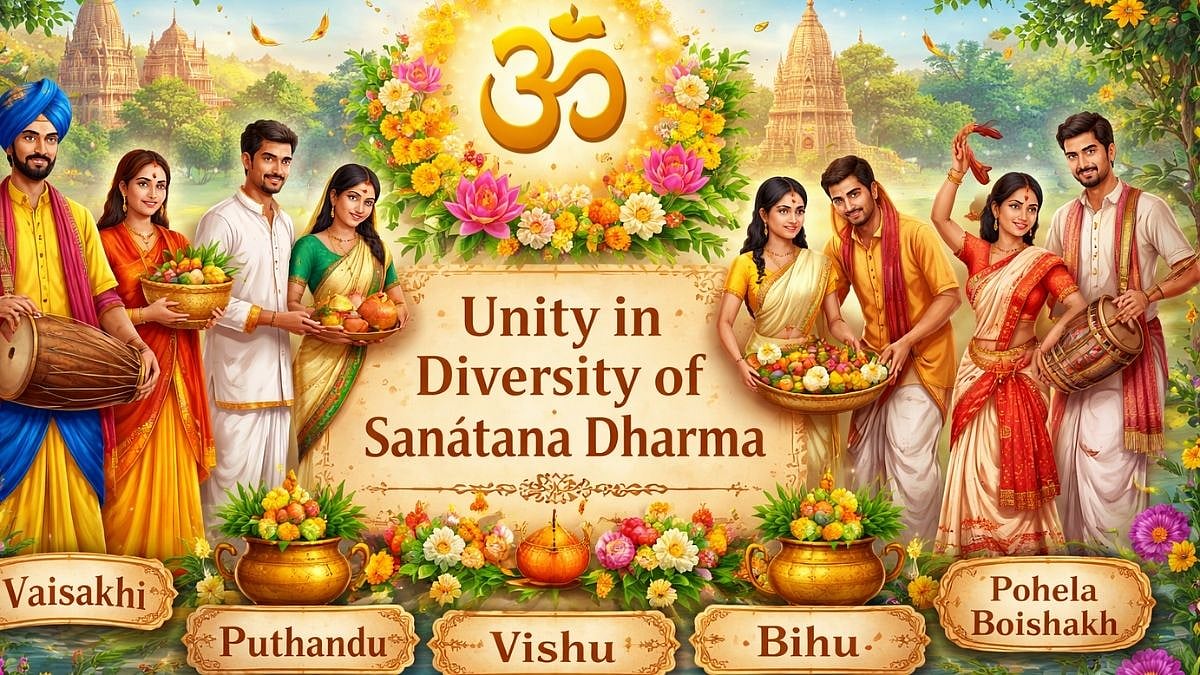
Diverse regional New Year celebrations across India reflect a shared spiritual thread rooted in Sanātana Dharma | AI Generated Representational Image
A couple of days back, we celebrated a festival throughout the country — one festival, many names. Tamil New Year, Bengali New Year, Vishu, Bihu in Assam, Vaisakhi in Punjab. On April 14 and 15 — two days, owing to the difference between the solar and lunar calendars — the same festival is celebrated all over the country, and the same importance is given to it.
This definitively proves one thing: that there was a time when Hinduism, or Sanātana Dharma, was practised across the entire Indian subcontinent, Bhārata Varṣa.
Cultural variations shaped by geography and time
You will also notice that it is celebrated in very different ways, with various emphases on various things. These are the cultural and local variations that arose because communities, five hundred or a thousand years ago, were separated by time, distance, and geography. Interaction was limited to pilgrimages and similar occasions.
As a result, local customs and practices evolved. Hinduism never believed in straitjacketing everyone into one mould. We knew the festival was the same; we knew Īśvara was one, even though different forms were emphasised in different places.
In some places it may be Gaṇeśa, in some it may be Rāma, in others Śiva. In some places, greater emphasis is placed on Devī or Durgā; in others, it may be Murugan or Kārttikeya. And that is perfectly fine — we always knew there was only Īśvara, and that he could be invoked in a million different forms.
Unity reflected in shared spiritual understanding
This understanding extended even to our armed forces, where soldiers of different sects functioned together under the simple Hindi declaration: Sabke Mālik Ek — the Lord of all is One. And when other religious denominations later joined the army, this spirit was extended to them as well.
Call to uphold unity amid diversity
So, while celebrating this diversity, we must also be vigilant against any religious fanaticism that seeks to impose one idea of God on the entire population and condemns every other idea as wrong. Let us understand: there is only Īśvara, and he can be appreciated in a million different forms.
(The writer is the founder of Aarsha Vidya Foundation. You can write to him at aarshavidyaf@gmail.com)
RECENT STORIES
-
-
-
-
-