One District, One Cuisine: Meatless In UP, With All Veg And No Verve
Uttar Pradesh’s “One District, One Cuisine” scheme has drawn criticism for excluding all non-vegetarian dishes despite the state’s rich culinary heritage. Critics argue the list presents a limited view of UP’s diverse food culture by omitting iconic dishes such as galouti kebabs and biryani while including raw commodities as cuisine.

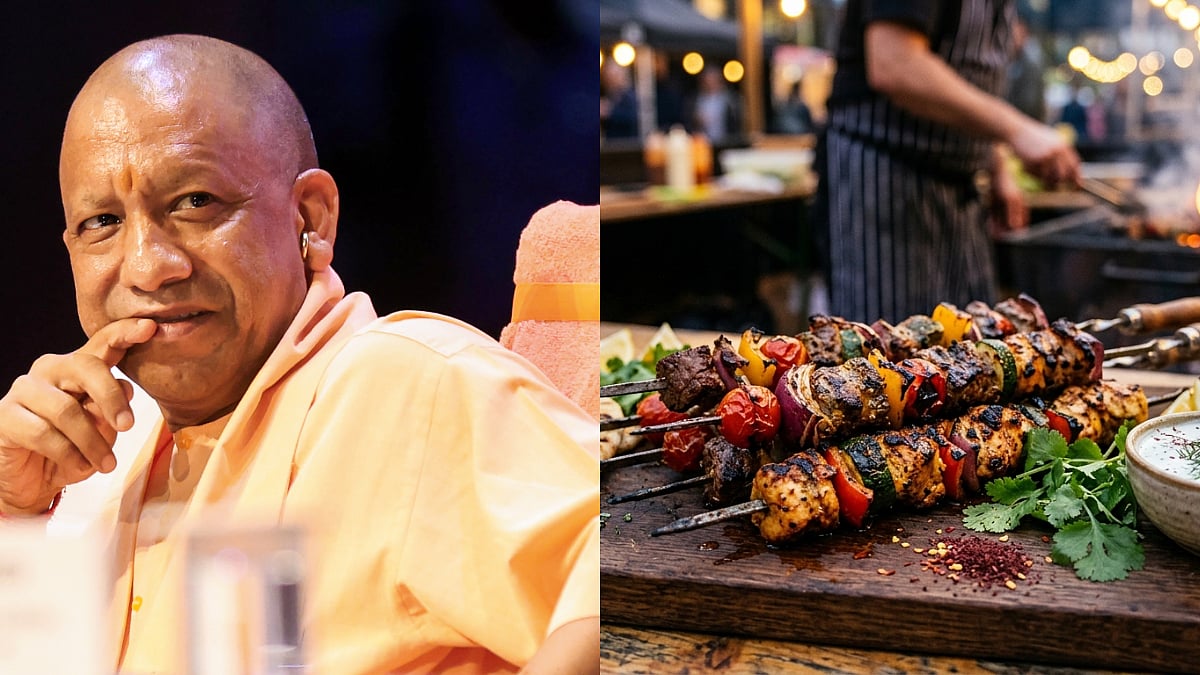
The Uttar Pradesh government’s ODOC food list has triggered debate over the exclusion of the state’s non-vegetarian culinary heritage | File Photo (Representational Image)
Uttar Pradesh is often described not as a state, but as a country pretending to be a province. With a population exceeding 24 crore, it is an administrative titan comprising 75 districts, 18 divisions and a staggering 97,814 villages. To attempt to distil the culinary soul of such a vast geography and the hoary history that accompanies it, stretching from the humid plains of Purvanchal in the east to the rugged outcrops of Bundelkhand, is a task that requires both a gourmet’s discerning tongue and a sharp sociologist’s eye.
ODOC scheme aims to showcase regional cuisine
In this context, the government’s recent unveiling of the "One District, One Cuisine" (ODOC) scheme is, in principle, a move to be lauded. Identifying 208 signature dishes to spark a rural economic engine is an ambitious farm-to-fork strategy. Yet, as the menu is pored over, the results are rather baffling.
In a land where the culinary map is far more diverse than its linguistic flavours, the official list has managed a feat of statistical improbability, worthy of a Guinness Records citation: out of 208 items, not a single one is non-vegetarian.
Absence of non-vegetarian dishes questioned
For a state that gave the world the delicate galauti of Lucknow and the fragrant biriyani of Moradabad, this oversight is less like a selection and more like a dietary redirection. While the tiranga barfi of Varanasi and the peda of Mathura are undeniable crown jewels, the denizens of UP do not live by sugar alone. By excluding the protein-rich heritage of the qorma or the handi mutton, the list presents a sanitised, one-dimensional portrait of a multi-layered palate.
Questions raised over classification criteria
Furthermore, the rigour of the classification raises eyebrows. The list occasionally confuses a trip to the kitchen with a trip to the pantry. Items like ‘Spices’ from Raebareli, ‘Edible Oil’ from Kanpur, and ‘Honey’ from Saharanpur are vital commodities, but they are hardly what mortals like us call ‘cuisine’. One does not sit down to a bowl of mustard oil for dinner.
Simultaneously, the inclusion of highly perishable street foods, like Lucknow’s malai makkhan (which famously wilts at the mere suggestion of heat) or the chaat of various districts, poses a logistical nightmare for a scheme meant to boost exports and shelf life.
Call for broader culinary representation
That much-maligned person, Jawaharlal Nehru, famously observed that India’s strength lies in its ‘Unity in Diversity’. It is a pity that this inaugural culinary showcase does not fully reflect that rich mosaic. The government has helpfully noted that the list remains open to amendments. We hope the next iteration embraces the full spectrum of UP’s kitchens.
Public policy, like a good nihari, requires patience, the right balance of ingredients, and an avoidance of the one-sidedness currently rampant in our modern school textbooks. A state as grand as Uttar Pradesh deserves a menu that tastes of all its people. A feast is only as good as the variety on the table.
Published on: Friday, May 08, 2026, 09:52 PM ISTRECENT STORIES
-
-
-
-
-