Of Oil, Gold And The American Dream Of Ruling Over The World
The US action against Venezuela’s president exposes a troubling blend of resource politics, power projection and selective legality. Framed as law enforcement, it raises deeper concerns about sovereignty, global norms and whether oil and strategic dominance are reshaping the rules of international order.

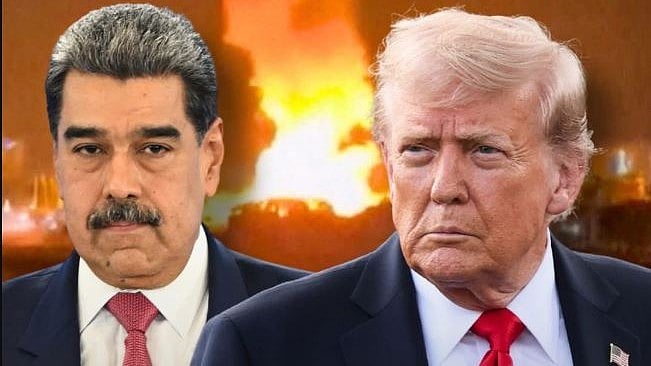
Oil, power and geopolitics collide as US action in Venezuela raises questions over sovereignty, resources and global order | File Photo
Even by the exalted standards of the US military and its precision bombing raid on Iran’s nuclear facilities, the forced removal and transfer to the US of Nicolas Maduro, the sitting President of Venezuela, awed. But it also shocked.
Violation of sovereignty and law
This was not a regime change engineered by intelligence agencies but a violation of international law and respect for the sovereignty of nations, not to mention disregard for the US constitutional requirement of keeping Congress informed. Rightly, it raises serious concerns not only in the US’s hegemonic domain of the Americas but across the world.
Narcotics charges as justification
Venezuelan involvement in the narcotics trade and President Maduro’s indictment in a US court on those counts is the stated reason for the action, which was billed by the Secretary of State as law enforcement, no matter US military boots on Venezuelan ground. But by all accounts, Venezuela is hardly the big narcotics player.
Democracy argument rings hollow
And the usual pretext — human rights violations and restoration of democracy — does not appear to carry the day either. Indeed, President Trump said that the leader of the opposition, Maria Machado, who was recently conferred the Nobel Peace Prize, did not have much “respect and support” in Venezuela. On the ground, some kind of deal seems to be getting pushed with Delcy Rodriguez, who was President Maduro’s vice-president. All of this appears to be an oily deal with Venezuela.
Oil at the heart of the move
The US is the largest oil producer in the world, but most of it is light crude. Its old refineries are used to processing heavy crude, the sources of which are Canada, Russia and Venezuela. While currently there is no shortage of oil in the market, and it will take time to ramp up Venezuela’s now relatively small production, the lure of its largest oil reserves in the world can hardly be overstated for President Trump, who thinks that climate change is a hoax and that the US needs even more fossil fuels than it has.
Denationalisation and corporate control
Years of sanctions have degraded Venezuela’s oil infrastructure and could be an opportunity for the US to have it denationalised and back under the control of US oil companies, as was the case prior to Venezuela’s nationalisation of its oil assets in 1976. No doubt President Trump referred to it as “American oil” while stating that US oil companies would move to invest large sums in Venezuela, adding as an afterthought, “making Venezuela great again”. No doubt, senior executives of oil companies were alerted by him before Congress. Of course, Venezuela has much more to offer, with rich deposits of gold and coal too.
A warning to other resource-rich regions
Other geographies with such resources would do well to beware. Greenland has often been mentioned as a US need, and there is little that Denmark, its sovereign, can do if it happens, no matter its NATO membership. Iran, which is witnessing street protests, has recently been warned by President Trump that the US is “locked and loaded and ready to go”, likely with Israeli encouragement. Interestingly, while stating that Mexico and Colombia may have to be dealt with, he said that Cuba would fold by its own volition. Cuba is not oil-rich.
China, the dollar and spheres of influence
There are views that the action was meant to crimp China, which was doing oil and other deals with Venezuela — indeed, a Chinese delegation was in Caracas and had met President Maduro on the day of the US action — and trying to find ways to undermine the US dollar in the oil trade. These issues certainly have merit but do not appear to be the prime movers, though anything that hurts the dollar as king is totally unacceptable to President Trump. His reference to the 1823 Monroe Doctrine also signals recognition of spheres of influence — music to Russian and Chinese ears.
Global reactions and muted criticism
China mouthed strong words at the UNSC and may have lost an oil supplier, but will it pull out of its critical minerals deal with the US? Unlikely, given indications of President Trump wanting a trade deal with Beijing. Other than France, whose foreign minister noted a violation of the UN Charter, reaction from Europe has been muted, with calls for restoration of democracy in Venezuela. Ruffling President Trump’s feathers is not seen as being in their interest, as they need to preserve the trans-Atlantic partnership — no matter the ‘new’ values and principles of the US — particularly in the context of national security and a possible peace deal with Russia over Ukraine. Their hope: this too (Trump 2.0) shall pass.
India’s cautious silence
India’s statement mentions neither the US nor international law, though that would have been expected from the current BRICS baton holder, especially when Brazil and South Africa have been clearly critical. However, with a trade deal in the offing, such circumspection is understandable, as ties with the US are now predicated on presidential happiness.
About the author
Former Indian Ambassador to the EU and former lead negotiator for India at UNFCCC. Distinguished Fellow, TERI.
RECENT STORIES
-
-
-
-
-