Myanmar’s Endless War: Civil Conflict And Rare Earth Rivalry Trap The Nation At A Strategic Crossroads
Myanmar faces deepening civil war as military airstrikes intensify in Rakhine and ethnic armies consolidate control in Kachin. Beneath the conflict lies a global struggle over rare earth minerals, drawing China, the US and India into a high-stakes geopolitical contest.

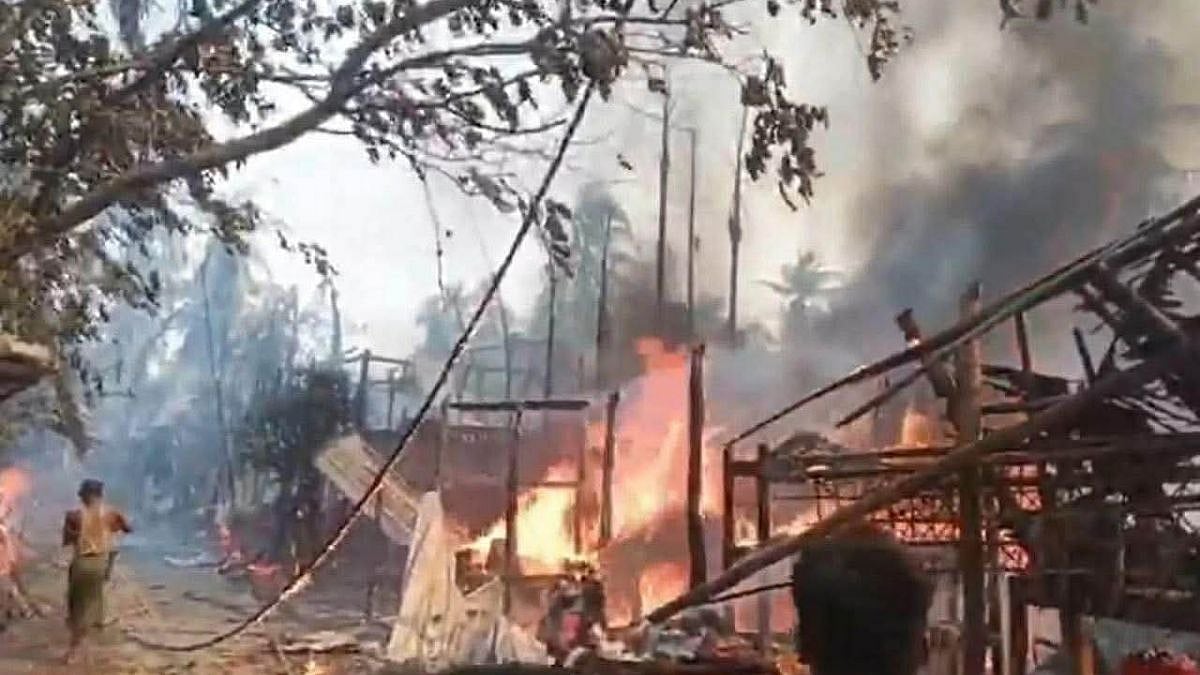
Conflict-scarred regions of Myanmar, from Rakhine to Kachin, reflect the intersection of civil war and global competition over rare earth minerals | X
Earlier this week, bombs fell on a market in the Ponnagyun township in Myanmar’s Rakhine state, killing a score of people in what has become a grim rhythm of never-ending war.
Homes were flattened, and roads were strewn with scattered body parts amidst shattered concrete.
The strike came just days after Myanmar’s military authorities announced the results of national elections held over December and January, a showpiece exercise that returned the junta-backed Union Solidarity and Development Party to formal power.
Official tallies gave the party 231 seats in the Lower House and 108 in the Upper House, totalling a commanding 339 of 420 seats in the Myanmar legislature.
On paper, the generals have restored a constitutional façade. On the ground, the largely Buddhist nation remains more fragmented than at any point in its modern history.
Fragmented state, fractured control
In Rakhine state, the military has lost control of 14 of 17 townships to the Arakan Army, whose growing administrative apparatus has begun to resemble a parallel state.
Unable to reverse its battlefield setbacks, the junta has taken to using air power, bombing markets, schools, hospitals and homes in what appears to be a strategy of collective punishment and an effort to make governance by insurgents unbearably costly.
The same pattern has unfolded in the northern Shan state, where towns under the sway of the Ta’ang National Liberation Army have been struck from the sky.
Rather than confronting rebel forces head-on, the military has targeted civilian life, hollowing out urban centres and sending waves of displaced families towards borders already strained by conflict.
The elections have done little to address Myanmar’s core political dilemma of a major democracy deficit entrenched by military dominance and an ethnic question that predates Myanmar’s independence from Great Britain.
Large swathes of the country, in Rakhine, Chin, Sagaing, Kachin, Shan and beyond, all located in northern Burma, are now governed not by Naypyidaw but by ethnic armies with varying degrees of legitimacy and local support.
For many of these groups, autonomy or outright independence is no longer a rhetorical demand but a lived reality.
War beneath the soil
Nevertheless, the irony of the new reality is that the civil war is no longer merely a domestic affair; it is increasingly shaped by big powers in a struggle over what lies beneath Myanmar’s soil.
In the forested hills of Kachin state, near the provincial town of Myitkyina, more than 300 mining sites extract what some officials have begun to call “muddy gold” — rare earth elements.
These 17 metallic elements, particularly heavy rare earths such as dysprosium and terbium, are indispensable to modern industry. They power permanent magnets that drive electric vehicles, precision-guided missiles, fighter jet motors, radar and sonar systems, battle drones and satellite communications.
Myanmar supplies nearly 94 per cent of China’s heavy rare-earth imports, much of it sourced from areas controlled by the Kachin Independence Army. Beijing has thus achieved a near-stranglehold on a supply chain that feeds its own high-tech manufacturing ecosystem.
However, dominance over riches always attracts challengers. The US, which recently set up Pax Silica, is also believed to be interested in these minerals. At one stage, Western officials were in discussions with Bangladesh over a possible supply corridor from Chittagong to Rakhine state.
Backing civil wars with the aim of extracting mineral rights is an old big power game, which has been played out in Africa over the last century.
India too, wary of overdependence on China for critical minerals, has quietly held talks with both Kachin rebels and the Myanmar government.
Officials have reportedly obtained samples of dysprosium and terbium from the region, exploring the possibility of diversifying supply. India’s recent membership in Pax Silica, aimed at reducing reliance on China for lithium, cobalt and rare earths, underscores New Delhi’s strategic calculation. Parts of the green transition and national security now run through contested terrain in northern Myanmar.
However, unlike American policymakers, who see Kachin’s deposits as a potential lever in the broader contest with Beijing, India’s game is limited to just getting a slice of what is on sale.
The power struggle in Myanmar means nobody will ever be sure who the sellers will be.
Right now, the Kachin Independence Army will deal with any or all of the interested parties. However, the fortunes of war may shift, or a negotiated settlement between the rebels and the junta may change the uniform of the sellers of the world’s new “gold”, critical to powering the 21st century.
The Stilwell Road revisited
Hovering over these ambitions is an artefact of an earlier great power struggle, the Stilwell Road. Built during World War II by American General Joseph Stilwell to connect India to China through Myanmar, the 1,700-km route was largely reclaimed by jungle.
Now, planners are revisiting a 400-km stretch between Ledo in India and Myitkyina, envisioning a revived corridor that could facilitate trade in rare earths and other resources.
The obstacles are formidable. Any shipment would have to pass through territories controlled by armed groups.
The road itself would be hostage to the shifting loyalties of rebels and to the calculations of the junta. China, with its deep economic ties and border leverage, retains the ability to influence both sides.
For now, Beijing enjoys the rare earths, even though India and the West enjoy relative goodwill among some ethnic communities, a delicate balance that could shift with a single diplomatic misstep.
Two wars, one fractured nation
Myanmar, thus, stands at the intersection of two unresolved conflicts. The first is internal — a civil war that pits a military regime against a mosaic of ethnic armies and pro-democracy forces. The second, which its fractured reality cannot control, is external — a great power rivalry over the minerals that will determine technological and military supremacy in the decades ahead.
The election results may satisfy the generals’ need for institutional validation, but ballots cannot reconcile bombed markets in Rakhine or the de facto autonomy of Kachin’s hills. Nor can they neutralise the geopolitical gravity of rare earths, which have transformed remote mining pits into strategic assets coveted by Beijing, Washington and many others alike.
The writer is former head of PTI’s eastern region network.
RECENT STORIES
-
-
-
-
-