Modi, Protests And Politics: Why The Government Chose To Blink
The Central Government's decision to concede key demands of the NEET protest was driven by electoral considerations rather than political magnanimity. Drawing comparisons with the farmers' agitation, the piece examines the BJP's electoral strategy, the Opposition's response and the potential impact of prolonged protests on upcoming state and national elections.

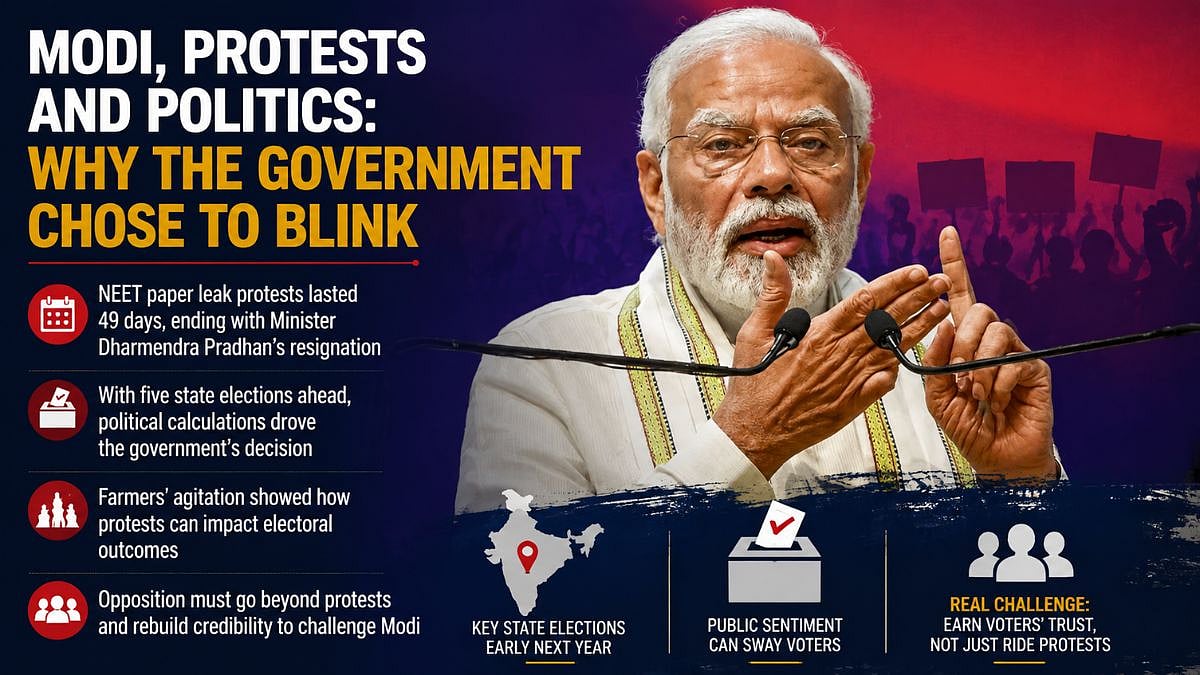
The article analyses the political calculations behind the Central Government's response to the NEET protest and its possible electoral implications | AI Generated Image
The students' stir over the NEET-UG paper leak may have ended with the resignation of the then Education Minister, Dharmendra Pradhan, and the Central Government agreeing to meet the other demands of the protesters, but the debate around it has certainly not ended. The race to take credit has already begun. Depending on political taste, it is being sold either as a defeat of the government or as proof of Prime Minister Narendra Modi's concern and largeness of heart.
The fact, however, is likely to be far more prosaic. This was not an act of Modi's magnanimity but a political decision made with the fast-approaching state elections in mind. Five states go to polls early next year. Except Punjab, the rest are BJP-ruled. Any setback in these states could have a bearing on the far more crucial 2029 Lok Sabha elections, when the BJP will be seeking a fourth straight term in office.
Modi's Political Calculus
Let us be clear: Modi is no saint. He is a hard-nosed politician who dislikes defeat and, more importantly, has rarely known it. In a quarter-century, he has not really been defeated at the hustings. He took over as Gujarat Chief Minister in October 2001, and the BJP went on to win three consecutive terms under his leadership. His winning streak only widened when the party projected him as its prime ministerial face in 2014. He has already set the record for the longest-serving elected Prime Minister, since Jawaharlal Nehru secured his first mandate only in the 1951-52 general elections. With half a dozen big victories behind him, Modi continues to remain an enigma for his opponents, who are yet to work out how to defeat him or even dislodge him from the high chair.
If he were as concerned and large-hearted as his admirers would like to believe, the students' stir may not have lasted for 49 long days. More likely, the authorities initially underestimated the satirical Cockroach Janta Party, founded by a US-based Indian activist. Many dismissed it as a joke, particularly after a controversial remark by the Chief Justice of India was interpreted as likening unemployed youth to cockroaches.
But the stir refused to fizzle out. With no sign of an early natural end and with the political calendar tightening, the Modi government was perhaps reminded once again of a simple truth: popular agitations and public sentiment can influence voters in ways that are not immediately visible but are often deeply felt at the ballot box.
Lessons From Farmers' Protest
The students' agitation can be compared with the farmers' agitation that lasted for over a year and four months, from August 2020 to December 2021. It began as a protest against the three contentious farm laws of the Modi government and then expanded into a broader demand for a legal guarantee on support prices for farm produce. That agitation, in many ways, punctured the BJP's dream of "Abki Baar 400 Paar". In the end, the party won only 240 seats in the 2024 Lok Sabha polls and had to cobble together a government with the help of its existing and new allies. Compared to 2019, the BJP's tally dropped by 63 seats.
The impact was visible in Uttar Pradesh too. In 2014, the BJP had won 71 of the state's 80 Lok Sabha seats. In 2019, that came down to 62, and in 2024, it crashed further to 33. That decline alone was enough to deny the BJP a majority on its own and force it into dependence on allies.
The tremors of the farmers' agitation were felt earlier in the 2022 Uttar Pradesh Assembly elections too. The BJP's tally fell from 312 seats out of 403 in 2017 to 255 in 2022. The message was not lost on the party.
Geography also matters. Uttar Pradesh, sitting next to Delhi on the eastern side and with a large chunk of the National Capital Region falling under it, has an unusually sharp sensitivity to central decisions. Add to this the fact that farmers from western Uttar Pradesh are traditionally combative, and that a substantial number of youths from the state had gathered at Delhi's Jantar Mantar during the students' stir, and the political risk becomes obvious.
A once-bitten, twice-shy Modi government was, therefore, in no mood to allow the students' stir to snowball into a larger electoral liability, especially with elections in Uttar Pradesh and other key states looming ahead. That is why the decision to blink was dressed up as magnanimity.
Challenge Before The Opposition
One should also not forget the larger political message such agitations send. They do not merely test the government's response; they also expose the Opposition's readiness, or lack of it, to convert street anger into lasting electoral gain.
There is, however, a word of caution for Modi's opponents, especially the Congress party. They tried to hijack the students' stir as though political branding alone could defeat Modi. It cannot. If the farmers' agitation could not dislodge him, this stir may not be enough either. Those who want to challenge him will have to do more than latch on to protests. They will have to reinvent themselves, rebuild credibility and make themselves genuinely attractive to the voter.
That is the harder task. And that is the one they keep avoiding.
Ajay Jha is a senior journalist, author and political commentator.
RECENT STORIES
-
-
-
-
-