Making Maharashtra Free Of Naxalism
Maharashtra's claim that no active armed Maoist remains is a milestone built on security operations and surrender policies, the editorial argues. It credits CM Devendra Fadnavis while noting earlier governments' role. The editorial says protecting tribal rights, rehabilitating surrendered Naxals and improving local governance must now remain key priorities to preserve these gains for the future.

Making Maharashtra Free Of Naxalism | AI
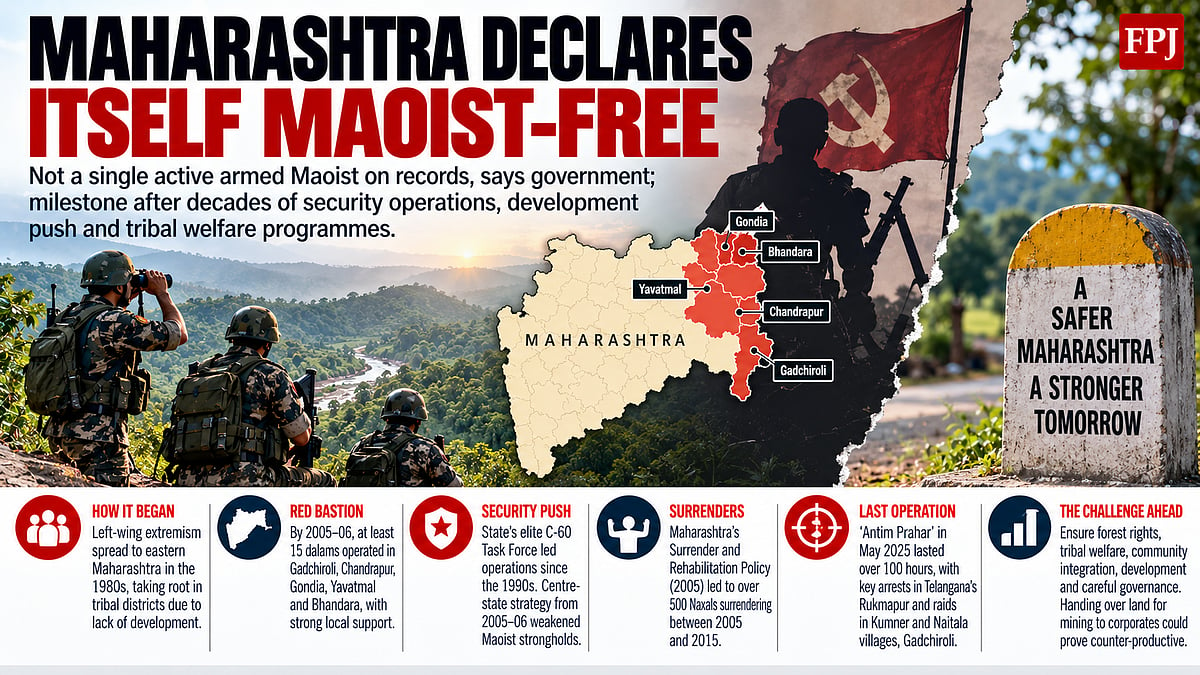
The Maharashtra government’s declaration that the state is free from armed Maoism or Naxalism, based on its assertion this week that not a single active armed Maoist remains on its records, should be welcomed with relief and caution. It has taken decades of sound strategy and foresight, bravery, and courage by the security forces on the ground and targeted development programmes and welfare schemes for the tribals in the affected districts to reach this milestone. The decisive and last operation, titled Antim Prahar, lasting over 100 hours, was carried out in May this year when a quartet of leaders was nabbed at Telangana’s Rukmapur railway station and raids conducted in Kumner and Naitala villages, Gadchiroli.
The Gadchiroli district, carved out of Chandrapur in 1982, was the red bastion of the Maoist struggle extended across eastern Maharashtra, which encompassed the tribal parts of Chandrapur, Gondia, Yavatmal, and Bhandara. These districts of Maharashtra, studies showed, suffered a spillover and an expansion of left-wing extremism from Madhya Pradesh, Chhattisgarh, and Andhra Pradesh (later bifurcated into Telangana) in the 1980s. Soon, it took root. By 2005-06, there were at least 15 dalams (units) across the districts with full-time cadres and robust local support.
The non-development of these districts, reflected in the absence of industries and strong welfare services such as health outposts and schools, allowed the armed rebellion against elected governments to flourish. The cadres were even able to set up a parallel ‘government’, Janatana Sarkar, in the dense forests of Gadchiroli in the first decade of the 2000s. However, the state’s elite Crack-60 (C-60) Task Force of commandos had been running counter-Maoist operations since the 1990s, and the strategic centre-state actions from 2005-06 had begun to dent the strongholds. Maharashtra’s Surrender and Rehabilitation Policy (2005) led to the surrender of over 500 Naxals between 2005 and 2015.
The past decade saw the final push and sharp action against Maoists—including controversially targeting the so-called support bases in urban areas with the ominous Maharashtra Special Public Security Act, 2025—that steadily led to high-profile arrests, collapse of the leadership, and mass surrenders. Chief Minister Devendra Fadnavis can be credited for having led Maharashtra to a Maoist-free status, but it must be remembered that he built on the far-reaching strategies and actions of his predecessors. This is the time to also recall the ultimate sacrifices that scores of security personnel made over the years in the line of duty battling landmines, IEDs, and hostile tribals. The challenge now is to ensure forest rights of tribals, community integration and welfare of surrendered Naxals, socio-economic development, and governance that addresses the basic needs of people. Making these districts Maoist-free to hand over rights to corporates for mining, as the government appears to do, might well be counter-productive.
RECENT STORIES
-
-
-
-
-