Maharashtra Government Set To Play The Villain In Interfaith Romance
The Maharashtra Freedom of Religion Act, 2026 has drawn criticism over its potential impact on religious freedom and interfaith relationships. The law requires 60 days’ prior notice before conversion, permits complaints by relatives and shifts the burden of proving a conversion voluntary and lawful to the accused, raising concerns over privacy and personal liberty.

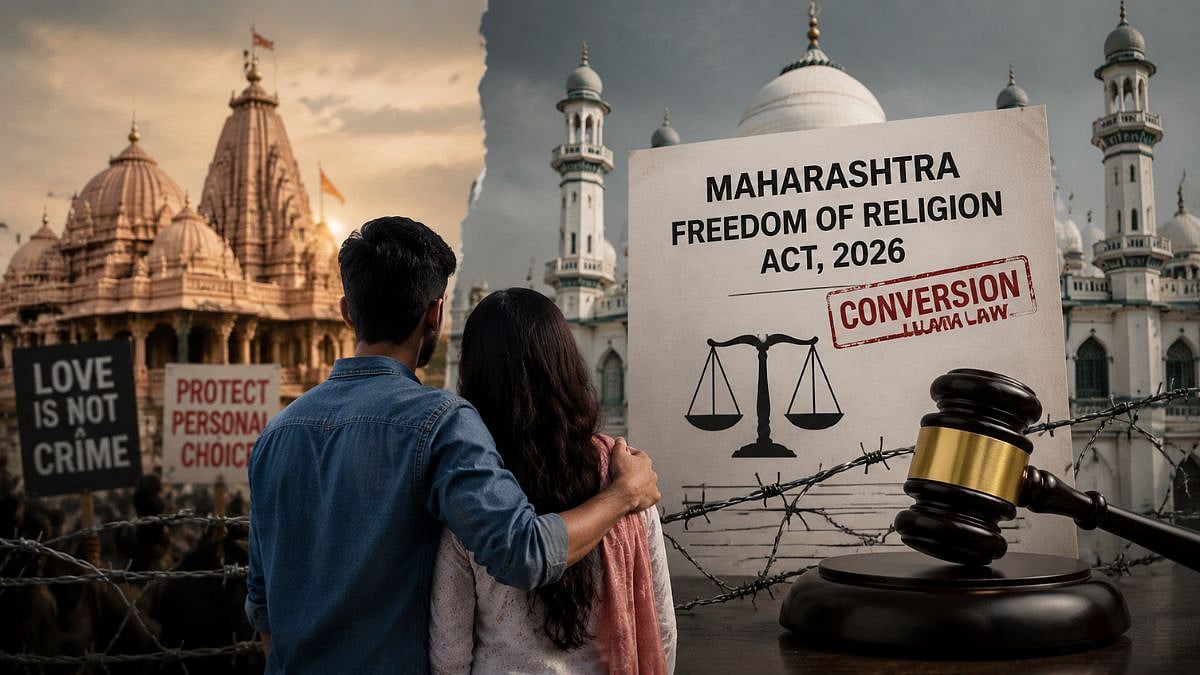
The Maharashtra Freedom of Religion Act has raised questions over privacy, religious choice and the rights of interfaith couples | AI Generated Representational Image
In matters of religious conversion, how exactly will state agencies distinguish between voluntary personal decision and coercion? Also, how will the state protect a person’s liberty and privacy? These and related questions linger even as the Maharashtra Freedom of Religion Act, 2026, has come into full force.
The first case was registered in Pune last month. Passed by the state legislature in March this year, within days of the introduction of the Bill by the Devendra Fadnavis government, without serious discussions, the law is supposed to prevent religious conversion by force, fraud, coercion, misrepresentation, allurement or undue influence.
However, it gives the state enormous power and oversight in matters of faith, ranging from voluntary embrace of a religious order to interfaith marriages.
The distinction between personal circumstances and coercion or allurements is a matter of judgement by police officials hardly trained in this. In fact, some have, in the past, displayed majoritarian religious bias.
The Act treats offering money, gifts, employment, education, promises of marriage, assurances of improved life or divine healing as unlawful inducements.
The risks are at least two-fold—the wide category of inducements means that genuine and lawful exchanges followed later by personal decisions to convert can attract criminal proceedings, and a legitimate exercise of one’s conscience and autonomy to change religions, a constitutional protection, becomes a potential criminal offence.
Key Provisions Under Fire
Three aspects of the law have drawn trenchant criticism—the mandatory 60-day notice to the district magistrate before conversion; complaints by relatives of the converted in interfaith marriages; and reversal of the burden of proof in which the accused must prove that the conversion was voluntary and lawful. By allowing relatives to file complaints, the law has turned familial or social opposition to inter-faith marriages into a legal issue.
The reversal of burden of proof means anyone can be accused and left to prove innocence for years. In one stroke, the Fadnavis government has placated its majoritarian vote bank raised on the propaganda of “love jihad” and “rice-bag converts”.
Cabinet minister and real estate mogul Mangal Prabhat Lodha had claimed that his department had got close to 100,000 complaints of “love jihad”, but RTI queries did not support this, nor does the government have a study backing the need for such a law.
Maharashtra Joins Other States
Of course, Maharashtra is not the first but the 13th state in India to enact such a law, but legal challenges to similar laws in other states are pending.
Importantly, the Fadnavis government chose to bypass the state’s revolutionary tradition of social reform laws for inclusivity and justice, including those framed by Rajarshi Shahu Maharaj of Kolhapur, who introduced, among other statutes, laws for free and compulsory education (1917), widow remarriage (1917), and inter-caste and inter-religion marriage (1919). How low has the state sunk now that a law is enacted against interfaith unions!
RECENT STORIES
-
-
-
-
-