Legislative Councils: The Last Refuge For Political Nonperformers
India's six State Legislative Councils face questions over their relevance, recurring costs and role as political rehabilitation platforms for leaders unable to win Assembly elections. Their abolition could free public funds for essential services such as healthcare, education and infrastructure.

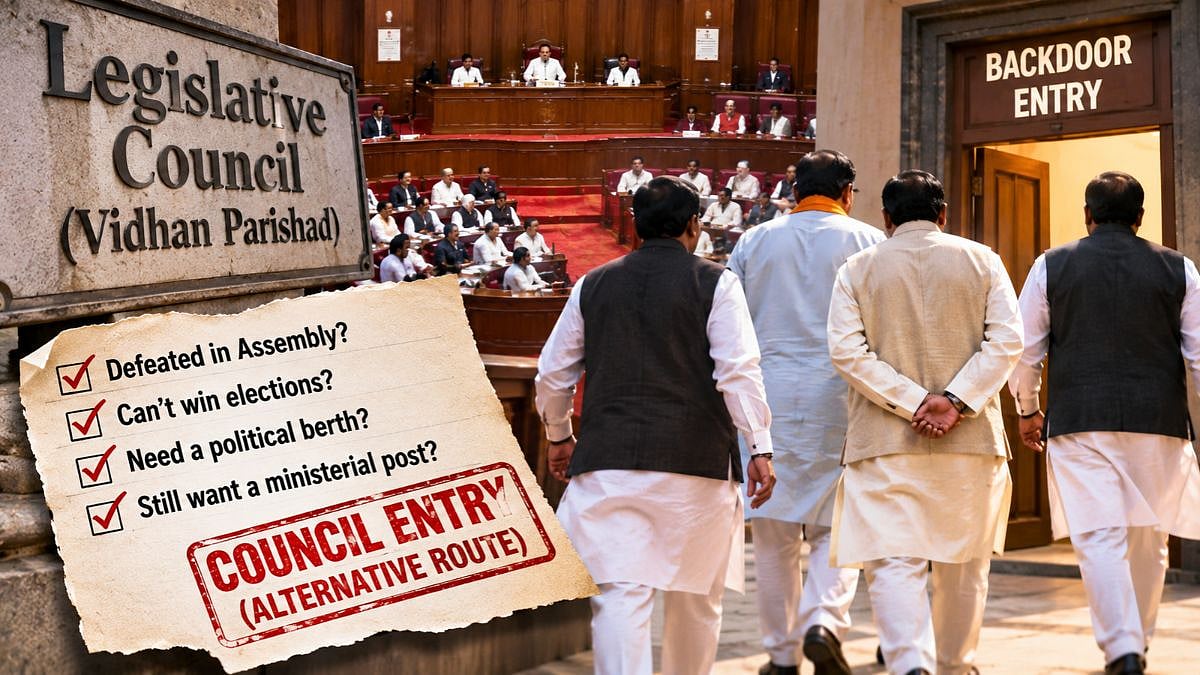
India's six Legislative Councils face renewed scrutiny over their electoral relevance, maintenance costs and role in accommodating political leaders | Representational Image
If politics, as the old saying goes, is the last refuge of the scoundrel, then State Legislative Councils are the last refuge of discarded politicians who cannot win Assembly elections otherwise.
The recently held Legislative Council (Vidhan Parishad) elections in some states were in the news. An impression was sought to be created that it was a general election in which the BJP suffered major losses. The fact remains that out of the 28 seats across four states, the BJP won 13, one more than its 2020 tally of 12. All the chatter was about its inability to win the Nagpur Division Graduates’ constituency in Maharashtra and the two seats of Varanasi. The focus was on Nagpur and Varanasi since Nagpur, besides being the RSS headquarters, is home to Maharashtra Chief Minister Devendra Fadnavis and Union Minister Nitin Gadkari, and Varanasi is the parliamentary constituency of Prime Minister Narendra Modi. However, none of these seats was held by the BJP. The Congress in Nagpur and the Samajwadi Party in Varanasi merely retained the seats they had won in 2020.
Utility Of State Legislative Councils
Beyond the results, it is time to ponder the utility of the state councils and whether they matter or are the right platform to gauge the mood of the voters. Of the 28 states, only six have legislative councils, which means more than 78 per cent of the states do not have one. The six states—Andhra Pradesh, Bihar, Karnataka, Maharashtra, Telangana and Uttar Pradesh—together have 426 seats. Of these, 367 are elected, and the remaining 59 are nominated by the state governors on the advice of the state governments.
And who are the voters in these elections? Not all teachers are voters, nor are all graduates, because the majority of them either do not know how to enrol or do not bother. Unlike in general elections, there is no door-to-door enrolment. One has to apply to become a voter, and a large majority simply ignore it since the state councils neither make nor unmake a government.
Of the 22 states without a legislative council, four abolished it, while the remaining 18 never had one. The Assam council was abolished in 1947, the Punjab and West Bengal councils in 1969, and the Tamil Nadu council in 1986. The States Reorganisation Act of 1956 provided for a council in Madhya Pradesh, but the President never notified a date for it to come into being. These abolitions were made on the recommendation of the respective state assemblies, mostly during the era when the Congress was in power at the Centre and in most of the states. The argument given at the time was that the Upper Houses were costly, unrepresentative and obstructed the elected assembly.
Attempts To Revive Councils
Since then, some states have made feeble attempts to get councils revived or created. The list includes attempts to revive the Assam and West Bengal councils and to create an Upper House in Odisha and Rajasthan. The most hilarious was the West Bengal Assembly’s 2021 resolution for revival, passed only to ensure that the then Chief Minister, Mamata Banerjee, who had been defeated in the Assembly election, could continue in her post. It is amazing that a state can seek the revival of a dead body only to safeguard an individual’s chair. However, Mamata Banerjee got elected to the Assembly through a by-election, and the resolution was never brought before Parliament for its mandatory approval.
The states spend crores of rupees every year on maintaining white elephants like the legislative councils, merely to ensure that defeated politicians remain eligible to continue as chief ministers or ministers, or that those rejected by the voters are kept happy, as their parties need them to keep some castes and communities in good humour. No official figure is readily available, but in a large council state, such as Uttar Pradesh or Bihar, the annual bill, once salaries, pensions, staff, infrastructure and development funds are counted, is likely to run into tens of crores of rupees. For smaller councils, the recurring costs are lower, but still substantial. The larger question is whether it is worth maintaining rejected or armchair leaders who cannot otherwise win direct elections. Imagine if the money spent on keeping such politicians in comfort were diverted to the crying needs of public health, education and infrastructure!
The Rajya Sabha Comparison
One may be tempted to extend this argument to suggest that the Rajya Sabha is also a refuge for rejected politicians, which to some extent is true. Yet, Rajya Sabha members are indirectly elected by the people, as only representatives elected by them to the state assemblies are eligible to vote in Rajya Sabha elections.
It is probably high time to take the tough call on abolishing these six state legislative councils once and for all, as they have no business remaining besides providing a safe passage to power to those who cannot win direct elections. But the moot question remains: who will bell the cat? Of the six states where they exist, Uttar Pradesh, Maharashtra and Bihar are ruled by the BJP, while Andhra Pradesh is governed by one of its key allies, the Telugu Desam Party. The remaining two, Karnataka and Telangana, are ruled by the Congress.
Ajay Jha is a senior journalist, author and political commentator.
To get details on exclusive and budget-friendly property deals in Mumbai & surrounding regions, do visit: https://budgetproperties.in/
RECENT STORIES
-
-
-
-
-