It Is Time To Take Tough Decisions Regarding OTT Platforms; A Dialogue Alone Won’t Do
A fresh controversy has arisen regarding the film Satluj. For the past four years, the film had not received certification from the Central Board of Film Certification (CBFC) as the producer and the board could not reach an agreement on certain issues.

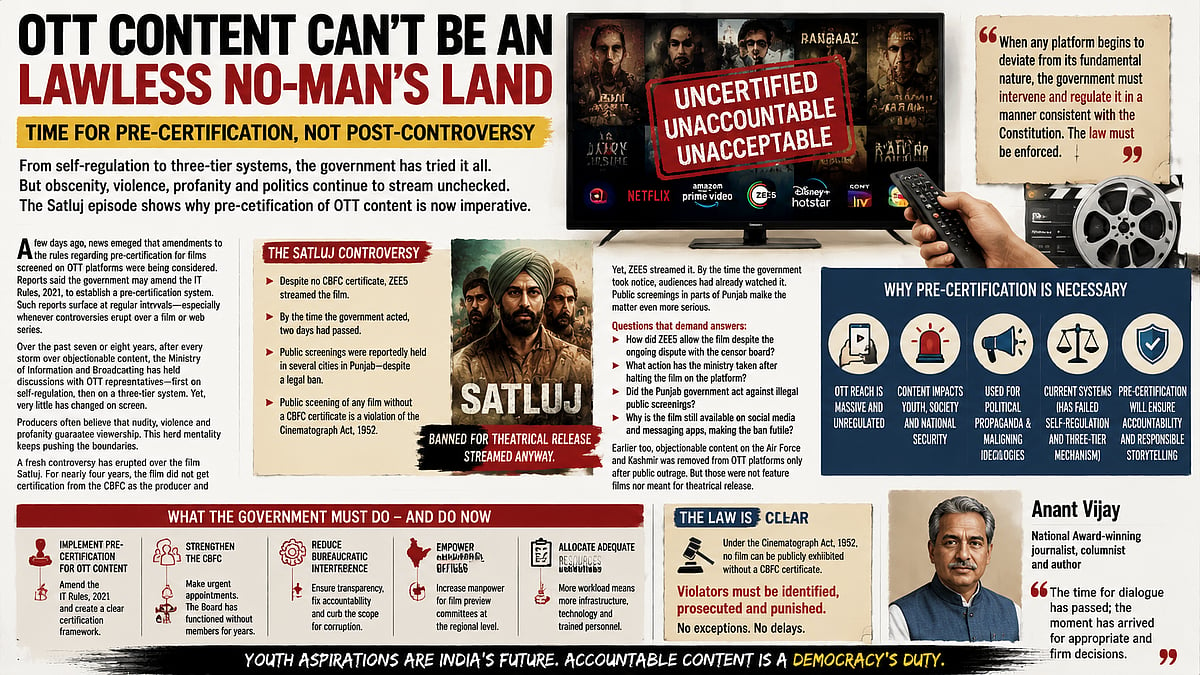
It Is Time To Take Tough Decisions Regarding OTT Platforms; A Dialogue Alone Won’t Do | AI
A few days ago, news emerged that amendments to the rules regarding pre-certification for films screened on Over-the-Top (OTT) platforms were being considered. It was reported that the government is deliberating on establishing a pre-certification system for films shown on OTT platforms. It also mentioned that the government might amend the IT Rules, 2021, to facilitate such re-certification. Such reports surface at regular intervals. Whenever questions arise regarding a specific film or web series, this topic inevitably comes up. Over the past seven or eight years, whenever controversies have erupted over content on OTT platforms, reports have surfaced suggesting that the Ministry of Information and Broadcasting is contemplating a strict review of the content. The ministry has previously held several rounds of discussions with representatives from OTT platforms. Representatives from the entertainment industry were conveyed a stern message by the government during these meetings. Initially, the focus was on self-regulation, followed by the establishment of a three-tier system. However, no significant change has been observed in the content streamed on OTT platforms. Lack of restraint regarding content and dialogue persists. Occasionally, certain series and films are released that pass without controversy. Yet, there are producers who persist in incorporating sexuality, nudity, grotesque scenes, violence, or profanity-laden dialogues into their films and web series. Web series producers often believe that spicing up a series with nudity, violence, and profanity guarantees success. The entertainment world is driven by a herd mentality; once a successful formula is found, everyone rushes in that direction and keeps following the same path.
A fresh controversy has arisen regarding the film Satluj. For the past four years, the film had not received certification from the Central Board of Film Certification (CBFC) as the producer and the board could not reach an agreement on certain issues. Meanwhile, ZEE5 began streaming it. By the time the government took notice, two days had already passed, and the intended audience had already watched it. Although the film is legally banned from public screening in India, reports indicate that public screenings have taken place—or are currently underway—in several cities across Punjab. This is a matter of grave concern. Public screening of any film without a CBFC certificate constitutes a violation of the Cinematograph Act, 1952. Under this Act, any film intended for public screening must first obtain a certificate from the Film Certification Board. The CBFC assesses whether a film is suitable for public viewing and evaluates whether it poses any threat to the country's integrity and sovereignty. The board examines various other factors as well to determine the appropriate category for public exhibition before granting permission in the form of a certificate. The public screening of the film Satluj without a censor certificate is unlawful; the Punjab Police or the administration should have stopped the screenings. An even more significant question is how and why ZEE5 permitted the film to be shown on its platform. Were they not unaware of the ongoing dispute between the producer and the censor board? If they were unaware, it is surprising; if they proceeded despite knowing the situation, the ministry of information and broadcasting ought to look into the matter.
This is not the first time such a controversy has arisen; disputes regarding content on OTT platforms have occurred frequently. Previously, objectionable dialogues and visuals concerning the Indian Air Force and the situation in Kashmir were shown on OTT platforms, only to be removed following public outcry. However, those were not feature films, nor did they have a public theatrical release. The fact that Film Satluj remains available on social media and messaging apps renders the ban futile. The nation also wants to know what actions the government took after halting the film's screening on Zee5. What steps did the ministry take subsequently? Did the Punjab government take any measures to identify and punish the violators? It is deeply concerning that those who frequently speak about the erosion of constitutional institutions either failed to notice this incident or chose ignorance. The time has come for the ministry to take concrete decisions regarding OTT content with utmost seriousness. It is time to move beyond mere rhetoric about taking strict action or sparing no one. The government has given the entertainment industry ample leeway. The self-regulation mechanism almost failed, and the three-tier system also proved ineffective. Consequently, the government should now implement a system for the pre-certification of broadcast content.
Establishing a certification system for OTT content will not be easy. It requires creating an institutional framework in addition to mobilising human resources. The ministry must prioritise this initiative. Attention must also be paid to the Central Board of Film Certification (CBFC), which has been functioning without members for years; appointments need to be made urgently. While operations can continue without members, it leads to various complications. Relying on temporary experts makes it difficult to fix accountability. The absence of members increases the interference of bureaucrats of the system, creating fertile ground for corruption, a phenomenon observed in the past. Resources must also be allocated to the regional offices of the certification board. The number of members responsible for previewing films at the regional level needs to be increased. Bringing OTT content under the purview of the film certification board will add to the workload. This step has become necessary because web series and films on OTT platforms are increasingly being used to engage in politics under the guise of entertainment. This is turning into tools for political messaging or for maligning individuals and ideologies. When any platform begins to deviate from its fundamental nature, the government must intervene and regulate it in a manner consistent with the Constitution. The law must be enforced. This is precisely the situation emerging with OTT platforms. The time for dialogue has passed; the moment has arrived for appropriate and firm decisions.
Anant Vijay is a National Award-winning journalist, Columnist and author and is currently working with Dainik Jagran.
RECENT STORIES
-
-
-
-
-