India's Union Budget 2026-27: A Bet On Manufacturing Amid Fiscal Constraints
The 2026-27 budget focuses on fiscal discipline with a debt reduction target and a ₹60,000 crore manufacturing push across seven sectors to create jobs. It shifts urban investment to Tier-2 cities and raises stock market transaction taxes. While services and consumption drive growth, manufacturing support is a cautious bet amid fiscal constraints and global competition.

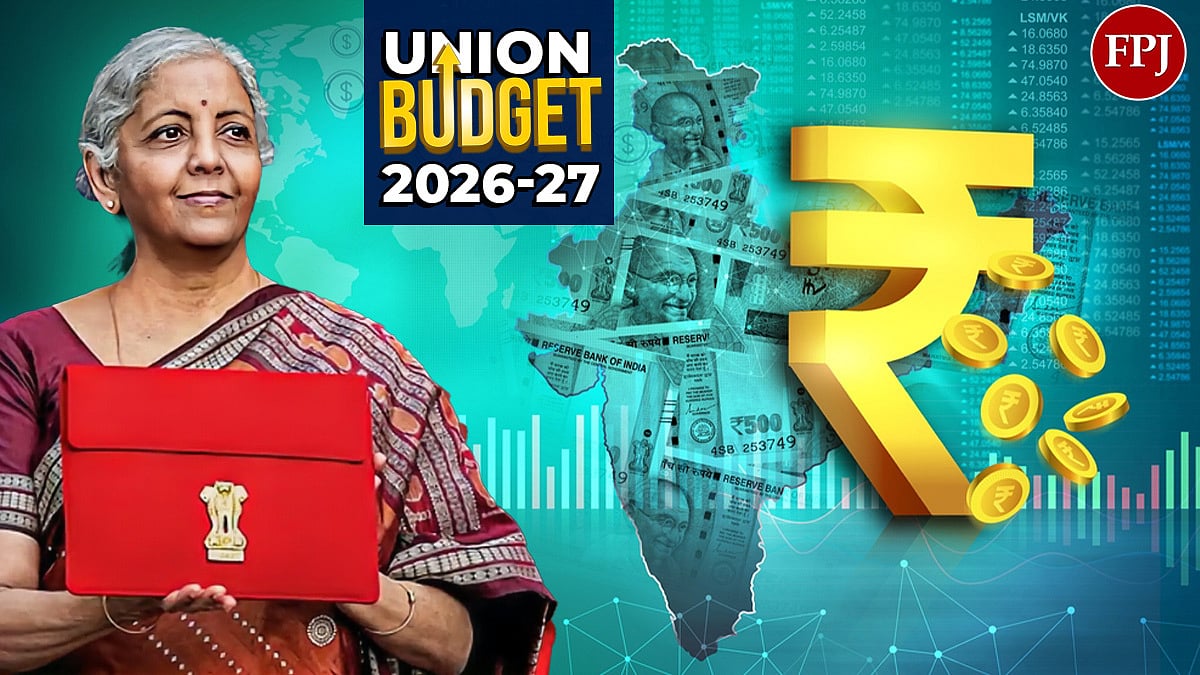
India's Union Budget 2026-27: A Bet On Manufacturing Amid Fiscal Constraints | FPJ
Union Finance Minister Nirmala Sitharaman presented a budget that looks prudent on paper but reveals something uncomfortable when read between the lines: the government has run out of easy choices. ‘The 202627 budget revealed its priorities in three stark moves: a manufacturing push across seven sectors with targeted subsidies, a sharp hike in stock market transaction taxes that rattled traders, and a formal commitment to reduce debt asits fiscal anchor. Finance Minister Nirmala Sitharaman framed it as "disciplined growth"—but for taxpayers, investors, and ordinary Indians, the question's whether it's enough to create jobs and raise incomes, or just another round of careful bookkeeping.
‘The centrepiece is a 7-sector manufacturing strategy: semi- conductors (equipment and de- sign), electronics components, biopharma, containers, chemicals, capital goods, and textiles. The budget allocated 340000 crore to electronics components, 10,000 crore each to biopharma and containers, and unspecified amounts to the remaining sectors. The government is using the tax system—subsidies, duty exemptions, and depreciation incentives—to pull factories into India. ‘This is a conscious pivot. Instead of spreading money across welfare schemes or tax relief, the government's betting that targeted manufacturing support will create jobs at scale.
‘The logic is sound: every semiconductor fab (fabrication plant), biopharma plant, or container factory employs thousands of direct workers and many more in supply chains. If India can capture even 5-10 per cent of global manufacturing in these sectors, it changes the employment story. But the numbers need scrutiny. The Rs40,000 crore for electronics components spread over five years is Rs8,000 crore annually across dozens of companies—roughly Rs50-100 crore per firm. India's electronics assembly sector is growing, creating anchor demand, which helps. Yet Chinese competitors operate at scales 50-100 times larger and at 10-15 per cent lower cost due to integrated supply chains. Indian manufacturers will need sustained protection or cost breakthroughs to compete.
The scheme helps, but it's not transformative without demand. Biopharma faces similar constraints. The Rs10,000 crore allocation (Rs2,000 crore annually) appears ambitious: establishing three new research institutes, upgrading seven existing ones, and establishing 1,000 clinical trial sites. But upgrading a single institute costs Rs500-800 crore. The arithmetic suggests the Budget covers 10-15 per cent of stated ambitions. India will likely get 2- 3 world-class plants and a handful of upgraded research institutes—good progress, but not the "global biopharma hub" promise. The government has also announced Rs5,000 crore per "City Economic Region" for Tier-2 and Tier-3 cities. These include Pune, Ahmedabad, Kochi, Coimbatore, Lucknow, and temple towns such as Varanasi, Ayodhya, and Tirupati.
The idea: build competing metros rather than deepen existing ones. Lower land costs, available labour, and growing consumer demand—Tier-2 cities have all of it. It's economically sensible. It's also politically safer: metros are congested, gritty, and full of voters who'd rather have their issues solved than hear about balanced urbanisation. Tier-2 cities are growing, optimistic, and grateful for attention. The government is choosing to placate Tier-2 rather than admit that metros are underinvested in. Urban development allocation actually fell 11.6 per cent—from Rs96,777 crore to Rs85,522 crore.
The government is reallocating money from metros to Tier-2 cities, not adding to them. That's a zero-sum game. Delhi, Mumbai, Bangalore wait. Pune and Ahmedabad get the chance to become the next metros. The Inheritance Problem Every rupee the government collects is already spoken for. Interest payments consume ₹10.70 lakh crore annually—30 paise of every rupee earned. Add salaries, pensions, and fertiliser/food subsidies, and 65-70 per cent of revenue vanishes before a single road is built or a school is funded.
The budget formalised this trap by adopting debt-to-GDP as the fiscal anchor instead of annual deficits. Central debt: 55.6 per cent of GDP, target 50 per cent by 2030-31. Translation: the government is saying it will not spend its way out of fiscal constraints. It will instead reduce debt relative to the size of the economy. That's economically sound. It's also politically limiting. It means no major new welfare schemes. No middle-class tax relief. No bold expansion of public health or education. The government has mortgaged the future to pay for the past, and now it's telling voters: Have patience, we're consolidating. A fiscal deficit of 4.3 per cent (down from 4.4 per cent) sounds stable.
But revenue deficit at 1.5 per cent shows the knife is cutting—the government is no longer even spending on committed, recurring programmes at the rate it would prefer. The Growth Story The Budget projects nominal GDP growth of 10 per cent. Real growth of 6.8-7.2 per cent (Economic Survey estimate). Here's what matters: the growth isn't coming from manufacturing. Service sector expands 9.1 per cent. Private consumption grows 7 per cent and will hit 61.5 per cent of GDP—the highest since 2012. Business investment (GFCF) rises 7.8 per cent. These are the engines. Manufacturing? The Rs60,000 crore across seven sectors is a seed, not a crop. The government is essentially saying: growth will be fine in 2026-27 because services and consumption are humming.
But we're betting that manufacturing will sustain growth through 2027- 28 and beyond, as services mature. It's a wager on execution in a country with a patchy record of PLI scheme execution. Gross tax revenue holds at 11.2 per cent of GDP, suggesting tax compliance will remain steady. There's no hidden tax grab here—the government is not expecting a revenue surprise to bail it out. Effective Capital Expenditure: The State Game The government allocated Rs12.22 lakh crore for direct capital expenditure. But effective capex—including grants-in-aid to states for capital creation—is Rs17.15 lakh crore, or 4.4 per cent of GDP. States will receive Rs16.56 lakh crore through the Finance Commission: Rs15.26 lakh crore in tax devolution, Rs1.4 lakh crore in grants. This is clever fiscal arithmetic.
The Centre is offloading half its infrastructure delivery to states. The risk: states with fiscal stress (many owe 28-30 per cent of GDP) might not execute their allocations. If states don't spend, effective capex falls, and growth slows. The government is betting that states are healthy enough to spend. History suggests otherwise. Amidst all this, the government has sharply raised the Securities Transaction Tax on derivatives: futures from 0.02 per cent to 0.05 per cent, options from 0.10 per cent to 0.15 per cent. For 1.5 crore F&O traders, this is a 2-3x increase in costs.
The stated rationale: curb speculation. The real logic: raise Rs300-500 crore annually without touching broad-based taxes. It had its impact: Nifty fell 2.5 per cent on budget day. Derivatives volumes are expected to fall 15-30 per cent. The trade-off: more government revenue, less market efficiency, wider bid-ask spreads, higher hedging costs for genuine risk management. It's not a mistake—it's a political choice that government revenue trumps market function. The budget is technically competent: debt anchor, capex focus, manufacturing bet. It's not reckless.
It's not transformative either. The budget bets on three things: that manufacturing will deliver jobs, services will sustain consumption-driven growth, and the FTA will improve exports. It's betting against fiscal constraints, capital outflows, tariff escalation, and state incompetence. For a developing economy with inherited debt, that's either prudent or pessimistic—depending on whether you believe India can export its way out of it. The budget assumes it can. The falling rupee and fleeing investors suggest the world isn't convinced yet.
RECENT STORIES
-
-
-
-
-