Indian Parliament’s Hollow Core: Policy Debates Give Way To Disruption, Symbolic Clashes And Legal Showdowns
The 2026 Budget session of Parliament was marked by adjournments, suspensions and political retaliation, leaving key economic and national issues undebated. Symbolic clashes between government and opposition deepened mistrust, raising concerns over the erosion of democratic accountability and legislative purpose.

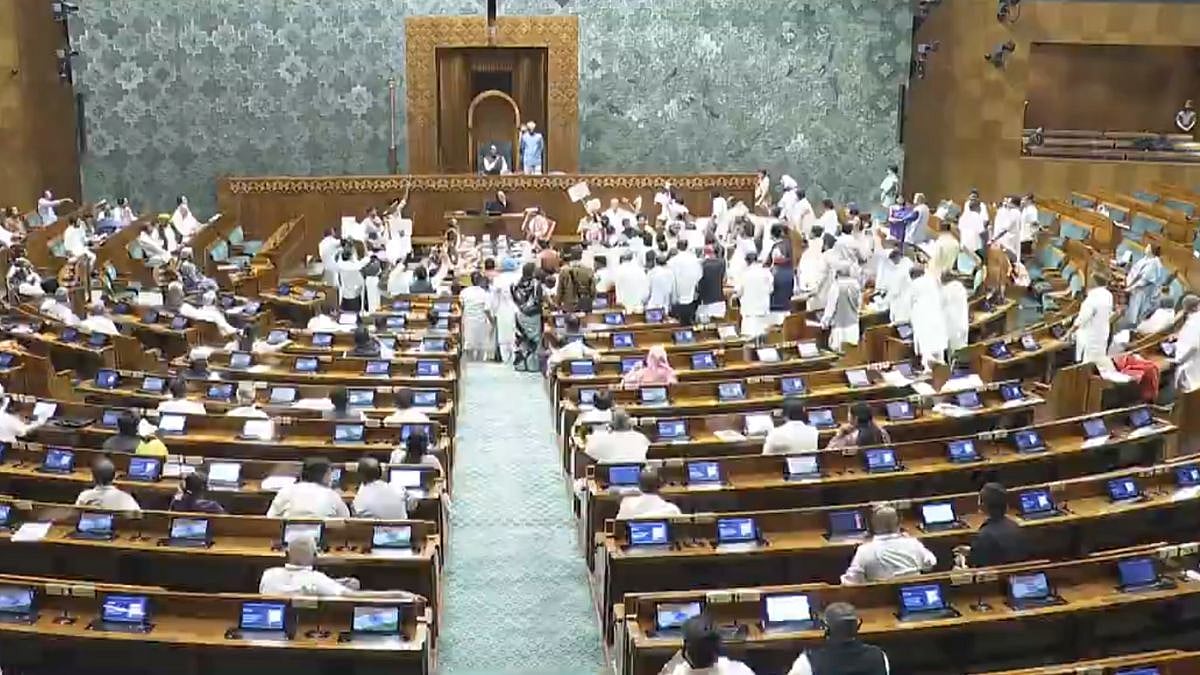
Repeated adjournments and political confrontations disrupt proceedings in Parliament, overshadowing crucial budget and policy discussions | X @sansad_tv
The Indian Parliament, once the vibrant arena of national debate and democratic accountability, now stands hollow—its chambers echoing not with reasoned arguments but with the clamour of distrust, procedural traps and mutual recrimination.
In the first phase of the 2026 Budget session, which concluded with adjournment sine die on February 13 before resuming on March 9, what should have been a rigorous examination of the Union Budget—addressing economic pressures, rural distress, unemployment, defence spending amid border tensions and fiscal allocations for a nation of 1.4 billion—degenerated into near-total paralysis.
The session became a stark illustration of form over substance: endless adjournments, symbolic motions and orchestrated outrage supplanted any meaningful discussion on policy or development.
Uproar over Naravane memoir reference
The spark came early, during the debate on the Motion of Thanks to the President's Address. Rahul Gandhi, as Leader of the Opposition, sought to reference excerpts from an unpublished memoir by former Army Chief General MM Naravane, titled Four Stars of Destiny, which reportedly detailed lapses in handling the 2020 Galwan Valley clash with China.
Gandhi aimed to question the government's narrative on national security and Prime Minister Narendra Modi's decisiveness. The Speaker disallowed it, citing rules against unpublished material, triggering immediate uproar.
Congress MPs rushed to the Well, tore papers and threw them towards the Chair, leading to the suspension of eight opposition members, mostly from Congress. Multiple adjournments followed, with proceedings halted for hours or entire days.
Escalation and counter-moves
This single incident snowballed into the session's defining feature. The government, leveraging its majority, responded aggressively: a BJP MP, Nishikant Dubey, moved a substantive notice seeking Rahul Gandhi's expulsion from the Lok Sabha on grounds of "anti-India activities", alongside an FIR related to the manuscript's handling.
Parliamentary Affairs Minister Kiren Rijiju accused the opposition of stalling and denying even government members a chance to speak on the Budget. In a telling admission, Speaker Om Birla reportedly advised Modi against attending to deliver his scheduled reply to the President's Address, citing fears of disruption and potential threats to the Prime Minister's safety—a reflection of the heightened security measures in Parliament since mid-2024, when the Central Industrial Security Force assumed protection duties.
Opposition pushback and procedural deadlock
The opposition, led by Congress, escalated further by submitting a no-confidence motion against the Speaker, signed by 118 MPs from the INDIA bloc and others, questioning Birla's impartiality in disallowing Gandhi's intervention while permitting provocative remarks from the treasury benches.
In the Rajya Sabha, similar bitterness surfaced: opposition attempts to move resolutions against the Chairman and Deputy Chairman were dismissed on technical grounds. Throughout, substantive business suffered.
The Houses barely managed limited productive time; key legislative items gathered dust, and the Budget's core proposals—defence outlays amid ongoing border concerns, rural employment schemes strained by economic slowdowns and infrastructure pushes—escaped serious scrutiny.
Standing committees would examine allocations during the recess, but the constitutional power of the purse, vested in the Lok Sabha, was effectively sidelined in the chamber itself.
Trust deficit at the heart of dysfunction
This dysfunction stems from a profound trust deficit. The BJP-led coalition, commanding a slim majority post-2024 elections and reliant on allies, views opposition tactics as deliberate sabotage aimed at headline management rather than accountability.
Congress, energised by its stronger showing in those polls, fixates on high-profile confrontations like the Naravane reference, often at the expense of broader INDIA bloc coordination. Allies, such as the Trinamool Congress and Samajwadi Party, pursued separate regional grievances—electoral roll manipulations in West Bengal or local issues in Uttar Pradesh—but found their voices drowned in the Congress-centric storm.
The result: a fragmented opposition unable to mount a unified critique and a government content to let disruptions run their course, knowing its numbers ensure passage of essential business even amid chaos.
Shared responsibility and democratic cost
Both sides bear responsibility. The opposition squanders its platform by prioritising symbolic battles over policy interrogation, allowing the government to deflect scrutiny. The ruling side, rather than de-escalating through transparency—such as addressing border preparedness openly—opts for counter-motions and legal reprisals, deepening the divide. This adversarial spiral treats political opponents as enemies, not adversaries worthy of engagement. The absence of accommodation erodes institutional dignity: the Speaker's role as neutral arbiter weakens, the Leader of Opposition's interventions are stifled, and the House itself becomes a boxing ring rather than a debating forum.
The cost to democracy is immense. With Parliament reduced to procedural theatre, citizens lose the chance to see their elected representatives grapple with pressing realities—rising inequality, climate vulnerabilities, job creation for the youth bulge and geopolitical challenges.
Historical sessions, even turbulent ones in coalition eras or during landmark Bills, eventually found resolution through mutual restraint and backchannel dialogue. Today's bitterness offers no such pathway without deliberate statesmanship.
A call for reset
To reclaim its purpose, Parliament needs a reset: leaders must prioritise debate over demolition, allow space for diverse voices within alliances and restore civility to proceedings. Only then can the hollow echoes give way to the robust roar of a functioning democracy. Until that shift, the institution risks remaining a shadow of its intent—full of noise, empty of answers.
Sayantan Ghosh is the author of The Aam Aadmi Party: The Untold Story of a Political Uprising and Its Undoing. He is on X as @sayantan_gh.
RECENT STORIES
-
-
-
-
-