India Lurching From One Disaster To Another; Decongestion Brooks No Delay
Recurring urban disasters in India stem from poor town planning, inadequate enforcement of safety norms and chronic congestion, the commentary argues. Using the Lucknow fire and other incidents as examples, it calls for uniform urban planning, decentralisation, stricter implementation of building codes and greater civic accountability.

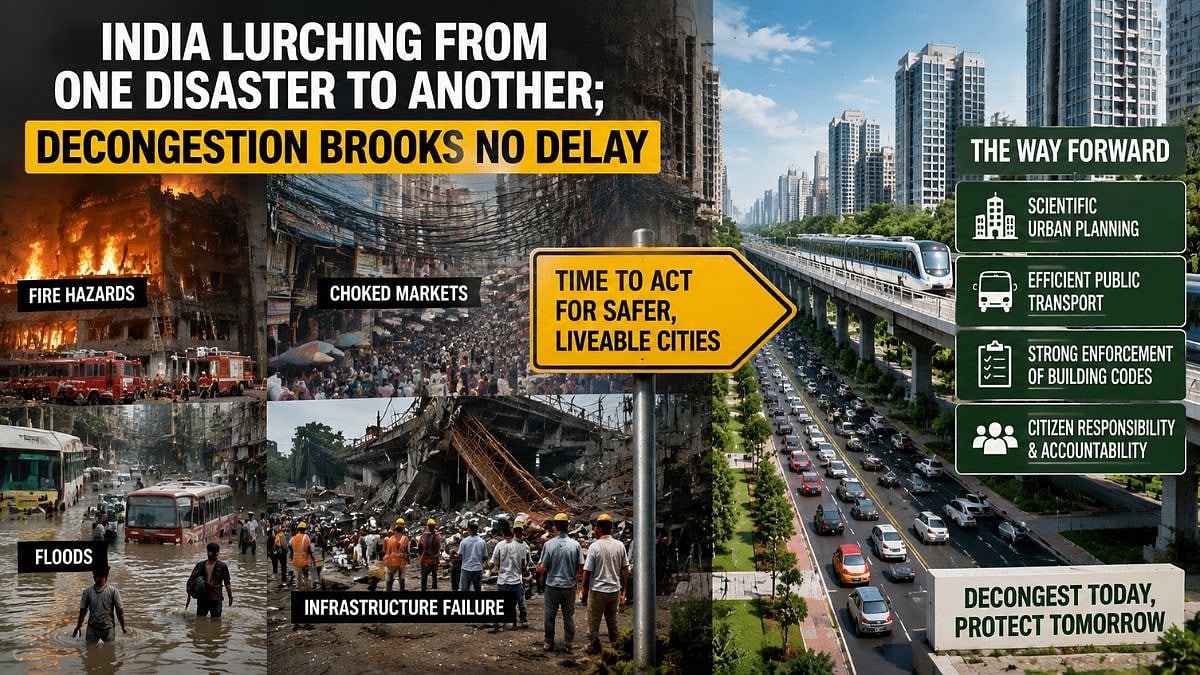
The commentary calls for stronger urban planning and decongestion to reduce the risk of recurring disasters | AI Generated Representational Image
A narrow, dingy staircase, which doubled as the sole entry and exit; absence of emergency exit doors, much simpler to put in place than in aircraft; and scarcely any ventilation in any of the halls or rooms—the sordid and shocking details that are emerging about the three-storey building that went up in flames in Lucknow on June 22, killing at least 15 people, seem strikingly similar to the lapses in hostels, coaching centres, hospitals, and business centres that were the sites of recent fire outbreaks as well as in the distant past.
Urban Congestion And Civic Failure
We banish slums, an eyesore for the well-heeled, to the fringes of the city, like the mega rehabilitation centres at Mangolpuri and Sultanpuri in Delhi. But when it comes to decongesting the shopscape, we hardly bestir ourselves. Chandni Chowk, with its Byzantine lanes choc-a-bloc with shops; Zaveri Bazaar in Mumbai; and Bara Bazaar in Kolkata are equally eyesores but romanticised as middle-class shopping centres, harking back to ancient civilisation. In such bazaars, disasters do strike time and again, with lanes frustratingly coming in the way of ambulances and fire brigades, but once the sound and fury of the public and the media are over, it is business as usual.
In the US, one is pleasantly surprised by the uniformity and conformity when it comes to shopping-complex layout and design. A country known for its empowerment of the states, such uniformity bespeaks a heightened civic sense both among the public and the town planners. Shop owners in a complex have to arrange for boxed car parking, including spaces reserved for the handicapped, toilets, and dustbins. Contrast this with haphazard parking at busy shopping centres in India that adds fuel to the fire when a fire breaks out.
Why blame the administrators and town planners alone? We citizens are equally to blame. New buildings bring in road rollers and cranes that leave a trail of destruction on the adjacent public roads. The ‘polluter pays’ principle, the cornerstone of civic discipline in the US, is conspicuous by its absence in India. We blame the municipality for laying shoddy roads that break up at the first hint of the monsoon but hardly put up resistance to new constructions, accelerating the damage to the roads.
Lessons From Past Failures
With such limitations, one apprehends what would happen to India’s bid to host the 2036 Olympics at Ahmedabad. The 2010 Commonwealth Games in New Delhi exposed severe infrastructural, structural, and management failures. Budget overruns ballooned costs from $412 million to $6 billion amidst widespread corruption, leading to collapsed bridges and unliveable conditions in the athletes' village. Less than two weeks before the event, national teams (including New Zealand, Canada, Scotland, and Northern Ireland) threatened to withdraw after finding the athletes' village unfinished, filthy, and structurally compromised. Days before the opening ceremony, an under-construction pedestrian footbridge near the Jawaharlal Nehru Stadium collapsed, injuring multiple labourers. On the first night of the swimming events, debris and part of the ceiling fell into the competition pool, resulting in race delays. Multiple constructed facilities suffered from poor-quality materials, with reports of live wires, leaking roofs, and broken plumbing even in premium areas.
India is a classic story of municipal failure, with fires and floods wreaking havoc every year. Though called natural calamities, they turn out to be man-made disasters thanks to poor town planning. The excuse trotted out without batting an eyelid is that India is overburdened by population and, therefore, should not be compared with the US. Touché! The truth is we have not decongested our cities beyond nudging denizens of Delhi to move over to Noida and Gurugram and denizens of Chennai to Sriperumbudur. The concentration of shops and office complexes places a heavy burden on infrastructure, with unauthorised power connections taking a heavy toll in peak summers. It is not for nothing that in the US, the commercial and political capitals of states are different. To wit, the political capital of California is Sacramento and not Los Angeles or San Francisco, the bustling metropolises. And again, Albany is the political capital of New York and not New York City. But for such a conscious decision in town planning, New York City would be reeling from power outages and water shortages.
Need For Better Planning
The Bureau of Indian Standards’ National Building Code, which came into effect 10 years ago, to be sure, has comprehensive fire safety guidelines. Several state governments, including Uttar Pradesh, have incorporated these provisions into their building codes. The state also has a Fire and Emergency Services Act, which mandates swift action after an outbreak. But in the face of administrative laxity in implementation and irregular inspections, even the most robust protocols remain on paper.
Multiple civic agencies, too, have been the bane of Indian cities. In Delhi, for example, we have a state government, albeit sans oversight over police and land, these being under the Central government. The Municipal Corporation of Delhi and the NDMC are the municipal arms of the state government. And at the town planning level, we have the Delhi Development Authority (DDA). Such plurality of agencies is conducive to sloth and buck-passing in the absence of clear demarcation of responsibilities. Truth be told, the opposite—overlapping jurisdiction—is the norm.
Whether we build consensus on the contentious Uniform Civil Code or not, what brooks no delay is consensus on uniform town planning, with decentralisation and decongestion being its leitmotifs. We are making progress in public transport thanks to embracing the concept of metro trains. Otherwise, our children, for example, would be sacrificed in their prime at the altar of municipal neglect, as happened in Lucknow, with shoddy construction and wiring taking a regular toll.
S. Murlidharan is a freelance columnist and writes on economics, business, legal, and taxation issues.
RECENT STORIES
-
-
-
-
-