How The World Is Navigating Global Chaos Under The Shadow Of War
Despite wars, geopolitical tensions and trade disruptions, the global economy has remained resilient. Diversification in energy, bilateral trade agreements, greater gold reserves, local currency trade and evolving economic strategies have helped nations absorb shocks, while global financial markets remain closely interconnected.

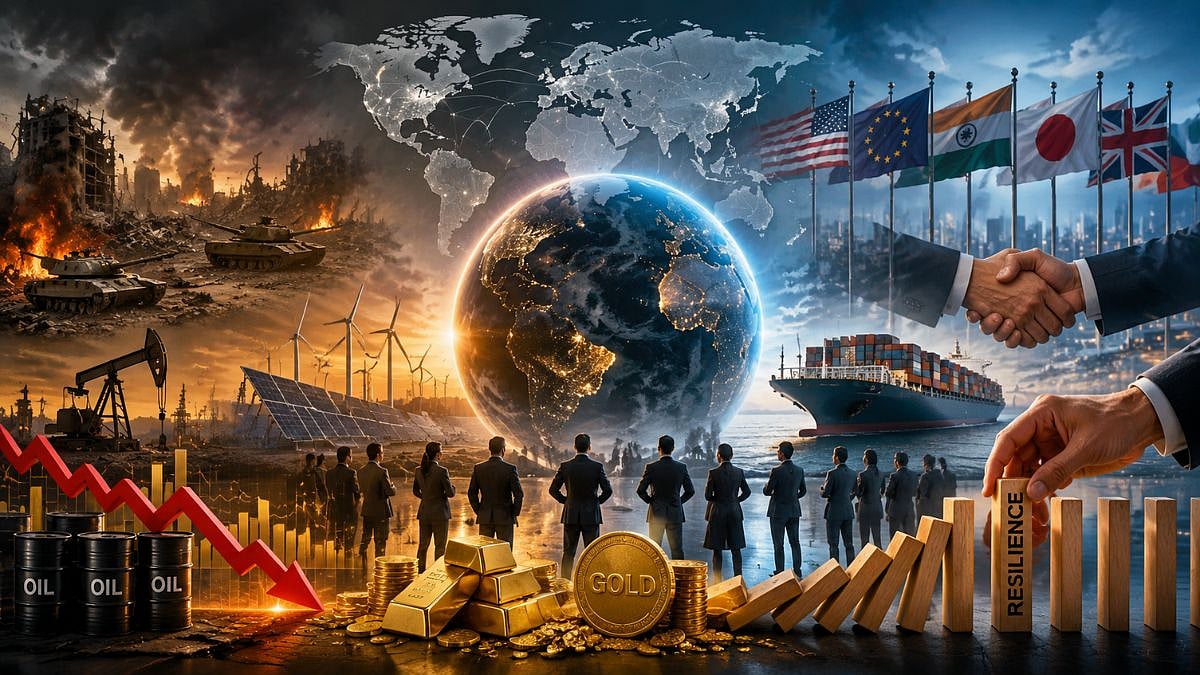
Global economic shifts are reshaping trade, energy and financial strategies as nations adapt to prolonged geopolitical uncertainty | AI Generated Representational Image
Is the world more resilient than it ever was? A pertinent question to ask, considering that post-COVID there have been several disruptions in the form of wars and fairly idiosyncratic policies pursued by the US. Yet, the world has not gone into a recession. Nor has there been runaway inflation in any geography. This is notwithstanding considerable volatility in the markets, where currencies and bonds have been erratic, which has been superseded, contrarily, by stock indices that have, in general, done very well. Just how does one piece this together?
The war between Russia and Ukraine led to an embargo on the former, with its foreign exchange reserves being impounded. There was a ban on dealing with Russia, though some allowances were made in terms of time, especially for gas imports. Then came the Israel-Hamas conflict, which continues even today. There were no sanctions on Israel, however, with the world condemning the action but not willing to take any action against the genocide. In 2025, President Trump had countries running to the US to strike deals to bring down tariff rates, which were unilaterally raised with differential rates for different countries.
The US invaded Iran in 2026 even after claiming to have destroyed its nuclear facilities a year earlier. The world went silent, with meek protests from some European countries that refused to support the action but did not openly condemn it. There was similar silence earlier when the US unilaterally picked up the elected head of state of Venezuela, exposing the rather ambivalent nature of the world.
What exactly have nations done to buffer against these shocks? This is interesting because the world will be driven by these erratic forces, where logic fails, and there will be fallouts for markets. Countries have to be more alert and create buffers.
Changing Energy Landscape
First, the world has become less dependent on oil than before. Here, two developments are taking place in parallel. The first is the move towards renewables, which covers not just power but also vehicles that are otherwise largely fuelled by refinery products. This has brought down the pace of growth in demand. Second, the US is now the largest producer of oil, which, though more expensive than the crude coming from the GCC, ensures that it is self-reliant on this front. Therefore, global demand has been lowered from the rest of the countries. In fact, the US has now started exporting oil in the wake of the recent conflict, ensuring that even if OPEC cuts output, there will be additional supplies from the US. Ethics have also been bent conveniently by the US, as seen during the Iran war, when temporary waivers on importing from Russia were announced.
A fallout of the oil dynamics has been that the GCC countries, too, are relooking at their economic models. Today, most of these economies run on a single product, namely energy (crude oil and gas). Some, like the UAE, have evolved into global financial centres. As the world progresses towards using less of these products, mainly due to environmental concerns, demand for them will decline, affecting growth. This has led these countries to work towards welcoming more foreign investment. A necessity here is to have a freer society. This gradual change has been witnessed in countries such as Saudi Arabia and is likely to gather pace over time. This economic change will also lead to political change.
Trade And Currency Shifts
Second, the breakdown in global cooperation has led to the emergence of bilateral trade agreements. This has been a major fallout, with like-minded countries coming together to further trade within these groups. Here, India has done very well by forging free trade agreements with several nations, including the EU and the UK, and is close to reaching an agreement with the US. As more countries do the same, there will be a different form of cooperation at the global level that can lead to a more efficient global economic order. In fact, the Indian template can be pursued by other countries, as several such agreements do add weight to overall trade.
Third, countries have realised the major risk of being dollarised and are, therefore, gradually moving towards alternatives. While trade will continue to rely on hard currencies such as the euro, yen and the pound, among others, central banks have moved towards diversifying their reserves into gold, which is noteworthy. Gold has the advantage of retaining value, though it can become volatile as the dollar behaves in a disruptive manner. However, it is not owned by any country and is therefore considered a safe asset. This represents a distinct change in thinking, and the fact that India is trying to work out arrangements with countries for rupee payments is constructive. It is the way forward, as the economic power of the US is no longer supreme, with emerging countries now being the major drivers of global growth.
Global Markets Remain Interlinked
However, while countries have been working towards protecting their growth drivers, which is important, as well as inflation, which is necessary for macroeconomic stability, they remain part of the global market system, which is difficult to avoid. Stock markets are interconnected through the flow of foreign investment funds. What happens to the Dow Jones still has an impact on the Sensex and NIFTY. Bond yields across the world are somehow linked to decisions taken by the Fed. Central banks say that their decisions are based on domestic factors. But the Fed's actions certainly have a bearing on the market. Currencies are still driven by the dollar, and the dollar index affects them all. A stronger dollar means weaker currencies. All this means that the severance from the superpower is not complete, and the journey is a long one.
The author is Chief Economist, Bank of Baroda, and author of Corporate Quirks: The Darker Side of the Sun. Views are personal.
RECENT STORIES
-
-
-
-
-