From Bankipur To Delhi? Why Prashant Kishor's Victory Could Echo Beyond Bihar
History suggests that seemingly ordinary by-elections sometimes become the first warning of major political change. By ending the BJP's three-decade dominance in Bankipur, Prashant Kishor may have done much more than win an Assembly seat.

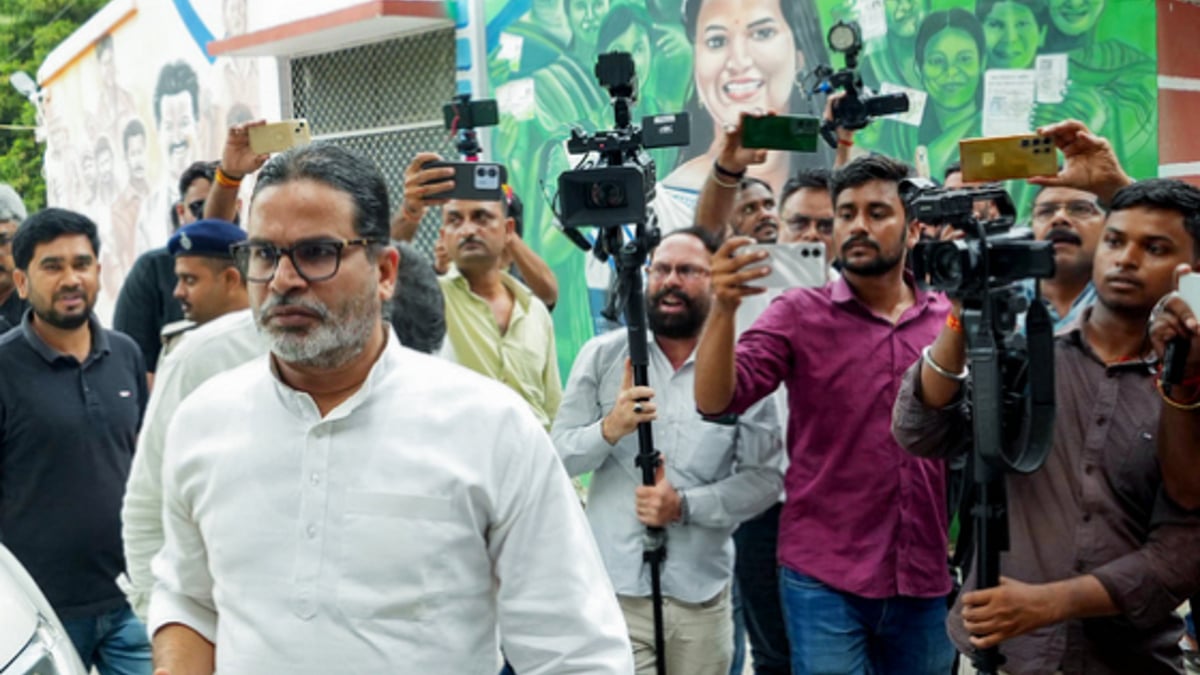
From Bankipur To Delhi? Why Prashant Kishor's Victory Could Echo Beyond Bihar | ANI
Every major political earthquake begins with a tremor that many initially dismiss. Indian politics has repeatedly demonstrated that by-elections, though limited in numbers, often carry consequences far beyond the constituency in which they are fought. Prashant Kishor's victory in Bankipur may prove to be one such moment.
By capturing a BJP fortress that had remained impregnable since 1995 despite the ruling party deploying its entire organisational machinery, the Bihar government and senior Central leadership, the Jan Suraaj founder has achieved far more than an Assembly victory. The constituency had long been represented by current BJP national president Nitin Nabin, making the contest one of prestige for the party. The verdict therefore raises an inevitable question: is Bankipur merely a local upset, or the first signal of a larger political shift?
The symbolism becomes clearer when the electoral numbers are examined. In the previous Assembly election, Nitin Nabin secured 98,299 votes, or 62.66 per cent, defeating the RJD's Rekha Kumari by a massive margin of 51,936 votes. This time, Prashant Kishor won by 19,000 votes and defeated BJP nominee Niraj Kumar Sinha while the RJD slipped to third place. The swing represents a remarkable reversal in one of the BJP's safest urban constituencies.
The setback became more uncomfortable for the BJP because it coincided with its defeat in the Datia Assembly by-election in Madhya Pradesh, where the Congress wrested the seat by over 10,000 votes. Although the party retained Gujarat's Manjalpur constituency through Satendrabhai Patel's convincing victory by 30,499 votes, the combined verdicts will inevitably trigger introspection within the BJP over emerging electoral trends.
When By-Elections Changed National Politics
Indian political history contains several examples of by-elections that later proved to be turning points in national politics.
The first came in 1978 when Congress candidate Mohsina Kidwai won the Azamgarh Lok Sabha by-election after the Emergency. Her victory marked the beginning of the Congress's political recovery following its humiliating defeat in the 1977 general election and signalled that the Janata Party's dominance was beginning to weaken.
A decade later, another by-election fundamentally altered India's political landscape. In 1988, V.P. Singh resigned from the Congress over the Bofors controversy and contested the Allahabad Lok Sabha by-election after Amitabh Bachchan vacated the seat. His emphatic victory transformed him into the undisputed face of the anti-Congress movement and accelerated the formation of the coalition that defeated Rajiv Gandhi in the 1989 Lok Sabha election.
Both contests initially appeared local. Both eventually acquired national significance. Whether Bankipur will join that distinguished list remains to be seen. Yet the comparison is no longer far-fetched. Like those earlier contests, this election has challenged the political invincibility of an entrenched ruling party in a constituency regarded as symbolically important.
The verdict also reinforces a broader political reality. By-elections rarely change governments overnight, but they frequently alter political psychology. They encourage the Opposition, weaken the aura of invincibility surrounding ruling parties and shape narratives that influence subsequent elections. In that sense, Bankipur may prove to be much larger than the numbers suggest.
Why Bihar's Verdicts Often Echo in Delhi
Bihar has repeatedly acted as the laboratory of India's political transformation. The JP Movement began as a state-level agitation before evolving into a nationwide democratic movement that challenged the Emergency and eventually brought down the Congress government in 1977. Time and again, political currents that first emerged in Bihar have travelled beyond the state's borders to influence national politics.
Bankipur therefore cannot be dismissed as just another Assembly by-election. It is certain to be interpreted as the first political assessment of the NDA government in Bihar ahead of the Assembly elections. More importantly, the BJP has lost a constituency that had remained one of its strongest urban bastions for nearly three decades. Such defeats carry psychological consequences far beyond their numerical value.
The message is particularly uncomfortable because Bankipur was no ordinary constituency. It was represented for years by the current BJP national president, Nitin Nabin, making its retention a matter of organisational prestige. The BJP deployed its full organisational machinery, senior state leadership and prominent Central leaders to defend the seat. Yet the electorate delivered a different verdict. When a ruling party loses despite such mobilisation, the defeat is rarely viewed as routine. It often reflects changing public sentiment that even the strongest political organisation struggles to reverse.
Has Bankipur Broken Bihar's Caste Script?
Perhaps the most significant political question arising from the verdict is whether Bankipur has signalled the beginning of a shift away from Bihar's traditional caste arithmetic.
The constituency itself reflects Bihar's complex social composition—around 14 per cent Kayasthas, 12 per cent Muslims, 9 per cent Chandravanshis (Kahars), 9 per cent Baniyas, 9 per cent Scheduled Castes, 8 per cent Bhumihars, 8 per cent Brahmins, 7 per cent Rajputs, 5 per cent Kurmis and 3 per cent Kushwahas. For decades, elections in Bihar have largely been analysed through the prism of such caste equations.
Prashant Kishor attempted a different political experiment. Instead of constructing his campaign around a dominant caste coalition, Jan Suraaj focused on governance, education, employment, corruption and political renewal. The verdict suggests that a section of the electorate was prepared to reward an alternative political narrative over inherited social loyalties.
It would be premature to conclude that caste politics has ended in Bihar. It has not. But Bankipur indicates that caste alone may no longer be sufficient to determine electoral outcomes. Aspirations, governance and credibility are beginning to compete with identity politics in shaping voter behaviour.
Generation Z May Have Rewritten the Contest
Another defining feature of the election was the visible assertion of younger voters.
Throughout the campaign, unemployment, paper leaks, declining educational opportunities and frustration with governance emerged as recurring themes among first-time and young voters. A sizeable section of Generation Z, which had earlier viewed the BJP as the party of aspiration, appeared willing to experiment with a new political alternative.
For the BJP, this may be the most significant warning emerging from Bankipur. Bihar has one of India's youngest electorates. If urban youth begin shifting their political preferences, the consequences could extend well beyond a single by-election. Organisational strength can compensate for many weaknesses, but rebuilding lost confidence among young voters is often far more difficult.
From Election Strategist to Political Challenger
The victory also marks an extraordinary personal milestone for Prashant Kishor.
Ironically, the man who helped design Narendra Modi's successful 2014 Lok Sabha campaign has now inflicted one of the BJP's most symbolic electoral defeats. After advising leaders such as Mamata Banerjee and M.K. Stalin, Kishor entered active politics by launching Jan Suraaj. His initial electoral ventures failed to produce significant results because the party lacked organisational depth and booth-level networks.
Bankipur changes that perception dramatically. It demonstrates that sustained grassroots engagement, effective messaging and public dissatisfaction can sometimes overcome even the most formidable political machinery. More importantly, it establishes Kishor not merely as India's best-known election strategist but as a politician capable of building an independent political base.
A Verdict That May Outlive the Numbers
Whether Bankipur ultimately assumes the historical significance of Azamgarh in 1978 or Allahabad in 1988 will be known only with the passage of time. Political history is written not by one election but by the chain of events that follows.
Yet one conclusion is already difficult to ignore. Prashant Kishor has achieved far more than capturing an Assembly constituency. He has breached one of the BJP's strongest urban fortresses, challenged the prestige of the party's national leadership and demonstrated that a credible alternative can emerge even against an exceptionally well-organised political machine.
History offers one enduring lesson: by-elections seldom change governments overnight, but they often change political psychology. If Bankipur has indeed altered that psychology, its real impact will be measured not merely in Patna, but in the corridors of power in New Delhi.
(Writer is a senior political analyst and strategic affairs columnist based in Shimla)
RECENT STORIES
-
-
-
-
-